


HiAstro Insights
Karwa Chauth Vrat Katha: The Story, the Meaning, and Why Many Husbands Now Fast Too
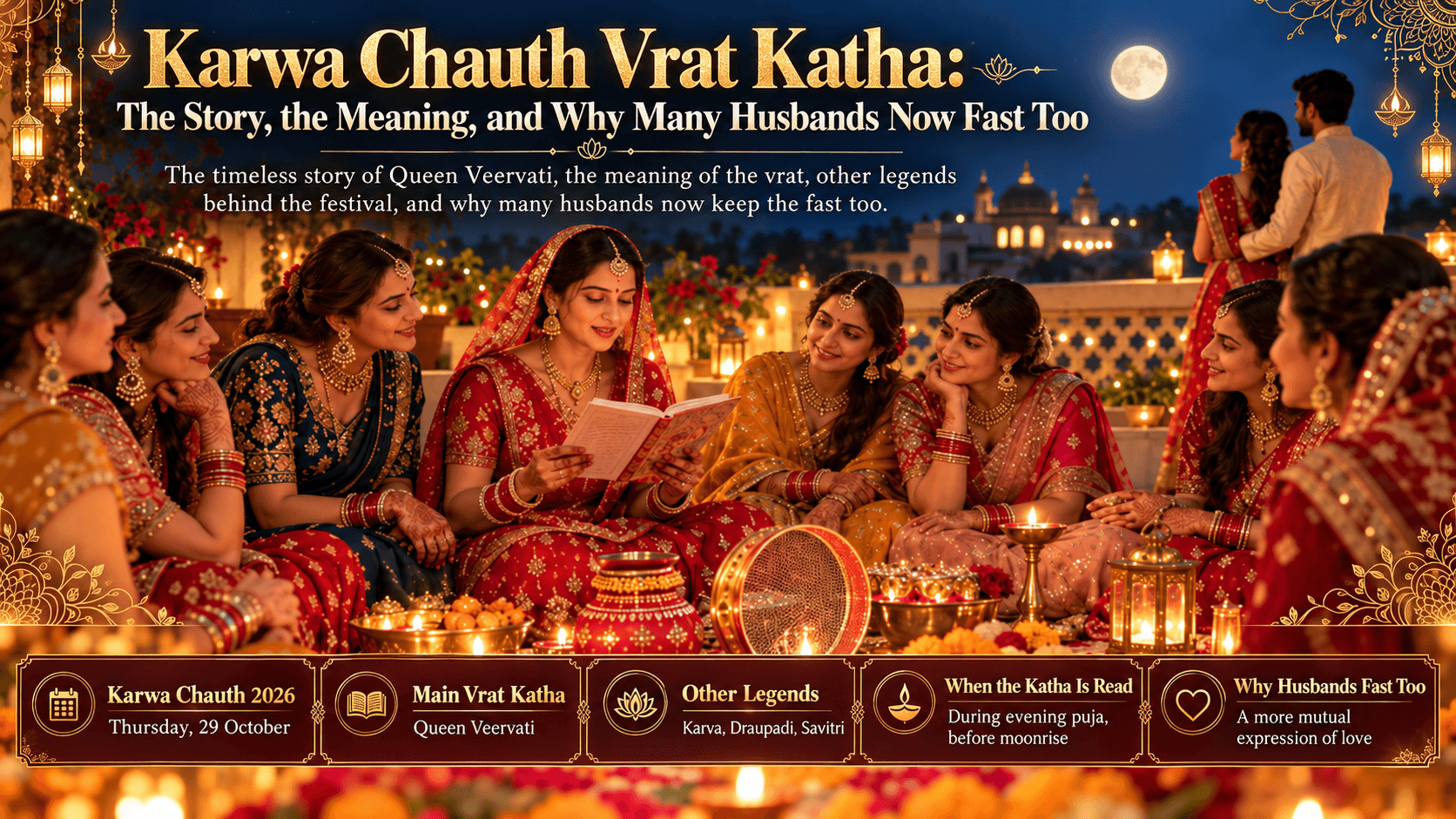
In the quiet hour before moonrise, a circle of women sits with their thalis, and someone begins to read. The Karwa Chauth vrat katha is the story at the heart of the day, told in homes across North India for generations, and as much a part of Karwa Chauth as the sargi, the mehndi, and the first sip of water.
The most commonly told Karwa Chauth vrat katha is the story of Queen Veervati, who broke her fast too early because of a false moon, lost her husband, and won him back by observing the vrat again with full devotion. Karwa Chauth 2026 falls on Thursday, 29 October. Here is the story, the other legends behind the fast, what it means, and how husbands have joined in.
Karwa Chauth Vrat Katha: The Story of Queen Veervati
Versions differ from region to region, but the core of the tale is well-known.
Veervati was a princess, the only sister of seven loving brothers. After her marriage, she returned to her parents' home for her first Karwa Chauth and began the fast, taking neither food nor water. By evening, she was weak with hunger and thirst, and she kept looking for the moon.
Her brothers couldn't bear to see her suffer. In many tellings, they created the illusion of moonrise by holding up a mirror or a flame among the branches of a pipal tree. Believing the moon had risen, Veervati broke her fast.
At the first bite, word came that her husband, the king, had died. Devastated, she rushed to him. On the way, a goddess, often identified as Parvati, appeared and told her that the fast had been broken before the real moonrise. She instructed Veervati to keep the vrat again, with complete faith. Veervati did, and Yama, the god of death, relented and restored her husband's life.
The lesson most families draw is simple: keep the vow sincerely and wait for the true moon.
Read more https://www.hiastro.in/blog/karwa-chauth-2026-date-moonrise-time-by-city-puja-muhurat-and-vrat-vidhi
Other Legends Behind Karwa Chauth
Several other stories are linked to the festival:
The legend of Karva: In one popular telling, a devoted woman named Karva saved her husband when a crocodile seized him at a river. She bound the crocodile with cotton thread and pleaded with Yama to punish it and grant her husband a long life. This tale is often said to give the festival its name.
Draupadi and Krishna: When Arjuna was away and the Pandavas faced troubles, Draupadi sought Krishna's advice. He reminded her that Parvati had once kept this fast, and Draupadi followed it.
Savitri and Satyavan: Savitri's famous bargain with Yama to save her husband is often woven into the vrat katha, though it isn't exclusive to Karwa Chauth.
Each story comes from a different tradition, and the exact origins of the festival are unclear, which is why you'll find slightly different versions in different families.
What Does the Karwa Chauth Katha Mean?
Beneath the miracle in each story is something quite human: love expressed through effort, endurance and faith. The katha celebrates patience, a promise kept, and the idea that care for another person can be an act of strength. The karwa, the spouted pot at the centre of the puja, is a symbol of that care and of abundance.
There is also something communal about the katha. It is traditionally read aloud by women gathered together, the thali passing from hand to hand, and for many that shared hour is the part of the day they cherish most.
Why Many Husbands Now Fast Too
For generations the fast was kept by wives for their husbands. In recent years, more couples have made it mutual. Some husbands keep a full fast alongside their wives, others a partial one, and some simply join in the evening puja or break the fast together. Unmarried women and engaged couples also keep the vrat, often with the same hope for a caring partnership.
People hold different views on this, and both are worth acknowledging. Some see the tradition as a loving ritual they choose freely, while others feel it reflects unequal expectations, and feel more comfortable when the fast is shared or optional. Many couples settle on a version that feels right for them, whether that means the traditional fast, a mutual one, or simply marking the day together. The heart of Karwa Chauth is the bond it honours.
When to Read the Karwa Chauth Vrat Katha
The katha is read during the evening puja, in the window after sunset and before moonrise. In Delhi, the puja muhurat is about 5:38 PM to 6:56 PM, and in other cities it begins at local sunset. Moonrise differs in every city, so check your local timings on HiAstro's city Panchang pages: Delhi, Mumbai, Kolkata, Chennai, Bangalore and Hyderabad.
Families abroad should use their local moonrise. Several calendars list Wednesday, 28 October for the USA and Canada, so confirm the date with your local temple or Panchang. If you have no circle of women nearby, read the katha alone, listen to a recording, or join family on a video call. The sincerity of the telling matters far more than the setting.
Read more https://www.hiastro.in/blog/rahus-aspects-in-astrology-house-by-house-effects-explained
A Balanced Note on the Fast and the Story
The Karwa Chauth katha is a devotional story, not a medical or factual promise, and the fast isn't a guarantee of anything beyond the love and intention behind it. A full day without food or water is demanding. Pregnant women, people with health conditions, and those on medication should speak to a doctor and feel free to modify the fast, which priests widely accept. A loving partnership is built on far more than a single day's vow.
Make Karwa Chauth Personal
If the stories of Veervati, Savitri and Draupadi make you curious about your own relationship and what your chart says about love, timing and partnership, speak with an astrologer on HiAstro for personal guidance this Karwa Chauth.
Frequently Asked Questions
1. What is the Karwa Chauth vrat katha?
The best-known Karwa Chauth vrat katha is the story of Queen Veervati, who broke her fast early because of a false moon, lost her husband, and revived him by keeping the vrat again with devotion.
2. Who started Karwa Chauth?
The exact origin is unclear. Tradition links it to several legends, including Queen Veervati, Karva, and Draupadi, and the festival is rooted in North Indian custom.
3. When is Karwa Chauth 2026?
Karwa Chauth 2026 is on Thursday, 29 October in India. Several calendars list Wednesday, 28 October for the USA and Canada.
4. When should the katha be read?
During the evening puja, before moonrise. The Delhi puja muhurat is about 5:38 PM to 6:56 PM, and other cities begin at local sunset.
5. Do husbands fast on Karwa Chauth?
Traditionally the wife fasts, but many husbands now fast fully or partially alongside their wives as a sign of mutual love.
6. Can unmarried women keep the Karwa Chauth fast?
Yes. Many unmarried women and engaged couples keep it, praying for a caring partner or a lasting relationship.
7. Why is the moon seen through a sieve on Karwa Chauth?
The chalni is a traditional part of the ritual, with the woman viewing the moon first, then her husband's face through it. Families explain the symbolism in different ways.