


HiAstro Insights
Rahu's Aspects in Astrology: House-by-House Effects Explained
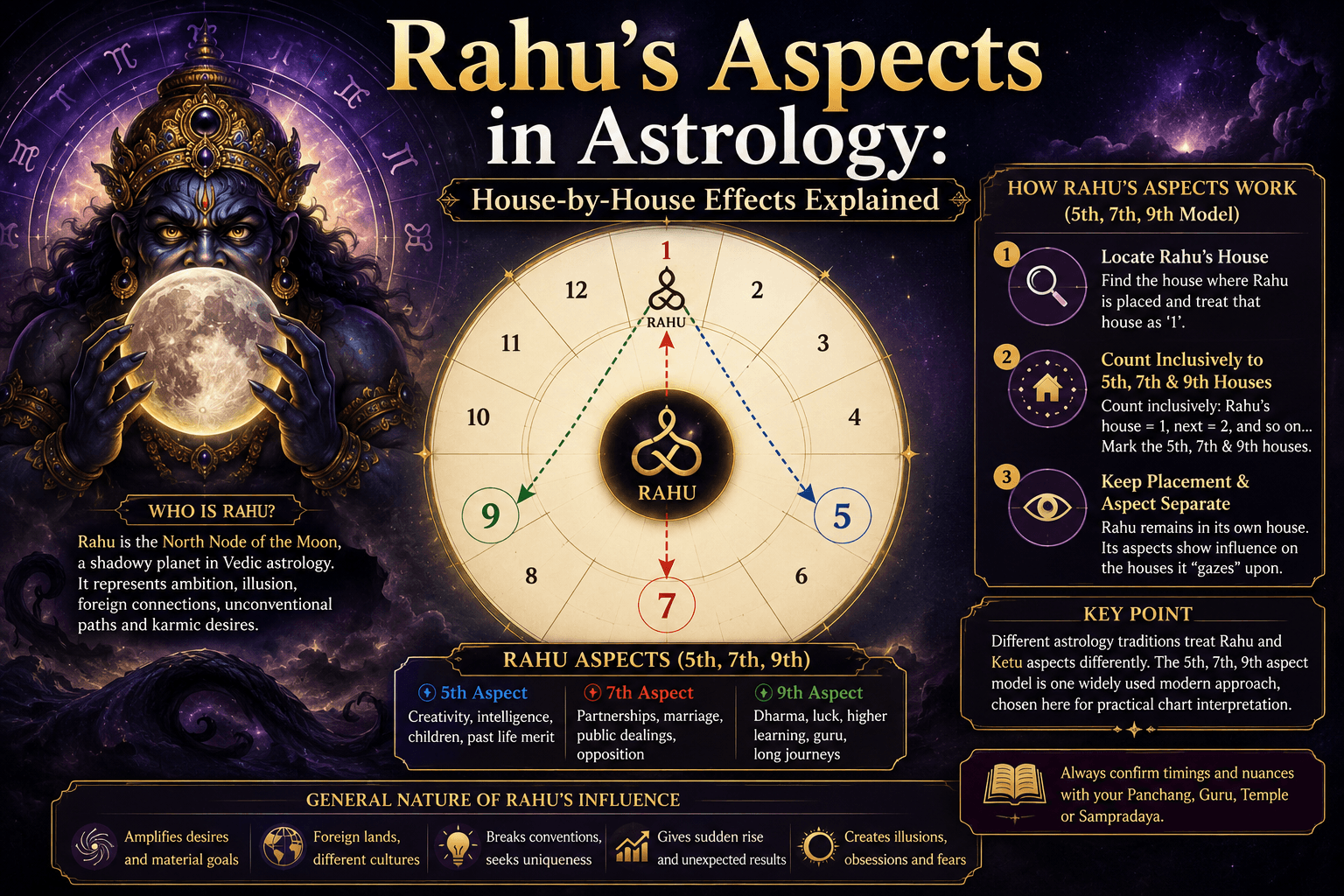
You may have come across the notion that Rahu includes only the 7th house in its aspects, or that it has an aspect over the houses 5th, 7th, and 9th in a manner similar to Jupiter. Alternatively, you may have also come across the idea that Rahu as a lunar node does not use any form of drishti in its functioning. All these statements come from different interpretative traditions and, therefore, it is impossible to resolve the difference by presenting one of the modern traditions as a universal classical rule.
The main distinction should be made between classical principles and later on practices introduced by different schools of astrology. Therefore, the examples provided below use one of the modern techniques (specifically the one that includes aspects over the 5th, 7th, and 9th houses) as modern practitioners do it in order to find some logic in chart readings. Therefore, all the examples presented below follow the indicated method of interpretation unless stated otherwise; however, it is worth mentioning that not every school of Jyotish acknowledges the proposed rules of interpreting Rahu aspects.
Graha drishti foundations and inclusive counting
Drishti stands for “sight” or “gaze.” In the context of the graha drishti, a planet influences another house or planet from where it is situated. A popular verse from the texts of Parashara tells that Saturn, Jupiter, and Mars have the 7th aspect, but it also lists their special aspects, like the aspect of Mars on the 4th and 8th houses, of Jupiter on the 5th and 9th houses and of Saturn on the 3rd and 10th houses.
The houses are numbered considering that the house has been occupied and is counted as 1. If a planet is there at the 1st house, then the 2nd house is occupied by the 2nd planet and so on across the chart so that the 7th house will have the aspect of 7th one.
The mentioned verse states about specific aspects of Jupiter, Mars, and Saturn, but does not give any set of rules regarding special aspects of the nodes like that of Rahu and Ketu. The interpretation of connection of the aforementioned nodes with any other aspects rules differs from one astrology school to another.
How different traditions treat Rahu and Ketu aspects
The word Drishti means “sight” or “gaze,” which is linked to the concept of graha drishti which refers to the way that an astrological planet influences the other zodiac sign, house, or zodiac planet from its own position. One of the famous passages from Parashara states that Saturn, Mars, and Jupiter have the aspect of the 7th position, but there are also special aspects mentioned, such as the one that Mars casts on the 4th and 8th houses, Jupiter casts on the 5th and 9th houses, and Saturn casts on the 3rd and 10th houses.
The houses are numbered based on the principle that one occupied house equals 1, so if there is a celestial body located at the first house, the second house will be the location of the second planet and so forth, while the seventh one will be the location of the seventh aspect.
The above-mentioned passage indicates the wonderful aspects of Mars, Jupiter, and Saturn, but it does not include any rules about special aspects of nodal planets like Rahu and Ketu. The way these planets interact with any house of planets or signs in the horoscope may be interpreted differently by different schools of astrology.
Read more https://www.hiastro.in/blog/pitru-paksha-2026-shraddha-dates-for-each-tithi
Working with the 5th, 7th, and 9th Rahu-aspect model
Use this method when you apply the 5th–7th–9th Rahu-aspect convention mentioned above.
Locate Rahu’s house
Find the house that contains Rahu in your Kundli and treat that occupied house as house number one for counting.
Count inclusively to the 5th, 7th, and 9th houses
Once Rahu's house is found, the next step is to count inclusively to the 5th, 7th, and 9th houses. This means that you will move from Rahu's house to the next, counting inclusive as follows: (Rahu's house = one, the next house = two, third house = three, etc). It is important to note that the count of five will be successful if it lands on the 5th, 7th, and 9th houses only. If after counting to 12, the counting process is still to continue, one must circle back to the 1st house.
Keep placement and aspect separate
It is important to note that when identifying the three houses that Rahu's aspects land on, Rahu remains placed only in its own house. This means that aspect refers only to the influence Rahu has on the houses where it is headed.
What Rahu’s aspect may bring to a house
Traditional interpretations frequently link Rahu to insatiable desire, growth, obsession, new realms, and unconventional approaches. The critical lens of Rahu on a house results in focusing attention on the matters associated with that house.
A certain person may begin doubting accepted principles, seeking new experiences, and searching for new achievements in that area. These traits can benefit the individual through research, technical thinking, exposure to various cultures, and ambitious strategies. However, the negative manifestation can take place as fixation, comparison, and unsteady priorities. Results will depend on the condition of the house and its ruler.
Read more https://www.hiastro.in/blog/navratri-2026-dates-colors-puja-vidhi-and-fashion-guide
House-by-house meanings of Rahu’s drishti
The characteristics stated below pertain to the influence of Rahu on the bhava position, where Rahu transits another house within the 5th–7th–9th functioning rule. These interpretations provide broad options and do not state one specific prediction. In the placement of Rahu in any of the bhava series the location shows where the planet is situated while the bhava that is affected shows where the gaze of Rahu goes.
When Rahu aspects the 1st house
Rahu aspecting the 1st house puts its planets in the sign of self, style, action, and overall identity in life. The aspect of Rahu brings experiments to the understanding of self, and one may not be able to decide on one's own personality. It can be concluded that Rahu aspecting the 1st is different from Rahu being placed in the 1st house of the sign signifying the ruler of the house.
When Rahu aspects the 2nd house
According to the essence of the 2nd house, it is connected to speech, the culture practiced in the family, family values, cuisine, and money. Rahu in the 2nd house provides either a trend for unusual communication or the desire to escape from traditions.
When Rahu aspects the 3rd house
The 3rd house is related to communication, skills, initiative, siblings, media, and short travels. The observation of this planet might bring bold messages or accelerate the development of skills or awareness in the digital world. At the same time, this would impact that knowledge and communication to create a sense of performance needed if it is done with a purpose.
When Rahu aspects the 4th house
The 4th house is connected to the notion of home, security, education, possessions. The third house is considered to make the person eager to change some aspects of life related to the place for living, make the relocations, and change the home in comparison to what their family traditions are associated with.
When Rahu aspects the 5th house
The notion of the 5th house refers to creativity, education, logic, love, youth, and self-expression. Rahu's influence can be beneficial for innovative research, interest in challenging themes, and unique types of creativity as well as for intense interest in mentorship or parenting issues. However, it can also lead to the illusion that popularity and excitement are of key importance, which requires careful evaluation and avoidance of impulsive activities.
When Rahu aspects the 6th house
The 6th house is responsible for routine, service, responsibilities, rivalries, and problem-solving. Rahu's influence on the 6th house is characterized by the ability to work hard, gain knowledge of complex systems, or to surpass expectations in difficult situations. However, without necessary structure, Rahu’s influence may contribute to disagreements, overload, or treating every issue as a fight.
When Rahu aspects the 7th house
In astrology, the seventh house means partnerships, contracts, cooperation, and dealing with the public. When Rahu shines down on the seventh house from another position, the relationship can come from unusual sources, have a special character, an unexpected base of expectations, strong attraction, and a powerful goal in life. In this situation, the importance of having a clear line of communication is emphasized, because otherwise the person's fascination may go beyond the limitations of common understanding.
When Rahu aspects the 8th house
The eighth house concerns shared responsibilities, trust, confidentiality, research, and changes. The fact that Rahu is present in the eighth house means that the interest in open and hidden systems, psychology, occult science, research, and any other subject that others find uncomfortable is enhanced. At the same time, Rahu would illuminate questions concerning control and transparency.
When Rahu aspects the 9th house
The 9th house signifies higher learning, philosophy, teachers, ethical living, pilgrimages, and international travel. When Rahu influences this house, it indicates a fascination for foreign philosophies, unconventional teachers, or belief systems that exist outside of one's background. This helps in expanding horizons wide, but in some situations, it may lead to the misconception that something new or fashionable signifies wisdom, which means one should evaluate any teachings carefully.
When Rahu aspects the 10th house
The 10th house is associated with profession, responsibilities, contribution to public life, and reputation. Rahu’s influence can amplify professional aspirations, interests in emerging industries, or the wish to gain a special place in the public eye.
When Rahu aspects the 11th house
The 11th house represents the concept of communities, social circles, big networks, dreams, and accomplishment after consistent efforts. The influence of Rahu can broaden contacts with people from significant global, technical, or unorthodox networks. This may be a great support in achieving ambitious tasks and collaborating on wide projects, but at the same time, Rahu can stimulate comparisons of friendships or business relationships.
When Rahu aspects the 12th house
This house brings such concepts as retreat, isolation, distant places, personal life, imagination and liberation. Rahu here may lead to an increase in interest when it comes to foreign environments behind the curtain, spiritual practices, or experience of profound understanding of the inner world. Profitable solitude may turn into escaping reality when borders are removed, so certain activities and commitments will help make use of one’s imagination and thoughts.
Chart factors that modify Rahu’s aspect results
Rahu's sign indicates how he operates, while the sign specifying the affected house indicates what type of life this area signifies. The dispositor of Rahu—the planet ruling over Rahu's sign—is particularly important since it represents a channel for Rahu's activities. Different schools provide various interpretations of Rahu's strength, therefore, the state of the dispositor is often the safest place to start.
Then consider the ruler of the affected house, Rahu's nakshatra, nakshatra lord, conjunctions made with Rahu, and also the aspects formed by Rahu. A well-placed and sound 10th house lord can bring Rahu's aspect an innovative accomplishment or a major breakthrough, while a weak lord of the 10th house can turn Rahu's aspect into some kind of changing goals or image anxious vibes.
Dasha periods are traditionally used in Jyotish astrology to make predictions about the timing of key natal themes. Different periods connected with Rahu may determine when some themes become more evident or significant, including its dasha or antardasha, periods connected to its nakshatra lord or to the lord of the house that Rahu is aspected by. Transits can be seen as triggering events but not necessarily as occurring events as well.
In Jyotish astrology, Graha Drishti, which indicates the effect of planets, should not be confused with rashi drishti, or the form of aspecting between signs, as in Jaimini’s astrology. The concept of the Rahu and Ketu axis is important for schools of astrology that do not apply graha drishti to planets: in Jyotish, Rahu is seen as pursuing something and Ketu as detached even though they get involved in the same houses and thus are analyzed together.
Read more https://www.hiastro.in/blog/ganesh-chaturthi-2026-sthapana-muhurat-and-visarjan-dates
Check Rahu’s aspects in your own Kundli
A birth chart makes the counting easier. Generate your free Kundli with HiAstro, find the house marked with Rahu or “Ra,” and treat that occupied house as one. Count forward inclusively to the 5th, 7th, and 9th houses if you want to test the working convention used here.
Write down those three houses, their signs, and their ruling planets before reading the house meanings. This keeps Rahu’s placement separate from its aspects and gives you enough context for a more careful interpretation.
Reading Rahu’s drishti responsibly
Start out by identifying the system you’re using, locating Rahu and examining the pertinent planets of the houses before starting with the reading. Look for recurrent themes in the chart rather than jumping to a conclusion based on one line. A good interpretation would indicate where to channel curiosity, ambition, or dissatisfaction, rather than whether Rahu destroys what it looks at.
Useful approaches might include questioning assumptions, double-checking facts before actions, setting limits on compulsive tendencies in people, or channeling the energy of Rahu into something productive, e.g. studies, technology, creativity, cross-cultural studies, etc.
Frequently asked questions about Rahu aspects
Are Rahu aspects always harmful?
No. While Rahu could detect restlessness and obsession at times, he contributes towards creativity, knowledge, skills, global experience, and somehow confidence. Whether the result will be positive or negative depends on the main planet of the house, its presiding planet, Rahu sectors, and other factors from the entire horary chart.
Should the 5th-7th-9th rule be used for Rahu?
No. While it is one of the working rules in astrology, it does not mean that it is unchangeable or obligatory. Implementing it is completely optional, so you can refer to any nodal aspects.
Does Ketu have the same aspects as Rahu?
In schools where special features are attributed to the nodes, as a general rule, both Rahu and Ketu are treated in the same way, although it does depend somewhat on the lineage. Even in the tradition which inherently doesn’t ascribe any independent graha drishti to the nodes, Ketu plays an important role by virtue of being positioned opposite Rahu and therefore completes the nodal axis.
What to do if there are two astrologers who follow different models of Rahu’s aspect?
Find out what textual or philosophical tradition each astrologer adheres to and check whether the two astrologers apply the method consistently to the whole natal chart. Disagreement over the nodal aspects does not mean that either interpretation is unprofessional; problems start arising when an astrologer states that the system they use is universal or selectively determines it to conform to their prediction.
Is Rahu’s graha drishti the same as rashi drishti?
No. Graha drishti refers to the aspects created by the planets whereas rashi drishti refers to signs interacting from a different perspective. Make sure you do not mix up their counting rules unless it is stated otherwise by the system of astrology you are using.