


HiAstro Insights
Govardhan Puja 2026: Date, Annakut Bhog, Puja Vidhi and the Story of Govardhan
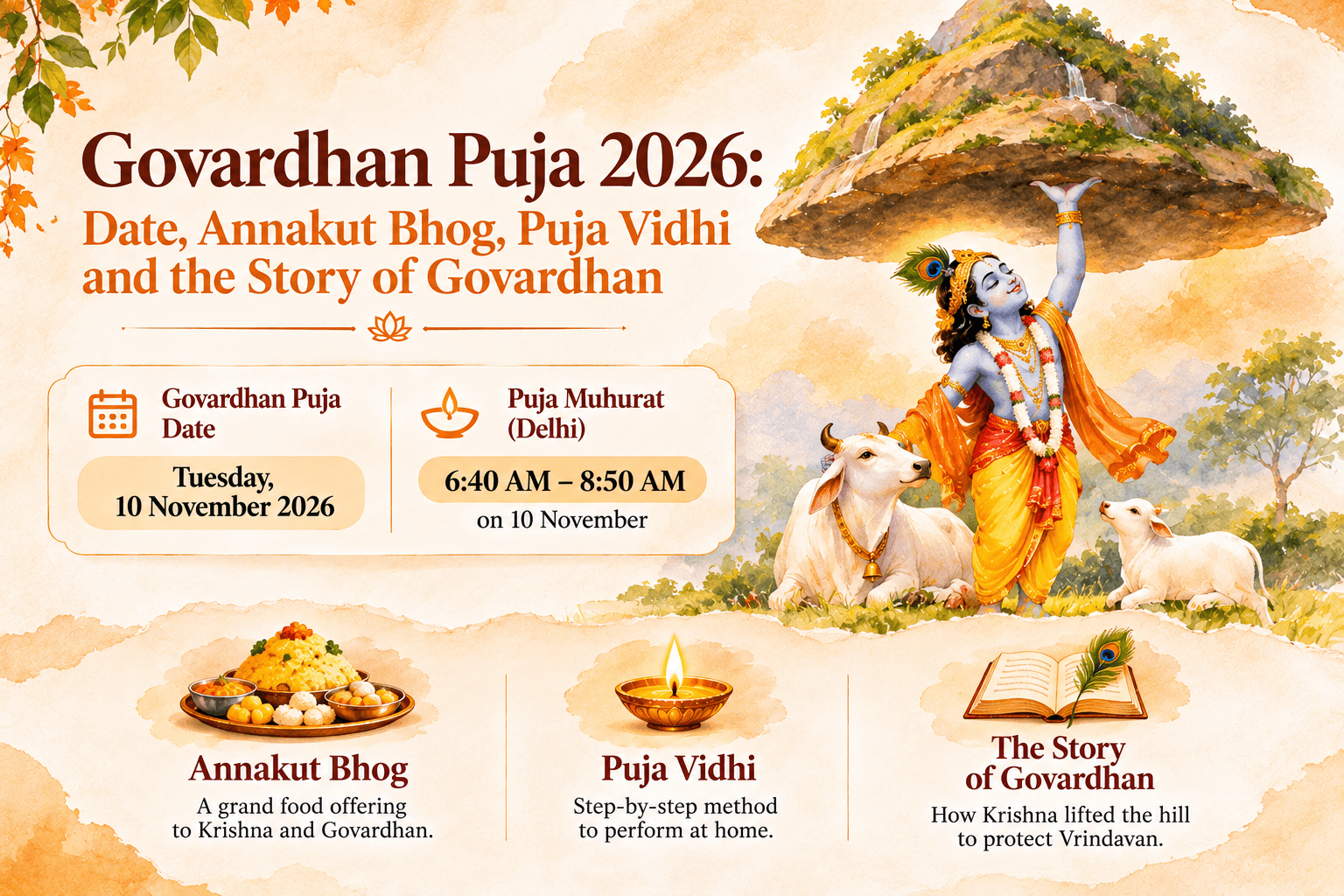
The morning after the lamps have burned low, many homes wake up to a different kind of Diwali. There is no rush of shopping and no fireworks, only a small hill of cow dung or clay in the courtyard, a table loaded with food, and a family gathered to say thank you. Govardhan Puja is among the most affectionate festivals of the five days, and this year it comes with a calendar twist that is worth understanding.
Govardhan Puja 2026 falls on Tuesday, 10 November, with the New Delhi morning puja muhurat from 6:40 AM to 8:50 AM. It is also called Annakut and Bali Pratipada, and it comes two days after Diwali this year, with one day in between.
Govardhan Puja 2026 Date: Is It 9 or 10 November?
Govardhan Puja is observed on Kartik Shukla Pratipada, the first day of the bright half of the month, and the puja is traditionally done in the morning while that tithi is in force. In New Delhi, the Pratipada tithi runs from about 12:31 PM on 9 November to about 2:00 PM on 10 November. Since the tithi begins after the morning of the 9th and is present at sunrise on the 10th, almost every Indian Panchang places Govardhan Puja on Tuesday, 10 November.
That also explains the one-day gap after Diwali. Amavasya continues until midday on 9 November, so the first Pratipada morning arrives on the 10th, and the 9th has no dedicated puja.
Govardhan Puja 2026 Muhurat
The recommended window is the Pratahkal (morning) muhurat, about 6:40 AM to 8:50 AM in New Delhi on 10 November. A few calendars list slightly different times, such as 6:30 AM to 9:00 AM, so confirm yours. You can do the puja any time before the Pratipada tithi ends at about 2:00 PM, though the morning is considered best.
Sunrise differs by city, so the muhurat shifts slightly. Check HiAstro's Panchang for Delhi, Mumbai, Kolkata, Chennai, Bangalore or Hyderabad.
The Story of Govardhan: Krishna, Indra and the Hill
In the traditional telling, the people of Vrindavan used to hold an annual worship of Indra, the god of rain, hoping he would bless their fields. The young Krishna questioned this. Their cows, he pointed out, grazed on Govardhan Hill, which gave them grass, water and shelter, so it was the hill and the land that truly sustained them.
The villagers followed his advice and honoured Govardhan instead. Indra, offended, sent torrential rain and storms to flood Vrindavan. Krishna lifted the entire hill on the little finger of his left hand, and the villagers and their cattle sheltered beneath it for seven days. Indra's pride was humbled, and the rain stopped.
The story is often read as a lesson in gratitude to nature, and in humility, since the festival honours the hill, the land and the cattle that sustain daily life.
What Is Annakut?
Annakut means "mountain of food." On Govardhan Puja, temples and homes prepare a large, varied spread of grains, sweets and vegetables, arranged to resemble the hill, and offer it to Krishna and Govardhan as thanks. In many temples, especially in Mathura, Vrindavan, Nathdwara and Swaminarayan mandirs, the offering can be spectacular, and some prepare the traditional Chhappan Bhog, fifty-six different dishes.
The day goes by other names across the country. It is Bali Pratipada in parts of the country, honouring King Bali, Padwa in Maharashtra, and Bestu Varas, the Gujarati New Year, in Gujarat.
Annakut Bhog: What to Offer
There is no fixed menu. Families offer what they can, usually made fresh and without onion or garlic. Common items include:
- Grains and staples: rice (often heaped into a small hill), puri, roti
- Savouries: kadhi, seasonal mixed vegetables, dal
- Sweets: halwa, laddoo, kheer, jalebi
- Dairy: curd, butter, milk-based sweets
- Fruit: seasonal fruit
Once offered, the food is distributed as prasad, and many households share it with neighbours and anyone in need. Nothing should go to waste.
Govardhan Puja Vidhi at Home
- Rise early and bathe, and clean the courtyard or puja area.
- Make a small Govardhan hill. Traditionally this is shaped from cow dung. If that isn't possible, use clay, rice flour or heaped rice, or simply draw it.
- Decorate the hill with flowers, small figures of cows and villagers, and a figure of Krishna.
- Light a diya and offer tilak, flowers and incense.
Offer the Annakut bhog, arranged around the hill.
- Perform the aarti, and chant Krishna's name or bhajans.
- Do a parikrama, walking around the hill, as a gesture of reverence.
- Worship the cows (Gau Puja). Offer them fodder, jaggery or fruit if you can reach one.
- Share the prasad with family and neighbours.
Read more https://www.hiastro.in/blog/diwali-2026-horoscope-money-career-and-love-for-all-12-signs
Govardhan Puja Abroad
Families outside India can follow the same steps with practical substitutes: a hill of clay or rice instead of cow dung, a picture of Krishna, and a home-cooked offering. Many ISKCON, BAPS Swaminarayan and other temples hold community Annakut festivals, sometimes on the nearest weekend. For the date, local tithi timings matter. In North America, the Pratipada tithi may already be in force at sunrise on 9 November local time, so some calendars there list Monday, 9 November. Confirm with your local temple or Panchang.
A Balanced Note on the Festival
Govardhan Puja is, at heart, a festival of gratitude, and you don't need an elaborate spread to take part. A small bowl of rice, a diya and a quiet thank-you carry the same meaning. If you can't make a cow-dung hill, a clay version is fully acceptable. Customs vary widely between Braj, Gujarat and Maharashtra, and none is more correct than another.
Make Govardhan Puja Personal
If you'd like to know which muhurat or practices suit you best, or how this day lines up with your own chart, speak with an astrologer on HiAstro for personal guidance on Govardhan Puja 2026.
Frequently Asked Questions
1. When is Govardhan Puja 2026?
Govardhan Puja 2026 is on Tuesday, 10 November. The Pratipada tithi runs from about 12:31 PM on 9 November to about 2:00 PM on 10 November.
2. What is the Govardhan Puja muhurat in 2026?
In New Delhi, the morning muhurat is about 6:40 AM to 8:50 AM on 10 November. The puja can be done until the tithi ends at about 2:00 PM.
3. Why is there a gap between Diwali and Govardhan Puja this year?
Amavasya continues until midday on 9 November, so the first Pratipada morning falls on 10 November.
4. What is Annakut?
Annakut means "mountain of food." It is the large offering of grains, sweets and vegetables made to Krishna and Govardhan on this day, sometimes including 56 dishes (Chhappan Bhog).
5. What is the story behind Govardhan Puja?
Krishna persuaded the people of Vrindavan to worship Govardhan Hill instead of Indra. When Indra sent a storm, Krishna lifted the hill on his little finger to shelter everyone for seven days.
6. Can Govardhan Puja be done without cow dung?
Yes. A small hill of clay, rice flour or heaped rice works well, and a drawn image is acceptable if needed.
7. Is Govardhan Puja the same as Bali Pratipada?
They fall on the same day, Kartik Shukla Pratipada. Bali Pratipada honours King Bali and is observed in parts of the country, while Govardhan Puja and Annakut honour Krishna.