


HiAstro Insights
How AI Interprets Planetary Positions in Your Horoscope
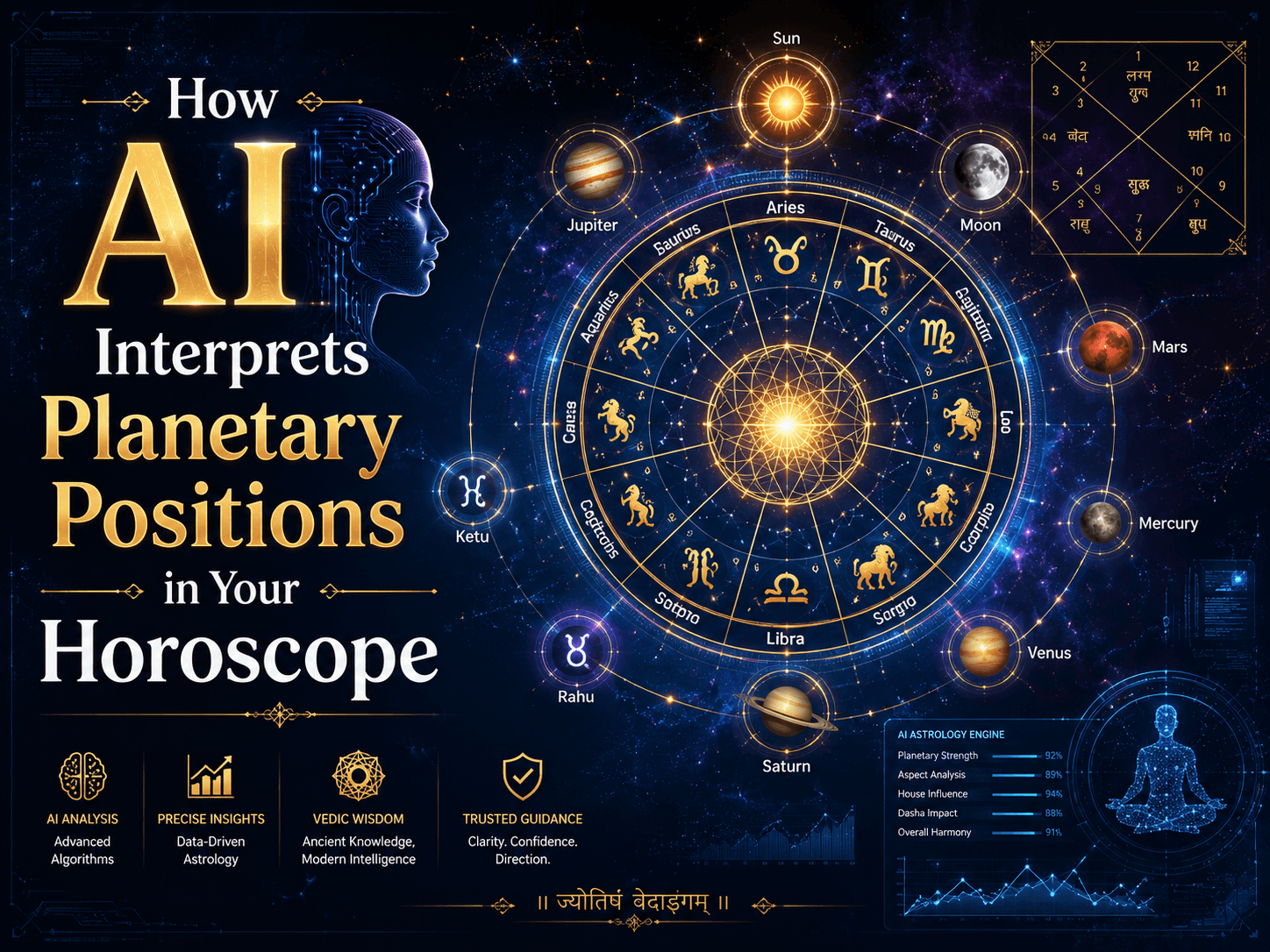
Astrology has long been one of the most comprehensive tools for understanding human beings in general, and their behaviours (personalities) specifically, as well as our emotions, relationships, career paths, and life patterns, all of which come together to shape our view of ourselves and how we relate to others around us. Until now, astrologers have used traditional methodologies to assess an individual's horoscope by analysing the placement of all the planets, signs, houses, nakshatras, aspects, and planetary periods relative to one another with respect to when someone was born, based on the alignment of the stars at that moment in time and space. However, with the use of artificial intelligence today, a completely new level of efficiency, structure, and customisation is being applied to this ancient practice.
Instead of simply predicting through the planets where you fall based on random placement on the given day, when A.I. assesses the position of the planets in your horoscope, it takes into account all the data provided to it, including birthdate and location, calculates your chart (how those various planetary placements interact), identifies any major planetary placements, and interprets them according to the various astrological rules and guidelines set up for use by astrologers. Therefore, astrological interpretations of AI are beneficial for quick and simple yet highly specific horoscopic interpretations.
What Are Planetary Positions in a Horoscope?
The planets are indicated by way of their location at the time of a person's birth, and these locations are determined using Vedic astrology's sidereal zodiac. Typically, the following planets are used to create a horoscope (the astrological calculations derived thereof): the Sun, Moon, Mars, Mercury, Jupiter, Venus, Saturn, Rahu, and Ketu.
Every planet governs an area of life. The Sun symbolises confidence, authority, and soul purpose. The Moon relates to emotions, thoughts, and inner satisfaction. Mars represents confidence, passion, and action. Mercury signifies communication, thought, and intelligence. Jupiter stands for wisdom, growth, and good fortune. Venus relates to love, beauty, material well-being, and relationships. Saturn represents authority, karma, responsibility, and delays. Rahu and Ketu represent karmic patterns, desires, detachment, and unusual experiences. AI takes the planets' positions and connects them to their zodiac signs and houses.
How AI Creates a Birth Chart
The first step in the AI interpretation of a horoscope is calculating the birth chart. To do this calculation, AI needs to input three key pieces of data: Date of Birth, Time of Birth, and Place of Birth. Using this data, an astrologer calculates the Lagna (Ascendant), Moon Sign, Sun Sign, Degrees of the planets, the houses in which they are located, and the Nakshatras associated with the planets in the birth chart.
Once the birth chart information has been collected, the AI organises it in an orderly manner. AI checks the strength of each planet, whether it is strong, weak, exalted, debilitated, retrograde, combusted, friendly or inimical by sign, and where it falls in terms of a good or difficult house.
A house is an astrological division that focuses on one area of life. For example: 1st house – personality and physical attributes, 2nd house – communication style, family, and finances; 3rd house – courage, communication, and siblings; 4th house – home, mother, property, and inner peace; 5th house – education, creativity, children, and wisdom; 6th house – competition, well-being, debts, and enemies; 7th house – marriage/relationships; 8th house – transformation, secrets, unexpected events, and research; 9th house – luck, higher learning, dharma/father; 10th house – career/public image; 11th house – gains/income/social networks; 12th house – foreign connections, expenses/spirituality, isolation, and sleep. AI analyses each planet based on its combination with its sign and house location.
Read more about: https://www.hiastro.in/blog/free-vs-paid-ai-astrology-tools-whats-the-difference
Role of Zodiac Signs in AI Horoscope Interpretation
The planets behave differently according to the zodiac sign they are in at the time of birth. An astrologer will interpret each planet based on the character of that particular zodiac sign. To put that into perspective, Mars is very much at home in Aries, so it will bring energy, assertiveness, and speed when placed in that sign. To contrast, when you place Mars in Cancer, it will act in a more emotional nature, as Cancer is not a comfortable sign for Mars. Likewise, we see the Moon as having great strength in Cancer because the Moon rules over Cancer, while it has stronger emotional intensity when it resides in Scorpio.
How AI Reads Nakshatras and Padas
The nakshatra is an important consideration in Vedic astrology. It represents a deeper layer of meaning than the planet's zodiac sign alone can convey. There are twenty-seven nakshatras in the Zodiac, and each nakshatra has four padas. While nakshatras (subdivisions) of a zodiac sign define the general characteristics of a planet in a zodiac sign, they also define the more subtle qualities (e.g., emotional tendencies, karmic patterns, and internal motivations) a planet will possess.
For example, Moon in Rohini will display charm, creativity, beauty, and emotional attachment. The Moon in Ashlesha will show great intuition, perceptiveness, emotional intensity, and strategic thinking. The Moon in Anuradha will show loyalty, dedication, discipline, and socially oriented qualities.
AI utilises the placement of planetary nakshatras when developing personal horoscopes. This brings an additional level of personalisation to a person's horoscope through birth chart reading, compatibility and career reading and also for understanding emotional well-being.
How AI Interprets Planetary Aspects
Planetary aspects are another significant piece to the puzzle of the interpretation of your horoscope. Essentially, an aspect occurs when one planet is affecting another planet and/or house. Regarding Vedic astrology, all planets aspect, or influence, the seventh house, from their position in the horoscope, but three planets, Mars, Saturn and Jupiter, have what is considered unique aspects.
Mars' unique aspects are in the fourth, seventh, and eighth houses. Jupiter's unique aspects are on the fifth, seventh and ninth houses. Saturn's unique aspects are on the third, seventh, and tenth houses. Each of these aspects will affect the outcome of a birth chart.
For example, Jupiter will aspect the seventh house, which may support the marriage, bring wisdom and provide a sense of protection in relationships. Saturn may aspect the tenth house, which could bring pressure for achievement and success in a career, a sense of responsibility, and slow to moderate success by creating the satisfaction of accomplishment as the career progresses. Mars may aspect the fourth house, which could bring restlessness in home life and a desire to acquire property. AI learns how to interpret these aspects to understand how planets will interact with each other..
AI and Yogas in Kundli Analysis
In a Kundali, Yogas show a combination of the planets that indicate wealth, leadership, intelligence, spiritual growth, fame, struggle or transformation. AI will be able to identify these combinations and how strong they are by comparing the planets' degrees to classical astrology definitions.
Yogas such as Gaj Kesari Yoga, Budh Aditya Yoga, Dhan Yoga, Vipreet Raj Yoga, and Neecha Bhang Raj Yoga can easily be detected by AI and tell if there are any Yogas that relate to that planets. AI will also tell you what area of your life may be affected by the Yogas and how strong the combination is.
However, AI will not look at yogas by themselves. For example, a good interpretation will add the strength of each planet, the house that the planet is in, and how the planets support each other, Dashas, as well as the overall balance of the chart.
AI in Career, Love, Marriage, and Health Predictions
The horoscope interpretation process will be even more useful once AI connects the position of the planets to each category of your life. To see the planetary connections to career, AI will be working with Saturn, Mercury, the Sun and the planets in the 10th, 6th, 2nd and 11th houses.
In love and marriage, the astrologer will check the 5th, 7th, Venus, Jupiter, Mars and relationship aspects. To see the planetary connections to health, the AI will work with the 1st, 6th, 8th, Moon, Sun, Mars, Saturn and Lagna lord. For finance, the astrologer will check the 2nd, 11th, 5th, 9th houses and the planets Venus, Jupiter and Mercury.
Benefits of AI Horoscope Interpretation
AI can be quick, consistent, and systematic while interpreting one's horoscope. It can look into several astrological factors simultaneously and express them in easy language, and is useful in writing up daily, weekly, monthly, and yearly horoscope content.
The major advantage of AI in personalised astrology. Instead of feeding everyone the same prediction because they belong to the same zodiac sign, every individual can be properly interpreted based on his or her unique and specific birth chart. This type of horoscope, therefore, becomes relevant and useful.
AI could also do several other things, such as comparing for compatibility, finding Dasha periods, analysing transits, and explaining complicated astrology terms in a way that even a novice can understand.
Read more about: https://www.hiastro.in/blog/10-things-ai-astrology-can-and-cant-tell-you-about-your-life
Limitations of AI in Astrology
Though very potent, AI in astrology must not be used without caution. Interpreting astrological data should be done based on proper context, intuition, an amazing amount of experience, and thus sensitivity. AI might be able to calculate and explain patterns, but in very emotional and spiritual contexts, as well as when it comes to life-changing decisions, human judgment would still be extremely valuable.
AI astrology should be adopted more as a tool for guidance rather than a concrete system for prediction. Tendencies and possibilities are shown in a horoscope, but life outcomes depend not just on those factors but also on individual choices, past karma, effort within a varied environment, and working on a mindset.
Final Thoughts on AI’s Future with Astrology
Using astrology software, AI takes your chart information, then uses astrological principles to understand where each planet is according to the chart and how it affects your life today and in the future.
For example, if you want to know what your career path is or which type of partner you are compatible with, AI can provide you with a clear, structured analysis of your career path, love life, marriage compatibility, health, and spirituality. AI helps make astrology easier for today's users by simplifying complex Kundli analysis and providing users with relevant advice in a format they can relate to.
In addition to the growth of astrology and technology as two different industries, AI astrology is quickly becoming a leading connection between ancient techniques to read the stars and modern solutions for personalising your astrology experience..
FAQs
What does AI check first in a horoscope?
AI retrieves the user's exact birth details, Lagna (ascendant), Moon sign, Sun sign, planetary degrees, zodiac signs, houses, and nakshatras.
Will AI astrologers be able to make accurate predictions?
AI will create personalised and structured interpretations using astrological laws; however, they should be used as a guide or as an opinion rather than as a final outcome.
Is AI Astrology A Better Option Over Traditional Astrology?
As far as speed and scalability, AI will always be superior to traditional astrology; however, when using both together, you may get maximum benefits from them.
Does AI Have The Ability To Analyse A Kundli For Marriage And Career?
Yes. AI has the ability to assess certain houses, planets, yogas, dashas, and transits throughout a person’s life concerning their marriage, career, finances, health, and relationships.