


HiAstro Insights
How AI Reads Your Kundli: Inside the Algorithm Behind Your Birth Chart
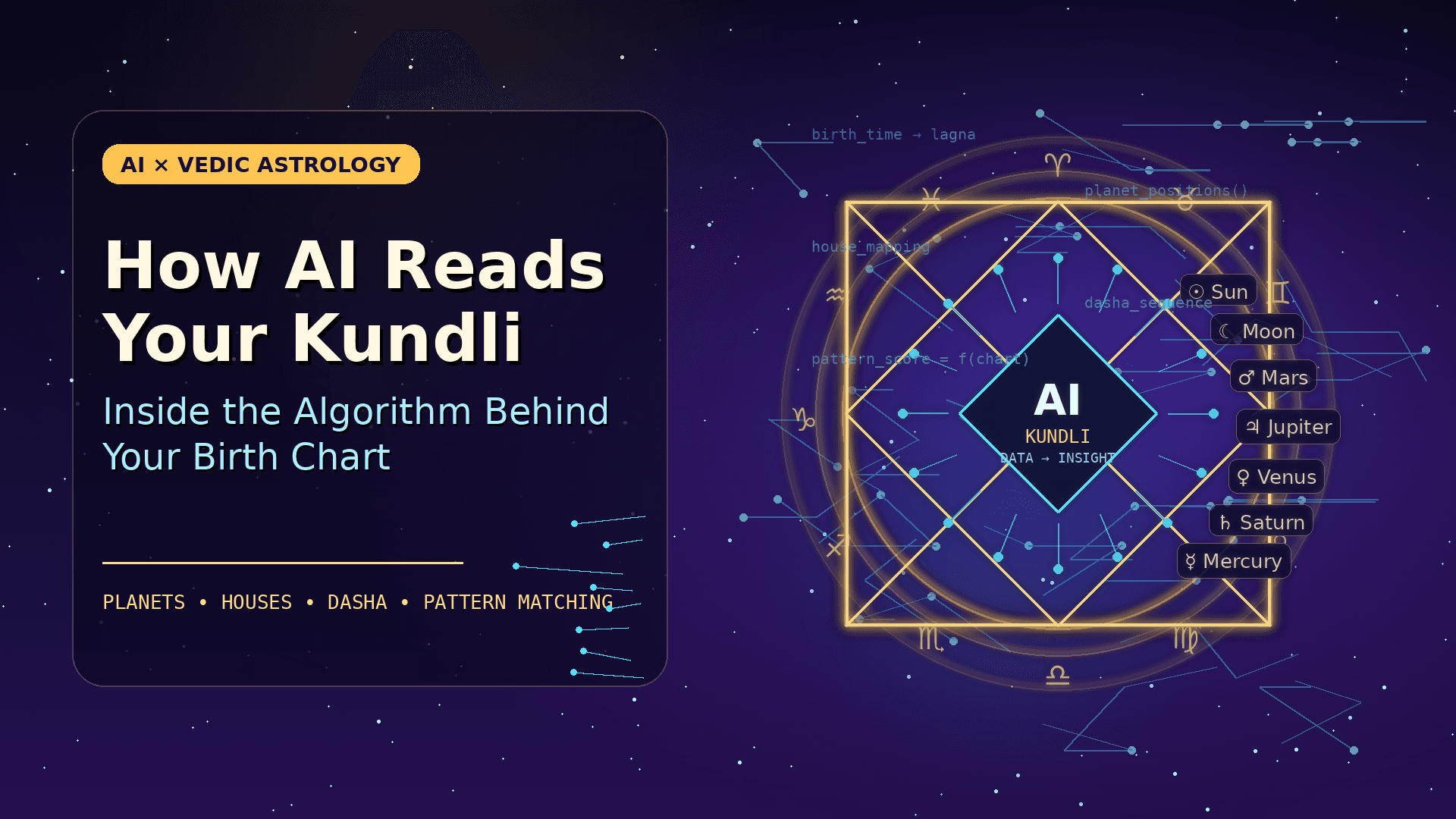
A Kundli (or birth chart) is a chart that has been used in Vedic astrology to interpret personality, career, relationships, marriage, health, finance, and life patterns for hundreds of years. Traditionally speaking, your astrologer would examine your birth date, time, and location and provide you with the equivalent of where the planets were when you were born, their meaning, or interpretation of the data.
Today, however, Artificial Intelligence (AI) is changing the way we do this; with the introduction of computers and AI, a computer-generated Kundli reading incorporates the ancient principles of Vedic astrology with algorithms of modern technology. By AI processing your birth data, generating graphs and identifying patterns between the planets, a Kundli can be done in seconds, making readings much faster, more available to people who have just started to learn about astrology, and easier to understand.
So how does AI "read" your Kundli? What happens after you enter the information about your birth at a site that has an astrological application for AI?
What Is an AI Kundli?
An AI Kundli is a computerised birth chart generated by artificial intelligence based on your date of birth, time of birth, and place of your birth to calculate the exact position of the planets at your birth.
When an AI system creates your chart, it will be able to process your Lagna, Moon sign, Sun sign, house placements, planets, nakshatras, yogas, dashas and transits using the rules from Vedic astrology. After the analysis of this astrological information is finished, AI translates this into clear guidance about many aspects of your life, including your personality, career, love life, marriage, finances/wealth/health and future trends.
So in summary, an AI Kundli is not just an astrological calculator, but also an advanced interpretation system for determining the meaning of the chart and providing insights to you.
Step 1: AI Collects Your Birth Details
Data collection is the first step to Kundli chart reading and is essential for accurate results. To create the most accurate Kundali possible, the AI will first collect the following three vital pieces of information:
1. Date of Birth: This is required to know the day, month and year you were born;
2. Time of Birth (this allows the AI to find Lagna and house placements);
3. Place of Birth (geographical coordinates will help ensure the AI calculates your chart correctly).
In Vedic astrology, time of birth is very important. As little as a few minutes can result in a change in Lagna degree or
the divisional chart. So, for the AI Kundali to provide you with an accurate reading, the AI depends heavily on the accuracy of your birth information.
Step 2: Time and Place are converted to a standard astronomical format by AI
The AI uses your Birth data to convert it to a standard astronomical format and adjusts your Birth time to the appropriate time zone of your place of Birth. This process also includes your latitude and longitude coordinates.
For example, if an individual was born in India, they would be born according to Indian Standard Time (IST). However, if an individual was born in another country, their time zone, daylight saving time rules and location coordinates would have to be taken into consideration.
Calculating planetary positions is the most important technical work of an AI Kundli system, and the day and time of birth must be accurately calculated before providing any kind of interpretation.
Step 3: Calculation of Planets from Positioning Data
Once the birth data has been standardised, the algorithm will calculate where the planets were located at the time of birth using the Sun, Moon, Mars & Mercury, Jupiter & Venus, Saturn, Rahu and Ketu as reference points.
Vedic astrology uses sidereal zodiac charting for this process; sidereal means that the zodiacal chart is calculated using real star positions. Most Vedic astrologers will use an ayanamsa (an absolute time and place reference) such as Lahiri in their calculations to establish which signs of the zodiac each of those planets was located at the time of your birth.
The previous step has resulted in finding the right chart's planetary positions; from here all the important pieces are now in place for calculating the Kundli house arrangements.
Step 4: The Lagna, Rashi, and Houses
The Lagna, or Ascendant, is one of the major determining factors of a Hindu Astrology Horoscope. The Lagna is defined as the sign rising in the east at the time of birth; the Lagna's significance within the astrological system is that it serves as the foundation from which all twelve houses will be defined.
Each Kundli house represents some part of a person's life: The 1st House represents how the person sees and presents themselves in the world. The 2nd House represents the person's ability to earn, communicate and develop themselves. The 4th House represents the person's environment, the value of their home and overall well-being. The 7th House represents the relationships that exist between people. The 10th House represents how the individual is judged in public and his or her success in the eyes of others.
The AI Kundli algorithm will take the planets' elements and map them into these twelve houses of the individual's future and will also determine how the placement of each planet will impact the individual's overall life path.
Step 5: The Nakshatras and Their Padas
In addition to using the twelve signs of the zodiac, Vedic Astrology utilises the Nakshatras, or lunar constellations. The Nakshatras are additional ways to describe one's personality and to determine an individual's future. The Nakshatra system has 27 different Nakshatras, and by examining each Nakshatra, we can begin to understand the individual more deeply than by looking solely at the zodiac sign.
For instance, two people might have their Moon in Capricorn, but they will be quite different in their emotional natures because they have their Moon in different nakshatras as per their individual horoscopes. As part of producing an AI Kundli, the AI system calculates each planet’s nakshatra and pada, especially for the Moon since Moon nakshatras are essential for calculating the Vimshottari Dasha. Thus, the AI Kundli is also far more detailed than the basic zodiac horoscope.
Step 6 – Detection Of Yogas And Planetary Combinations
Determining yogas (a unique combination of planets) is a major part of Kundli analysis. Certain yogas may represent leadership, wealth, intelligence, creativity, spirituality, struggle, delay or transformation.
For example, there are correlating planets in a powerful house or connected, which would indicate career-oriented, wealth-oriented or relationship-oriented yogas.
The ability to analyse and evaluate thousands of varying planet combinations is one of the significant advantages of using an AI Kundli. This application can detect patterns, which would have taken a human reader much longer to work out manually.
However, while being assisted by AI can assist with pattern detection, interpretation is still essential. Yoga should never be viewed in a void. The AI must assess the strength of the planets, the house lordships, the planetary aspects, how dignified the planets are, the dashas, and the overall balance of the chart when producing its conclusions.
Step 7: Use Dashas as Timing of Events in Your Life.
A Kundli provides a picture of your personality and life timing. The Vimshottari Dasha is the most common way to time the different planetary periods a person experiences in their lifetime. An AI Kundli can calculate your Mahadasha (the major period) and Antardasha (the sub-period within the major) according to your Moon nakshatra to explain what you will experience at different points.
Examples of how different periods are activated can be seen when you consider that during the Venus period, love, relaxation, artistic endeavours, luxury, and creativity may be more active. In contrast, during Saturn's period, you can expect more emphasis on your discipline, responsibility, career demands, and foundational structures.
Step 8: Astrology Transits Show Current Influences to Your Birth Chart.
While the birth chart provides a foundation for your life, astrology transits show the current planetary motions. An AI Kundli will compare the current planets' positions with how they were at your birth (the planets were in specific zodiac signs and degrees). The AI can provide you with daily, weekly, monthly, and yearly predictions.
The AI will also explain your current circumstances, such as job prospects, relationship changes, financial awareness, emotional phases, or health tips. For example, a Saturn transit through one of your prominent houses may indicate to you that you need to practice patience, discipline, and long-term planning. In contrast, if Jupiter is transiting one of your career houses, you may want to look for ways to grow, learn, and expand.
Step 9: Natural Language AI Provides Guidance Through Data
What creates the chart is the calculation. The action of language creates the final reading. This is where Natural Language AI has an important function.
The AI takes the astrological data and produces a simple description of the data. Instead of saying, for instance, "Mercury is placed in the 10th house aspecting the 4th", it may say something like "Your communication skills will greatly increase your prospects for growth if you engage in professional activities related to strategy development, business operations, writing, or any activities that involve the public."
With this simple explanation, the AI Kundli is designed for beginner users. The user does not need to have any knowledge of complicated Sanskrit phrases or technical rules of astrology. Instead, the AI has translated the information in the chart so that it can be accessed as useful, practical advice for everyday life.
What AI Kundli Can Tell You
An AI Kundli will provide you with descriptions regarding your personal and emotional characteristics, your strengths and weaknesses, your career direction (career direction), the way you relate to others (relationship style), how you might be when you marry (marriage tendencies), how you deal with money (financial habits), how you might act with respect to issues of health (health tendencies), or what the future holds for you in the long run (future themes).
In addition, an AI Kundli can also describe the birth chart in terms of its various components (as identified and classified). For example, the AI will analyze your Lagna, Moon Sign, Planetary Placement, Yogas, Dashas, and Transits, for making an AI Kundli useful to both beginners and seasoned astrological students.
Things an AI Kundli Cannot Assure You Will Happen
While we can be impressed with how powerful AI is when it comes to predicting events in our lives, you cannot rely on an AI-based Kundli to give you the definitive answer regarding your life. An AI-calculated Kundli will provide you with patterns and potentiality, but it cannot give you the exact events that will happen.
Astrology must be interpreted. The choices you make, the environment you live in, your karmic history, your effort and commitment to your own education, your relationships, and the timing of your lifetime experiences will all have an impact on the outcome of your destiny. Thus, while AI can assist your reflective ability, it does not replace your ability to exercise your own judgment or to seek professional assistance (e.g. legal, health, financial) in serious matters.
The Future of AI Kundli in Astrology
Traditionally, Astrology has been performed through the use of a book that contains the definition of all forms of charting; however, with the advent of technology and the ability to do more with an AI algorithm, the future of Astrology will become much more personal. Instead of simply being provided with an "overall" horoscope, people want to receive a daily reading based upon their specific birth chart, which is now possible through an AI Kundli.
When you can develop AI-generated reports instantly that respond to your query, as well as generate follow-up questions, compare charts, discuss dashas, analyse transits, and provide simple explanations about astrology, you will be using the future of astrology. The best AI astrology platforms will combine accurate astrological calculations with an authentic vedic basis, responsible interpretation, and an automated and Humanised User Experience.
Final Thoughts on AI Kundli
An AI-created Kundli, also known as a birth chart, is produced through a mixture of your birth information (time, date and place), astronomical calculations, rules of Vedic astrology, identification of patterns, dasha timing, transit mapping, and natural language generation (NLG). Each AI-generated birth chart is produced from an elaborate algorithm that converts complicated planetary information into meaningful guidance for an individual.
For new users, AI Kundlis help to simplify the process of reading your Kundli. For those already interested in astrology, AI Kundlis help to accelerate and enhance the analysis of a birth chart experience. For the future of astrology, AI Kundli serves as a bridge between ancient and new ways of thinking.
While AI may not have control over one's future, it can provide you with greater clarity, curiosity, and confidence when trying to understand your birth chart.