


HiAstro Insights
Janmashtami 2026: Nishita Puja Time and Fasting Rules
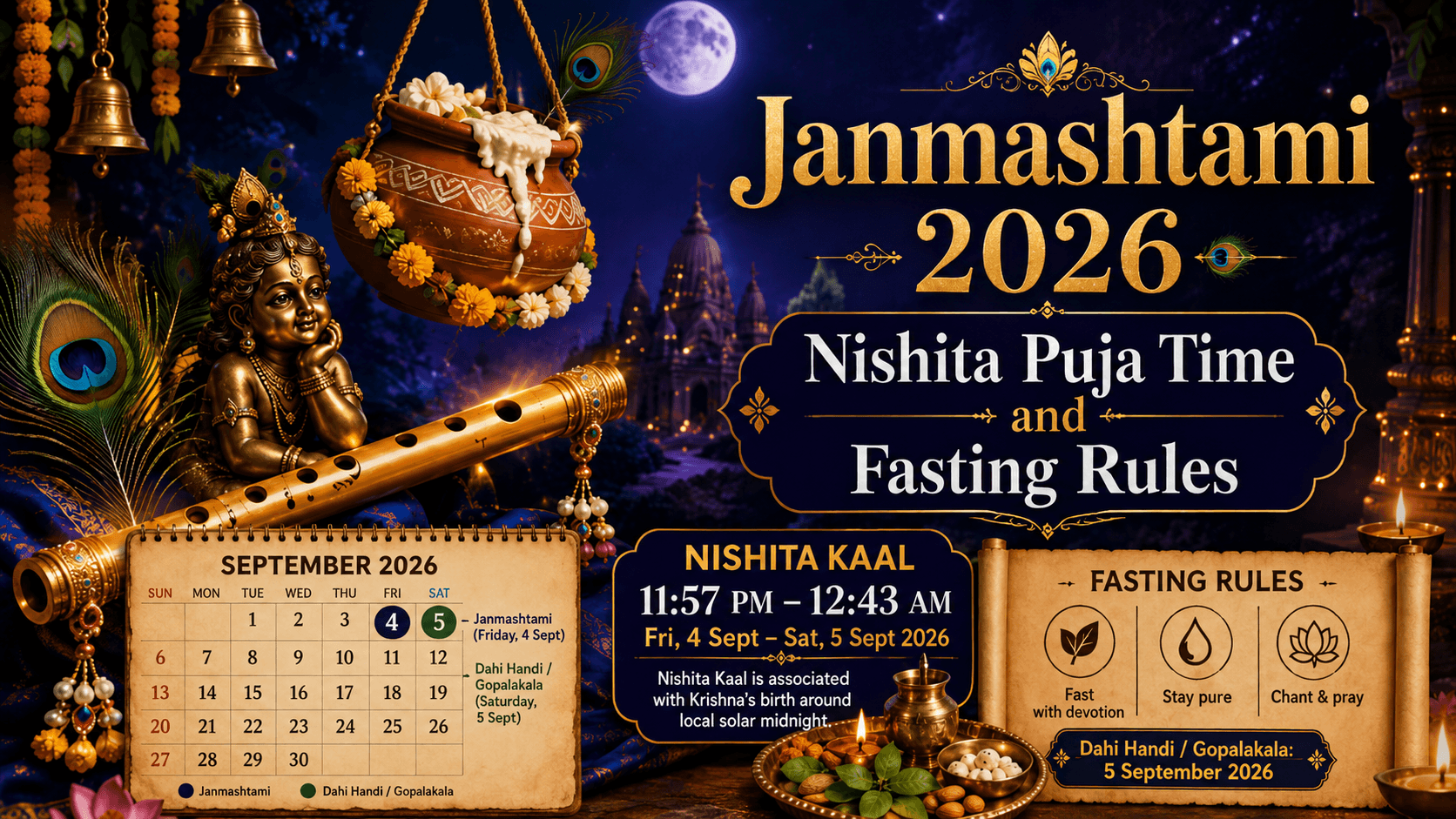
Janmashtami 2026 in India: Exact date and Key Timings
Mark Friday, 4 September 2026, for Krishna Janmashtami in India. For New Delhi, the main Nishita Kaal worship window is 11:57 PM on Friday to 12:43 AM on Saturday, 5 September. Nishita Kaal is the period around local solar midnight traditionally associated with Krishna’s birth. Dahi Handi, also called Gopalakala in some regions, follows on Saturday, 5 September.
The observance falls on Krishna Paksha Ashtami, the eighth lunar day of the waning fortnight, in the month of Bhadrapada under the common Purnimanta convention. Some Amanta regional calendars refer to the corresponding month as Shravana. In the New Delhi calculation, Rohini nakshatra, the lunar mansion associated with Krishna’s birth, begins at 12:29 AM on 4 September and ends at 11:04 PM that day. It therefore ends before the 11:57 PM Nishita window, while Ashtami overlaps the opening portion of Nishita Kaal.
Multiple modern Panchang calculations for 2026 agree on this date and New Delhi muhurat, and the official 2026 Indian holiday calendar also lists Vaishnava Janmashtami on 4 September. Janmashtami 2026 in India centres on the night of Friday, 4 September, with Nishita puja near midnight and parana after sunrise on Saturday, 5 September.
How the 2026 Panchang sets the Janmashtami Date
A Panchang does not choose Janmashtami by the Gregorian date alone. It considers whether Ashtami tithi prevails during Nishita Kaal and also examines Rohini nakshatra. In the New Delhi calculation, Ashtami begins at 2:25 AM on 4 September and ends at 12:13 AM on 5 September. Rohini begins at 12:29 AM on 4 September and ends at 11:04 PM that day. Rohini therefore ends before Nishita Puja begins at 11:57 PM, while Ashtami overlaps the opening portion of Nishita Kaal until 12:13 AM. Small minute-level differences can appear between Panchang calculation systems.
The midnight notation causes most of the date confusion. A time such as 12:20 AM belongs to 5 September on a phone or wall clock, but it remains part of the devotional night that began on 4 September. Traditional festival calculations also work with a sunrise-to-sunrise day and tithi boundaries rather than resetting the observance at 12:00 AM.
For practical planning, begin the vrata and daytime observance on Friday, prepare for worship late that evening, and treat the portion after midnight as the continuation of the same Janmashtami celebration. The birth narrative behind the timing is simple: Krishna is worshipped as having appeared at midnight, so the central abhishek and aarti are scheduled within Nishita Kaal rather than during the daytime.
City-wise Nishita Puja Timings across India
Nishita Kaal shifts with local longitude and sunset, so the New Delhi window should not be copied blindly across India. For Janmashtami 2026, the cited Drik Panchang calculations give
11:57 PM–12:43 AM for New Delhi
12:14 AM–1:01 AM for Mumbai
11:55 PM–12:42 AM for Bengaluru
11:45 PM–12:31 AM for Chennai
11:13 PM–11:59 PM for Kolkata
11:52 PM–12:38 AM for Hyderabad
12:10 AM–12:57 AM for Pune
12:16 AM–1:02 AM for Ahmedabad
12:03 AM–12:49 AM for Jaipur
NCR timings are 11:57 PM–12:42 AM in Noida and 11:58 PM–12:44 AM in Gurugram
Use these timings to plan your evening, but confirm the final muhurat for your location close to the festival. A nearby temple may also publish a different programme because its abhishek, kirtan or darshan schedule does not have to match the full astronomical window exactly.
Smarta and Vaishnava/ISKCON observance in 2026
Smarta and Vaishnava traditions sometimes observe Janmashtami on different dates because they apply different priorities when Ashtami, Rohini and sunrise boundaries do not align neatly. Smarta calculations generally give close attention to Ashtami at Nishita, while Vaishnava calendars commonly place additional weight on the sunrise tithi and their sampradaya’s fasting rules.
For 2026 in India, widely followed Panchang calculations converge on Friday, 4 September, for both traditions. Temples that follow Vaishnava rules, including ISKCON centres in India, are therefore expected to observe the principal Janmashtami celebration that day, although each temple controls its own programme and parana instructions.
If your family calendar and temple announcement differ, following the tradition in which you normally worship is a sound approach. Devotees outside India should not import Indian timings: local sunrise, longitude and tithi boundaries can move the observance to another civil date. Check a location-specific Panchang and the calendar of your local temple.
Fasting options and Parana rules for Janmashtami 2026
Janmashtami fasting can be adapted to your tradition and physical capacity. Nirjala means taking neither food nor water and is the strictest option. A phalahar fast permits customary vrata foods such as fruit, milk, nuts and grain-free preparations. A partial fast may involve simple permitted food, fluids or one light meal. Households differ on ingredients, but grains, pulses and ordinary salt are commonly avoided during a traditional fast; sendha namak is often used in vrata dishes.
Parana is the formal breaking of the fast. The stricter reference practice is to complete it after the relevant tithi and nakshatra restrictions have ended and, where prescribed, after sunrise. For New Delhi in 2026, major Panchang listings support a morning parana after about 6:00 AM on Saturday, 5 September, because Ashtami has ended before sunrise. Check your temple’s instructions if it requires a particular post-sunrise window.
Many families instead take water, fruit or prasad after the Nishita puja finishes at about 12:43 AM. This is a widespread but less strict household custom. Decide before the vrata whether you will follow midnight parana, a sunrise-based rule or your temple’s discipline; that prevents uncertainty when the puja ends late at night.
A dry, full-day fast is not a test of devotion. It can contribute to dehydration or dangerous blood-sugar changes, particularly for someone with diabetes or another chronic condition. Medication schedules should never be changed without personalised clinical advice. A hydrated phalahar fast, a shorter observance or prayer without fasting may be the safer choice.
A festive Janmashtami thali can include fruit, milk-based sweets and household-approved fasting foods; check every ingredient against your own vrata rules.
Read more https://www.hiastro.in/blog/gayatri-mantra-meaning-significance-and-power
A Practical Home Puja Plan for Janmashtami
You can keep Janmashtami 2026 at home with a simple, time-aware routine that fits around work, school and temple visits.
Prepare the altar and sankalpa in the morning
In the morning, clean the worship area and place a Krishna or Laddu Gopal murti on a secure altar or jhula. Make a simple sankalpa by stating your intention to observe Janmashtami according to your capacity. Set aside the puja thali, lamp, incense, flowers, clean water, cloth and planned offerings before evening so the late-night worship feels calm rather than rushed.
Use the evening for light worship and bhajan
During the evening, offer flowers and light a lamp, then spend time in nama-japa, bhajans, scripture reading or a temple visit. Prepare grain-free bhog according to household custom; fruit, milk preparations, makhan-mishri and grain-free dhaniya panjiri are common choices. Keep food covered and separate anything intended for after parana.
Begin Nishita Kaal abhishek close to midnight
Begin the central worship shortly before your local Nishita window. Perform a modest abhishek with clean water or customary ingredients if your idol is suitable for bathing, dry and dress the murti carefully, offer bhog, and complete aarti near midnight. Families with children can keep the ritual short rather than stretching it beyond everyone’s capacity.
Distribute prasad and plan parana
After worship, distribute prasad according to the fasting rule you chose. If you are following sunrise parana, rest and break the fast the next morning with water and a light meal after the permitted time. Avoid beginning with a very heavy or oily plate after a long fast so that your system adjusts gently.
Dahi Handi and Next-day Celebrations in 2026
Dahi Handi falls on Saturday, 5 September 2026, the day after the main Janmashtami observance. The celebration recalls Krishna’s childhood fondness for butter and curd, with teams forming human pyramids to reach an earthen pot suspended above the ground. It is especially prominent in Maharashtra and Goa, although cultural events take place elsewhere as well.
Dahi Handi is a regional celebration rather than a required part of every household’s worship. If you attend a public event, use managed viewing areas and follow organiser and local-authority instructions. Pyramid participants need trained supervision, suitable protective measures and a clear emergency plan; risky height or overcrowding should not be treated as a measure of devotion.
FAQS
Is Janmashtami 2026 on 4 or 5 September?
In India, Janmashtami is observed on Friday, 4 September 2026. Some Nishita puja timings continue past 12:00 AM and therefore appear under 5 September on a civil clock, but they belong to the Janmashtami night that began on 4 September. Dahi Handi is on 5 September.
Do ISKCON temples in India follow a different Janmashtami date in 2026?
The principal Smarta and Vaishnava or ISKCON dates coincide on 4 September 2026 in India. Temple programme times can still differ, so check your chosen centre for its abhishek, darshan and parana schedule.
Can I break the Janmashtami fast at midnight?
Many households break the fast with water, fruit or prasad after the midnight puja, but this is less strict than sunrise-based parana. If you follow a temple or sampradaya, use its rule; otherwise decide in advance whether your vrata ends after Nishita worship or after sunrise on 5 September so everyone in the home follows the same plan.
What should I do if I am not medically fit for nirjala fasting?
If strict fasting is unsafe for you, choose a hydrated phalahar or partial fast, shorten the fasting period, or observe Janmashtami through prayer without restricting food. Anyone with diabetes, kidney or heart disease, pregnancy, advanced age or medication concerns should seek personalised medical advice rather than attempting a dry fast.
What date and puja time should I use outside India?
If you live outside India, use a Panchang calculated for your city rather than converting the New Delhi time. Local sunrise, sunset and tithi boundaries can change both Nishita Kaal and, in some countries, the civil observance date. Your local temple’s 2026 calendar is usually the most practical reference for both the fasting day and the main puja schedule.