


HiAstro Insights
Shraad, Tarpan, and Pind Daan: What's the Difference? A Simple Guide
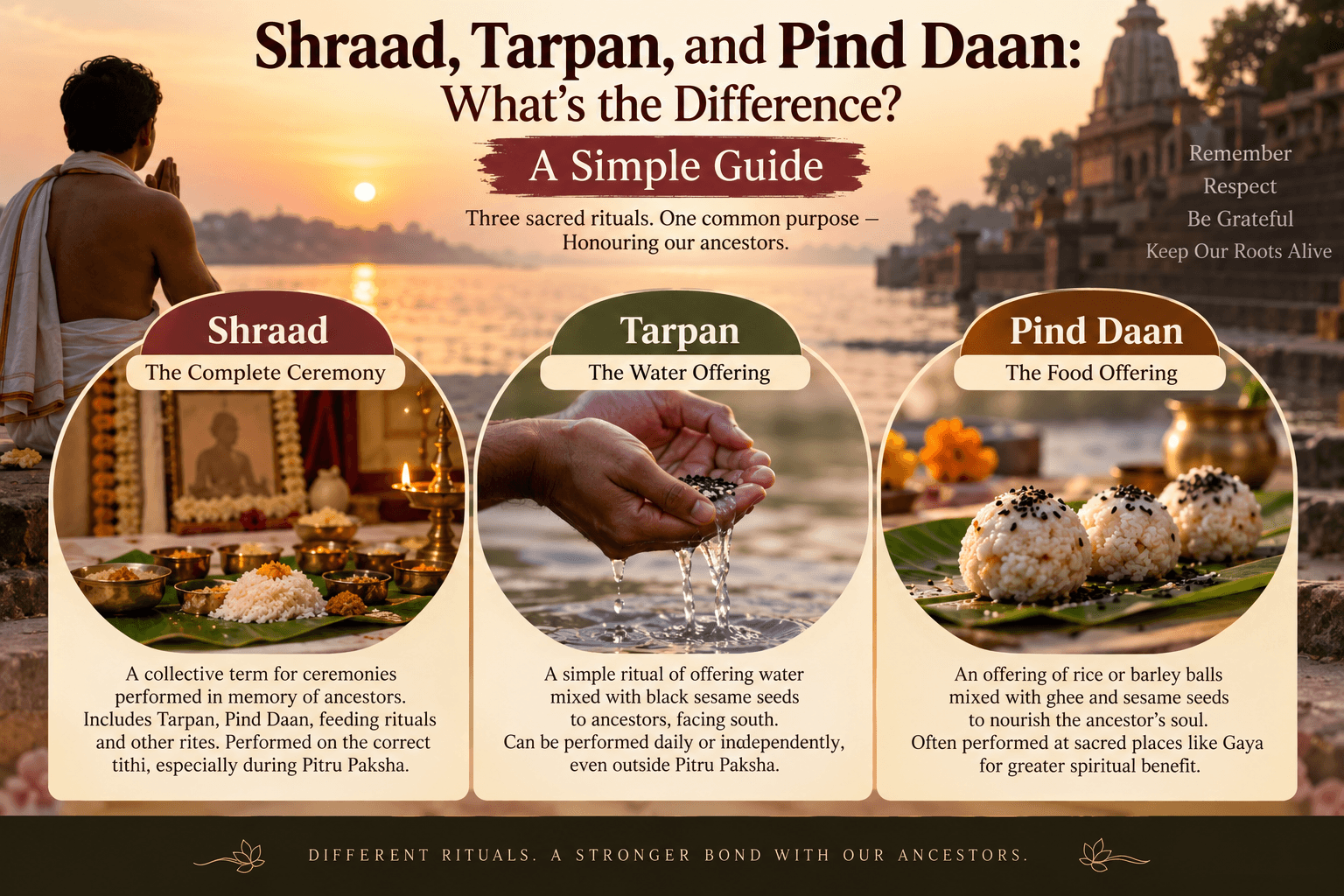
If you ask about the difference between Shraad, Tarpan, and Pind Daan from ten individuals, you would likely find that nearly half are going to use these terms as synonyms. While the confusion may appear justifiable, as these three procedures are performed during the Pitru Paksha period and are aimed at venerating ancestors, the truth is that these are three different aspects of ancestor worship.
With the arrival of Pitru Paksha 2026, taking place from September 26 to October 10, this is the perfect time to gain the necessary insights into each of these terms and perform these rituals correctly instead of treating them as one blurred tradition.
What Is Shraad?
Shraddha is a term used to cover a series of ceremonies carried out in memory of the deceased ancestors. The etymology can be traced back to the Sanskrit word ‘Shraddha ’, which means faith. It is the collective term that includes a number of important rites including Tarpana and Pinda Daan, charitable acts involved in feeding Brahmins, as well as preparing special food for the deceased ancestor.
Shraddha includes the funeral ceremony itself, while the two rites of Tarpana and Pinda Daan are observed as part of Shraddha. Shraddha takes place every year on the death anniversary of the ancestor, according to the lunar calendar (Tithi). Shraddha takes place during the period of Pitru Paksha, when the ceremonies are carried out at once for all ancestors over the period of two weeks.
Read more https://www.hiastro.in/blog/7-common-mistakes-people-make-during-pitru-paksha
What Is Tarpan?
Tarpan is a ritual where water is given to the ancestors, divine beings, and great sages as tribute and in respect. Water is offered mainly by mixing it with black sesame seeds and then poured from cupped palms by facing south, which is where Yama, the god of death and ancestor’s domain, is located. With Tarpan, it is assumed that the thirst of ancestral souls is assuaged. Furthermore, it is one of the simplest rituals and requires no elaborate materials . It can be performed even without conducting full Shraad. This is why Tarpan is often celebrated on a regular basis as well as on certain occasions like Amavasya despite leaving out Pitru Paksha's observance.
What Is Pind Daan?
Pind Daan is a ritual involving the offering of Pind, which are small balls of cooked rice, barley flour or wheat mixed with ghee (clarified butter) and sesame seeds to ancestors, done as a ritual food offering. Unlike Tarpan, which deals mainly with the aspect of water, Pind Daan is more significant in the sense that it offers nourishment to the soul of the ancestor, which eventually leads to its peace in the afterlife.
Pind Daan is best performed at selected pilgrimage spots known for their spiritual significance for this purpose, with the best-known being Gaya, followed by others like Haridwar, Varanasi, and Prayagraj. Although Pind Daan can also be performed at home, many people plan a trip to Gaya at least once in their life, especially for their parent’s Shraad, as the Pind Daan done there is said to give complete freedom to the soul of the ancestor (moksha).
A Simple Side-by-Side Comparison
Shraad: The complete ceremony honouring an ancestor; includes Tarpan, Pind Daan, and feeding rituals. Performed on the correct tithi, especially during Pitru Paksha.
Tarpan: A water offering (with black sesame seeds) made to ancestors, facing south. Simple, can be performed daily or independently.
Pind Daan: An offering of rice/barley balls symbolising food for the ancestor's soul. More elaborate, often performed at pilgrimage sites like Gaya for maximum significance.
In short: Shraad is the ceremony, Tarpan is the water offering within it, and Pind Daan is the food offering within it. All three work together, but none of them is a substitute for the others when a complete ritual is intended.
Why the Confusion Exists
One of the explanations for the ambiguity behind these terms could be their variation in the various regions. The different communities across India may have different priorities towards each aspect, with some families simply referring to the whole activities as Shraad and leaving out the specific components. As the two customs Tarpan and Pind Daan are, in most cases, carried out during the Shraad ceremony, their identical usage may be considered another possible cause of confusion in the meaning of the terms.
Do You Need to Perform All Three?
This is not entirely true, which makes this question almost an evergreen one during Pitru Paksha. A complete Shraadh ceremony consisting of Tarpan and Pind Daan along with rituals such as feasting is considered the most beneficial and perfect. But if, for some reason, one cannot carry out the complete ceremony due to any reason such as lack of resources, time, or location, then it is still much more useful to at least perform Tarpan than not to perform it at all. It is important to note that Pind Daan can be performed at a different time and place unlike Tarpan, which can be performed just once in Gaya in a lifetime for the parent instead of performing it every year.
The Astrological Connection
In addition to the mechanics of the ceremonies, all three techniques are based on the same astrological principle, Pitru Rin, which refers to the debt owed to ancestors, manifested in the 9th house of the natal chart. Unresolved Pitru Rin, caused by skipping ceremonies, lack of dead dates, or other family issues, results in what is referred to as Pitru Dosh, a concept associated by astrologers with delayed marriages and problems in the career path, as well as difficulties within family life.
For those wondering whether their natal charts reveal Pitru Dosh and which of the three rituals is necessary for their family, getting a personal reading is the best way to figure it out. You can check your free Kundli or consult astrological service in order to get personalized reading for your natal chart during this Pitru Paksha.
Frequently Asked Questions
1. Is Tarpan the same as Shraad?
No. Tarpan is a specific water-offering ritual performed within a Shraad ceremony, not the entire ceremony itself.
2. Can Pind Daan be performed without visiting Gaya?
Yes, Pind Daan can be performed at home or at other pilgrimage sites, though Gaya is considered especially significant for its spiritual benefit.
3. What is offered during Tarpan?
Water mixed with black sesame seeds is offered using a specific hand gesture, typically while facing south.
4. Do I need a priest to perform these rituals?
A priest is traditionally preferred for a complete Shraad ceremony, but simplified versions of Tarpan can be performed at home without one.
5. Which ritual is most important if I can only do one?
Tarpan is considered the most accessible and important standalone ritual if a full Shraad or Pind Daan isn't possible.
6. Why is Gaya considered special for Pind Daan?
Gaya is traditionally believed to be a site where Pind Daan offers complete liberation (moksha) to the ancestor's soul, making it one of the most significant pilgrimage destinations for this ritual.
7. Are these rituals only performed during Pitru Paksha?
Shraad is typically performed on the ancestor's exact death anniversary tithi throughout the year, while Pitru Paksha is the specific period dedicated to performing it collectively for all ancestors. Tarpan can also be performed independently on other occasions like Amavasya.