


HiAstro Insights
Shradh Dates 2026: Complete Tithi-Wise Shraddha Calendar & Which Day to Perform Shradh
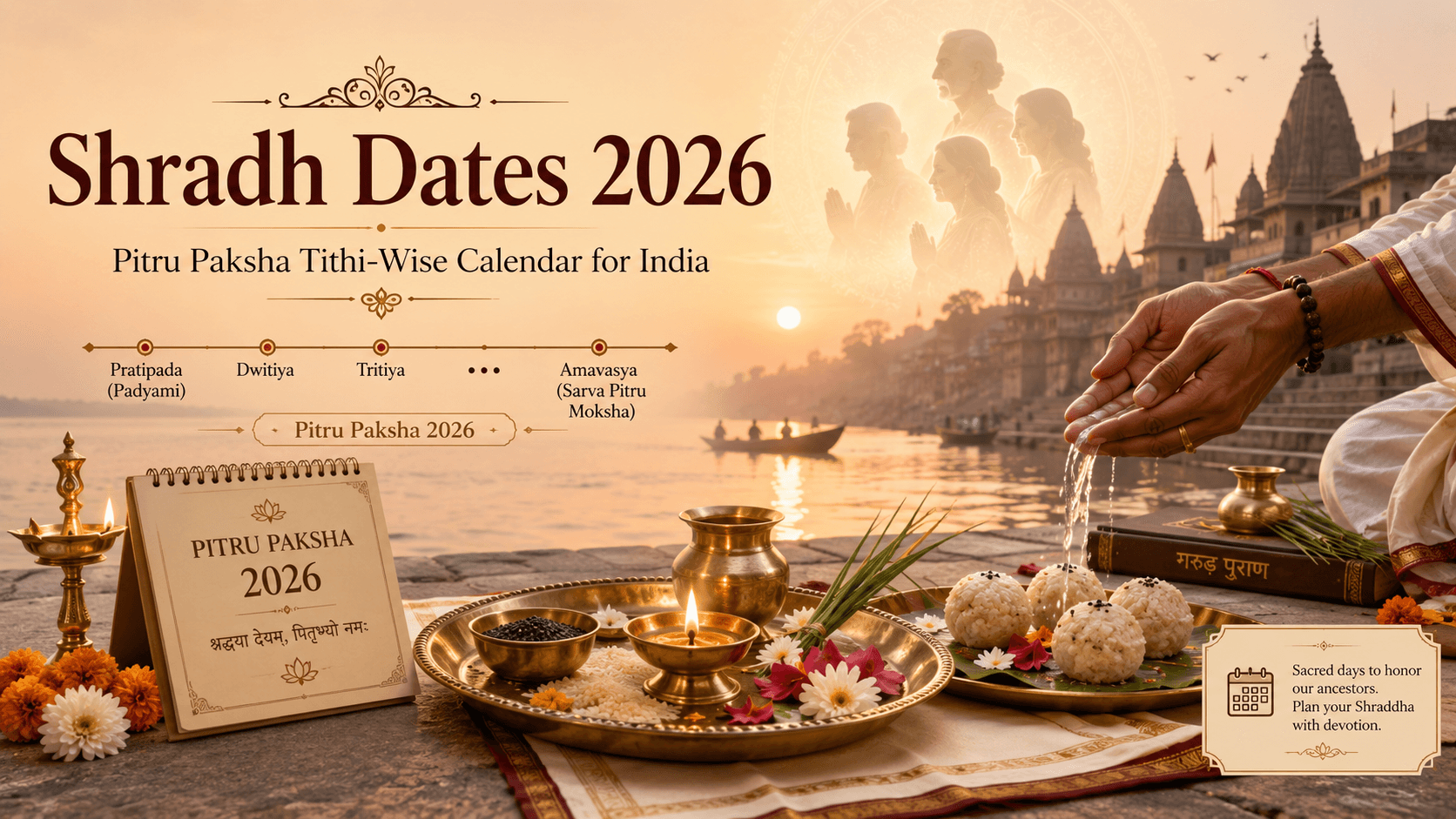
Before your family goes ahead with the Shraddha for the year in 2026, it is important to know the distinction between Purnima Shraddha and Pitru Paksha. Purnima Shraddha for the month of Bhadrapada falls on 26 September, which is a Saturday, just before the fortnight period. The Drik Panchang method states that the Mahalaya Shraddha for the person passing away on the Purnima tithi is held on the Amavasya, instead of automatically observing it on this Bhadrapada Purnima. In the case of Pitru Paksha, the period begins from Pratipada on Sunday, the 27th of September and concludes on Sarva Pitru Amavasya on Saturday, the 10th of October.
Pitru Paksha refers to the yearly interval in which people are offered prayers and shraddhas to their dead ancestors. Normally, families decide their shraddha observance day based on how the lunar months progressed with respect to the lunar death tithi of the ancestor. Additionally, some families also observe tithis or nakshatras whose importance is based on family traditions.
The Purnimanta calendars of North India state that this segment is called Ashwin Krishna Paksha, while the various Amanta calendars of South India refer to it as Bhadrapada Krishna Paksha. The month name changes, but the dates for Shraddha remain the same according to the calendars for Delhi and Mumbai mentioned above. The schedule mentioned below is meant to be used as an Indian planning guide; exact boundaries in respect of tithi and Muhurta will require location-specific checking.
Shradh Dates 2026: Tithi-Wise Calendar for India (IST)
In the 2026 Indian reference calendar, the observance of Pitru Paksha begins from an isolated Purnima Shraddha on Saturday, 26 September, and ends with Sarva Pitru Amavasya on Saturday, 10 October. The actual Pitru Paksha period lasts from 27 September. It is important to note that the same tithi can occur on the same civil day, so it is advisable to not consider a fixed one-to-one correspondence in dates in such situations.
Maha Bharani is a nakshatra based event. In the Delhi reference calendar, this event occurs on Tuesday, 29 September 2026, along with Tritiya Shraddha and not on 30 September. Chaturthi and Panchami shraddha also fall on Wednesday, 30 September.
The next in the sequence is Dwadashi on 7 October, followed by Magha shraddha. The next date is Trayodashi on Thursday, 8 October, Chaturdashi on Friday, 9 October, and finally the Sarva Pitru Amavasya on Saturday, 10 October. To identify the correct date, refer to the foreseeable tithi applicable as per local Aparahna and confirm with a priest or temple.
Use this calendar for advance India planning, then verify the place where the rite will occur. A tithi can cross civil dates, and overseas calendars can differ from India. Closer to the observance, HiAstro’s city Panchang can help you review the current local Tithi, sunrise and daily timing values displayed for supported cities. It is not a substitute for a dated 2026 annual Panchang or your priest’s instructions.
Purnima Shraddha — Saturday, 26 September 2026: This is a separate Bhadrapada Purnima observance held immediately before Pitru Paksha proper begins.
Pratipada Shraddha — Sunday, 27 September 2026: Pitru Paksha proper begins with Pratipada Shraddha.
Dwitiya Shraddha — Monday, 28 September 2026: Krishna Dwitiya Shraddha is observed on this day.
Tritiya Shraddha and Maha Bharani — Tuesday, 29 September 2026: Tritiya Shraddha is observed along with Maha Bharani, a separate nakshatra-based Shraddha observance.
Chaturthi Shraddha — Wednesday, 30 September 2026: Both Chaturthi and Panchami Shraddha fall on the same civil date in 2026.
Panchami Shraddha — Wednesday, 30 September 2026: Panchami Shraddha is also observed on this date. Some family traditions may associate this tithi with additional customs.
Shashthi Shraddha — Thursday, 1 October 2026: Krishna Shashthi Shraddha is observed on this day.
Saptami Shraddha — Friday, 2 October 2026: Krishna Saptami Shraddha is observed on this day.
Ashtami Shraddha — Saturday, 3 October 2026: Krishna Ashtami Shraddha is observed on this day.
Navami Shraddha — Sunday, 4 October 2026: Navami Shraddha is also known as Avidhava Navami or Matri Navami in some traditions.
Dashami Shraddha — Monday, 5 October 2026: Krishna Dashami Shraddha is observed on this day.
Ekadashi Shraddha — Tuesday, 6 October 2026: Krishna Ekadashi Shraddha is observed on this day.
Dwadashi Shraddha and Magha Shraddha — Wednesday, 7 October 2026: Dwadashi Shraddha is observed along with Magha Shraddha, which is a separate nakshatra-based observance.
Trayodashi Shraddha — Thursday, 8 October 2026: Krishna Trayodashi Shraddha is observed on this day.
Chaturdashi Shraddha — Friday, 9 October 2026: Some lineages prescribe specific procedures for ancestors who passed away under particular circumstances. Families should confirm the appropriate observance with a knowledgeable priest.
Sarva Pitru Amavasya or Mahalaya — Saturday, 10 October 2026: This day is meant for the collective remembrance of ancestors. It is especially significant when the ancestor’s death tithi is unknown or when the relevant Shraddha could not be performed earlier during Pitru Paksha.
Read more https://www.hiastro.in/blog/pitru-paksha-2026-shraddha-dates-for-each-tithi
Which ancestors are Honoured on each Shraddha Tithi
From Purnima through the last day of Pitru Paksha, the basic principle is straightforward: perform Shraddha on the lunar tithi that matches the ancestor’s death tithi. The table below summarises how that rule applies and where certain tithis or nakshatra-based observances are customarily associated with particular ancestors or circumstances.
Bhadrapada Purnima Shraddha: This is a separate Parvan observance performed immediately before Pitru Paksha. Under some traditions, if an ancestor passed away on Purnima tithi, their Mahalaya Shraddha is performed on Sarva Pitru Amavasya rather than automatically on Bhadrapada Purnima.
Ordinary Tithis — Pratipada, Dwitiya, Tritiya, Chaturthi, Shashthi, Saptami, Ashtami, Dashami, Ekadashi and Trayodashi: These days are generally observed for ancestors whose death tithi corresponds directly with the respective lunar date. The known death tithi usually takes priority over special observances unless the family priest or tradition advises otherwise.
Panchami Shraddha or Kunwara Panchami: In some communities, this day is specially associated with unmarried men and women who passed away. Panchami Shraddha is also observed in the usual manner when the ancestor’s death tithi was Panchami.
Navami Shraddha, Avidhava Navami or Matri Navami: This day is traditionally associated with married women who passed away while their husbands were still alive. It is also widely observed for remembering mothers and other married women in the maternal or family lineage.
Dwadashi Shraddha or Yati Dwadashi: This observance is commonly associated with sanyasis, yatis and other renunciates. In some traditions, it may also be observed for children. Renunciates are often treated differently from householders because they are considered to have moved beyond ordinary grihastha obligations.
Chaturdashi Shraddha: This day is observed for cases in which the family’s lineage or customary practice specifically prescribes Chaturdashi. As practices differ between regions and traditions, the appropriate observance should be confirmed with a trusted priest rather than decided from a general description.
Maha Bharani Shraddha: This nakshatra-based observance takes place when Bharani Nakshatra falls during Pitru Paksha. It may be performed for all ancestors and carries special significance because Bharani is traditionally associated with Yama. It is generally treated as an additional opportunity for Shraddha rather than a replacement for a known death tithi.
Magha Shraddha: This observance is performed when Magha Nakshatra occurs during Pitru Paksha. It is associated with the Pitrs and may be performed for all ancestors. Families may observe it as an additional rite when it is supported by their customary tradition or parampara.
Sarva Pitru Amavasya or Mahalaya Amavasya: This day is dedicated to the collective remembrance of all ancestors. It is especially important when an ancestor’s exact death tithi is unknown or when the relevant Shraddha could not be performed earlier during Pitru Paksha. It is also commonly chosen by families who can perform Shraddha only once during the year or wish to remember all departed family members together.
Read more https://www.hiastro.in/blog/saturn-aspects-in-vedic-astrology-meaning-and-effects-explained
Shraddha, Tarpan and Pind Daan: Core Timing and Steps
Aaparahna signifies the part of the day that is identified with the Shraddha ceremonies. There are two specific time intervals that are usually taken into account during this period, namely, Kutup Muhurtha and Rohina Muhurtha. Kutup Muhurtha is considered as the most fitting time as it occurs at the time of midday. These Muhurthas are derived from the time of sunrise and sunset, thus even though they are carried out today, they remain bound by time and local conditions. They should not be confused with the civil noon of today.
For instance, Purnima Shraddha performance on 25 September 2026 in New Delhi, can be carried out with the various aanthshti times for New Delhi that are available in the calendar. The same time measurements cannot be applied in some other cities of the world.
In general, a priest will perform the actions according to your sampradaya, however, the process of Pitru Paksha performances includes the following stage.
Prepare yourself and the ritual space
Bathe, wear clean and modest clothes, and set up a simple, clean space for the rite with a mat or asana, vessels for water, sesame, flowers and food offerings.
Make Sankalpa and invoke the deities and ancestors
Under guidance, state the Sankalpa, naming the tithi, place, gotra and ancestor(s) for whom Shraddha is being performed, then invoke the Vishwedevas and Pitrs through prescribed mantras.
Offer Pind Daan
Prepare pindas from cooked rice with sesame or barley and other prescribed ingredients, place them on kush grass or a plate as directed, and offer them to the ancestors with appropriate mantra and gesture.
Perform Tarpan with water and sesame
Offer water mixed with sesame through the hands or a spoon, usually facing south, reciting the ancestors’ names and gotra where known, or offering collectively when names are not remembered.
Offer food, dakshina and charity
Serve a simple sattvic meal to invited Brahmins or other appropriate recipients, along with dakshina, or arrange equivalent charity and feeding of those in need as your priest advises.
Conclude with prayers and visarjan
Recite closing prayers seeking acceptance of the offerings, then immerse or respectfully dispose of pindas, flowers and other ritual materials in the manner prescribed for your area.
Many families adapt this into a simpler home observance under local or remote guidance: bathing, making a clear Sankalpa with names and gotra, performing Tarpan with water and sesame, preparing a home-cooked offering or full meal, and arranging suitable charity. Mantra selection, directions, who leads the rite, how many pindas to make and how to dispose of them are matters for your priest or family tradition; if a full Vedic Shraddha is not feasible every year, a smaller but focused remembrance is still treated as meaningful.
Regional and Pilgrimage Traditions during Pitru Paksha
Some families perform the Shraddha ceremony either at home or in a temple; others travel to a specific tirtha. Gaya is famous for its Pitru Paksha pilgrimage and the Pind Daan ceremony, an event that is annually described by the tourism authority of Bihar. Therefore, if someone decides to go on a pilgrimage, one needs to register, find a priest and learn about the local rules and tithi beforehand.
Local practices vary: Mahalaya Tarpan is performed in Bengal, Odisha and Assam; Mahalaya Shraddha is performed in Maharashtra and Gujarat; Pitru Karma or the Bali ritual is followed in certain regions of South India. Hence, one should not try to generalize these traditions.
Mahalaya traditions aim to remind people of their ancestors and differ from each other; for example, there are certain differences in what components, which people get and food, how many pindas there should be and whether one needs to perform the rituals near water or not.
Planning Pitru Paksha 2026 for your Family
To start with, find the lunar death tithi of each of your ancestors. In case you only know the date of death according to the Gregorian calendar, you should give the date of death and approximately the time and place of death to a priest or suitable tithi-calculating service. Just repeating the same date of death in 2026 is not going to help pinpoint the Shraddha of that particular year. If the record is inadequate, ask how your tradition employs Sarva Pitru Amavasya on October 10th.
The priest should be contacted in advance if you want your tithi booked or your pilgrimage done by the end of September and the sequence of events should fall as follows—the Dwadashi and Magha Shraddha need to be observed on October 7th, the Trayodashi on the 8th and the Chaturdashi on the 9th. If there are multiple ancestors which occurred at separate tithis, then they can be remembered separately. The family tradition may also suggest altogether remembering the ancestors if the practice allows.
The individual or entity executing Shraddha rituals is dependent upon region, culture and other important factors such as the family line of origin. Many families believe in the tradition of first-born sons offering these rites, while there are others that allow daughters, widows and other family members to preside over these rituals. Learning the ritual is very easy and if a professional does not have availability a priest who is knowledgeable about family customs should be consulted on how to get from here.
For the purpose of this rite the Panchang of the exact place where it is performed must be referred to by those who are foreigners. Calculations done referring to Delhi or Mumbai do not work here because the dates can differ. If a family in India and abroad wants to celebrate it together, appropriate arrangements that are acceptable in every locality should be taken, unless otherwise indicated by the family priest.
Practical Do’s and Don’ts during Pitru Paksha
During Pitru Paksha, families adapt their lifestyles in order to focus on acts of remembrance and charity. This can include eating a simple vegetarian, sattvic food such as rice or dal; keeping the home and ritual space clean; and limiting distractions, especially on the days of Shraddha.
On Shraddha days, families normally prepare simple vegetarian meals, such as cooking rice, dal, kheer and seasonal vegetables. Many traditions avoid eating onion and garlic or spicy food during this period.
Cleaning the house and ritual area and placing a lighted lamp/candle and photographs or written names of ancestors means paying respects to the ancestors.
While offering offerings such as food, water or pinda, it is encouraged to remember and mention the name of your ancestors.
Another idea is to give food, dakshina or any useful donation to someone closest to you as a third party act of charity.
On the avoidance front, a lot of people tend to postpone their important events including marriage, housewarming, launch of their business until after Pitru Paksha and some of them even refrain from luxurious purchases, hairstyling, shaving, etc. The reason for such behavior lies not in some specific rules, but in customs and traditions; thus, it is advisable to inquire what your forebears or priests do rather than follow a presumption that those rules apply to you.
At the same time, important work, healthcare, and journeys are justified.
Pilgrimages during Pitru Paksha are seen as auspicious by some families, and if the modern-day life contradicts customs, one should place emphasis on essential acts of Shraddha, Tarpan, food offerings, and charity, and check how they can be adapted by asking the priest rather than suffering from anxiety during the fortnight.
Frequently asked questions about Pitru Paksha 2026 and Shraddha
Which day should I perform Shradh in 2026?
Start with the ancestor’s lunar death tithi, not the Gregorian anniversary. Then use the tithi prevailing during Aparahna for the place where the rite will occur. If the tithi or time of death is unknown, ask a priest how your tradition uses Sarva Pitru Amavasya on 10 October 2026.
Can women perform Shraddha and Tarpan?
There is no single performer rule used by every family. The cited tradition gives customary precedence to certain relatives but also lists daughters, wives, mothers and daughters-in-law among those who may perform Shraddha in particular circumstances. Because sampradaya, lineage and local practice differ, confirm the Sankalpa and method with a priest familiar with your family rather than assuming the rite cannot be performed.
What should I do if I know only the Gregorian death date?
Use the death date, approximate time and place to identify the lunar tithi through a priest or suitable calculation. The annual Shraddha follows that lunar tithi rather than the same Gregorian date. If reliable calculation is not possible, ask how your family tradition uses Sarva Pitru Amavasya.
What if the correct Shraddha tithi is missed in 2026?
A missed rite can usually be included on Sarva Pitru Amavasya, Saturday, 10 October 2026 in the India reference calendar. If that date also passes, do not assume that nothing can be done; a priest can advise an appropriate later observance based on your family tradition and local calendar.
Is one Shraddha on Sarva Pitru Amavasya enough?
Sarva Pitru Amavasya is intended for collective remembrance and is particularly useful when individual tithis are unknown or the family can manage only one ceremony. Families that regularly observe known death tithis may continue to prefer those individual dates, so treat Amavasya as a respected collective option rather than a universal replacement.
Must Shraddha be performed at Gaya or another pilgrimage place?
No. Gaya has a well-established Pitru Paksha pilgrimage and Pind Daan tradition, but pilgrimage is not the only setting described for Shraddha practice. Families also arrange rites through a priest at home or in an appropriate local setting according to their tradition. Choose travel when it fits your parampara, purpose, budget and capacity, and confirm the procedure locally.