


HiAstro Insights
Chaitra Navratri vs Shardiya Navratri: What's the Difference?
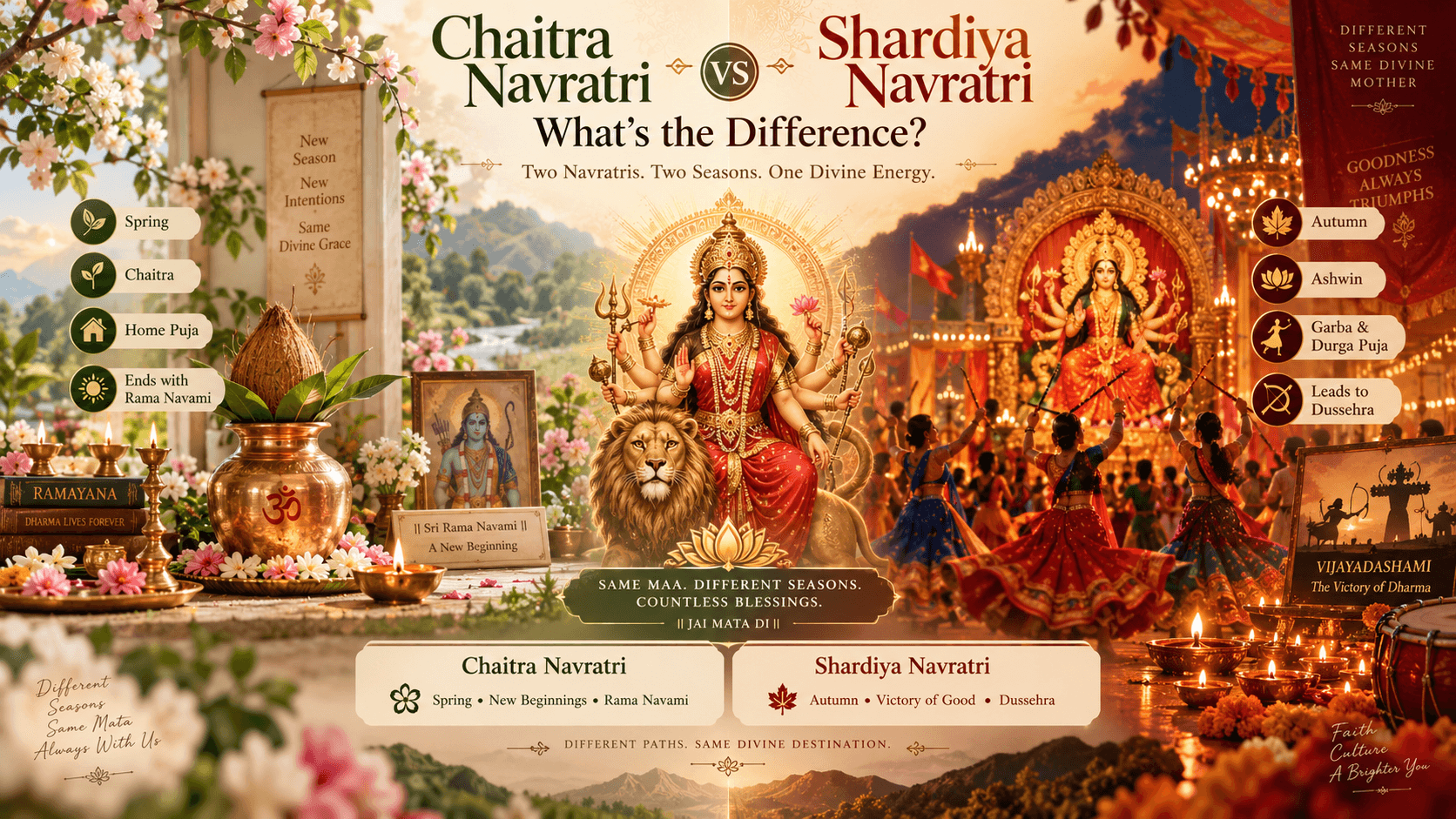
Every year, as the Garba music starts its circulation, one of the family members raises the same question: didn’t we just celebrate Navratri in spring? Why is it happening again? This question is legitimate. Navratri comes two times on the Hindu calendar, the two occurring six months apart from one another, and both involve the worship of Goddess Durga.
Chaitra Navratri is celebrated in spring (March–April), according to the Hindu calendar in many parts of India, and ends with the celebration of Rama Navami. Shardiya Navratri is celebrated in autumn (September–October), the bigger public celebration consisting of Garba and Durga Puja, leading to Vijayadashami (Dussehra). Dates for Shardiya Navratri 2026 are from 11 to 19 October.
How Many Navratris Are There in a Year?
Technically four. In terms of significance, there are two main Navratris being celebrated across the world. Chaitra Navratri (spring) and Shraddh Navratri (autumn) are the main ones observed by families, and the other two, namely Ashadha and Magha Navratris, are celebrated on a much smaller scale.
What Is Chaitra Navratri?
Chaitra Navratri is also referred to as Vasanta Navratri, commencing on the day of Chaitra Shukla Pratipada, which marks the start of the bright phase of the lunar month of Chaitra. The same day is celebrated as New Year in several parts of the country.
This festival concludes on Rama Navami, a festival celebrating the birth of Lord Rama. Therefore, it is also termed as Rama Navratri by some sections of people. In 2026, Chaitra Navratri was celebrated from March 19 to 27, and this is followed by the next celebration in the beginning of April in 2027.
What Is Shardiya Navratri?
Shardiya Navratri occurs during the month of Ashwin, which marks the transition from the rainy season to the autumn season. People use the term Navratri most often to talk about this event. The celebration symbolizes the victory of Goddess Durga over the buffalo demon called Mahishasura. The nine-day event culminates in Vijayadashami, which in the year of 2026 will take place on October 20. This is the Navratri that is famous for Garba and Dandiya nights, Durga Puja pandals, and the associated goddess worship and daily colors that are present in all parts of India and overseas.
Chaitra vs Shardiya Navratri: Key Differences at a Glance
Season: Chaitra falls in spring; Shardiya in autumn.
Hindu month: Chaitra (March–April) versus Ashwin (September–October).
Ending day: Chaitra ends with Rama Navami; Shardiya leads into Dussehra.
Significance: Chaitra coincides with the lunar new year and renewal; Shardiya commemorates the victory of good over evil.
Style of celebration: Chaitra is generally quieter and more inward, often centred on home puja and personal discipline. Shardiya is more public and festive, with community events.
Regional visibility: Chaitra is widely observed in North and West India and tied to regional new year festivals; Shardiya is celebrated across the country, including Durga Puja in the east and Garba in Gujarat.
Do the Rituals Actually Differ?
Both Navratris honour the same nine aspects of Durga, also called Navadurga, in the same order, beginning with Ghatasthapana (Kalash Sthapana) on the first day and often ending with Kanya Pujan on Ashtami or Navami. The day-wise mantras are the same for both.
Yet, where they differ is in emphasis and local customs. Sources differ on which Navratri is more meditative, some saying it is Chaitra Navratri while others claim that Shardiya fasting is the stricter fast of the two. Hence, there is no set pattern of observance for each Navratri.
Read more https://www.hiastro.in/blog/navratri-mantras-one-powerful-mantra-for-each-of-the-nine-days
Which Navratri Is More Important?
The two forms of observing the festival are not mutually exclusive. Shardiya appears to be more popular and grand than Chaitra, yet both have important religious meaning, and despite appearing milder and quieter, Chaitra is believed to be an equally important start of the new lunar year. Some households celebrate one or the other form of the festival or whichever one is favoured by their respective communities, families or households.
Observing Navratri Abroad
Families that happened to move outside the borders of India celebrate the festival of Shardiya Navratri much more energetically through Garba activities and temple events across the US as well as other parts of the world. At the same time, the practices of celebrating Chaitra Navratri are usually more smooth in style with the ceremony traditionally not requiring a priest or a temple visit.
A Balanced Note on Observing Both
Observing just one Navratri and keeping a lesser ritual during challenging times is fully acceptable, for there is no spiritual punishment involved. Traditions based on agricultural and seasonal cycles have developed over time, while modern-day living is often so demanding that the compliance with strict rituals turns out to be difficult. What actually matters is that the sort of the observed rituals is less important than the genuineness and persistence of one's actions.
Which Fits Your Chart and Your Year?
Some people find that certain Navratri suits them best, either because of family tradition or their own personal needs. Those who wish to know which particular Navratri is suitable for them according to their chart and planetary period should consult astrologers via HiAstro.
Read more https://www.hiastro.in/blog/navratri-fasting-recipes-easy-vrat-ka-khana-for-all-9-days
Frequently Asked Questions
1. What is the main difference between Chaitra and Shardiya Navratri?
The difference between Chaitra Navratri and Shardiya Navratri is that Chaitra Navratri occurs in spring and ends with Rama Navami while Shardiya Navratri occurs in autumn and culminates in Dasara.
2. Why are the two Navratris celebrated every year?
The two Navratris represent the changing seasons – Spring and Autumn which in Hindu culture is considered to be the time for spiritual practice and rebirth at the same time.
3. What are the dates of Shardiya Navratri 2026?
Shardiya Navratri 2026 falls between Sunday, 11th October to Monday, 19th October with Vijayadashami or Dussehra taking place on Tuesday, 20th October.
4. Does Chaitra Navratri conclude on Ram Navami?
Yes, the last day of Chaitra Navratri is celebrated as Ram Navami which is the birthday of Lord Ram.
5. Is it possible to observe both Navratras?
Yes, several individuals carry out rituals in both observances, and there are others whereby only one Navratri ritual is observed depending on the practice of the family and culture of the community.
6. Are there any differences in the fasting rules?
The fasts observed during Chaitra and Shardiya Navratris are essentially the same as both including consuming only satvik food during both occasions, no eating of onions and garlic, and use of sendha salt instead of normal salt.
7. What are Gupt Navratris?
There are two types of Gupt Navratris celebrated on the months of Ashadha and Magha, which are mainly observed by spiritual individuals or attuned practitioners of the beliefs.