


HiAstro Insights
Why Do We Worship Nine Forms of Durga? The Astrological and Spiritual Meaning of Navratri
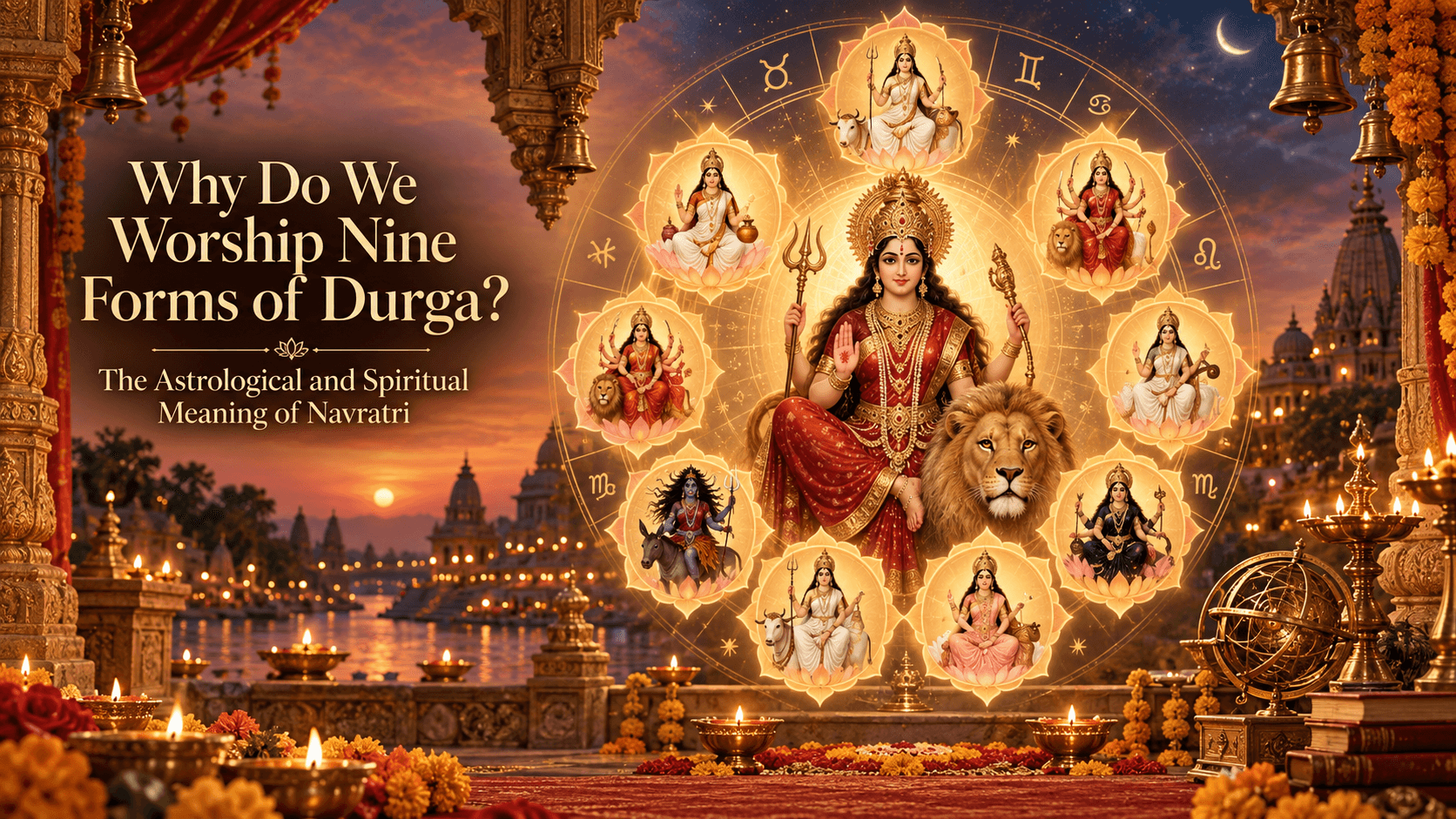
From selecting the colour scheme for the decor to shopping for clothes for the occasion, it's easy to forget the wider question of why the festival is celebrated for nine days instead of seven, or maybe just one day of worship. The explanation to this lies in a unique place that combines mythology with astronomy, numerology and astrology, and learning it provides additional meaning to a holiday that people usually consider as a holiday full of fun.
Shardiya Navratri 2026 is from October 11 to 19, and this is a good time to look at what's behind its meaning and significance.
The Story: Why Nine Forms, Not One
As stated in the Devi Mahatmya, Goddesses appeared in numerous forms to eliminate Mahishasura, a demon no single male deity could defeat. Instead of having one form of power, in scriptures Shakti– divine feminine energy represents itself differently according to the needs. In one moment, Shakti is courage; in the next, patience, ferocity when needed, and peace once the battle is won.
The nine forms of Devi, which are referred to as Navadurga, demonstrate this principle. They signify nine manifestations of divine energy rather than different goddesses in the forms of Shailaputri, Brahmacharini, Chandraghanta, Kushmanda, Skandamata, Katyayani, Kalaratri, Mahagauri, and Siddhidatri. Paying respect to the nine Durgas during nine nights doesn’t mean worshipping nine gods but rather going through nine qualities, each of which is important to a person during his/her lifetime, such as the capacity to ground, discipline, courage, creation capability, nurturing capacity, will, being able to face darkness, purification, and fulfilling oneself at the end of life.
Why Nine Days, Specifically?
In Hinduism, the number nine carries a particular significance. As the last digit before the numbers begin to repeat, it denotes the idea of fulfilment and the start of something new. This concept is further reinforced by Vedic astrology in the form of Navagraha, which includes the nine planets, namely the Sun, the Moon, Mars, Mercury, Jupiter, Venus, Saturn, Rahu, and Ketu.
Many traditions associate the nine forms of Goddess Durga with the nine grahas, where every incarnation of the Goddess stands for a cosmic power of its related planet. For example, Shailaputri is representative of the Moon, Brahmacharini is linked with Mars, Chandraghanta is associated with Venus, Kushmanda is the incarnation of the Sun, Skandamata represents Mercury, Katyayani corresponds to Jupiter, Kalaratri stands for Saturn, Mahagauri indicates Rahu, and Siddhidatri is associated with Ketu. This concept of invoking the different forms of the Goddess over nine nights aids the devotees in the process of attaining compatibility with each of the nine planetary forces governing an individual’s life.
The Astronomical Timing: Why Autumn?
The calendar of Shardiya Navratri is not, however, haphazardly placed, as it is timed just before the autumn equinox when the days and nights are evenly balanced in length. Balance in nature is also reflected in the way Navratri symbolises the inner journey of attaining balance from imbalance, from confusion to clarity. The changing season, the shift in days and the timing of the festival are all subtly connected to one another.
The Three Phases: Durga, Lakshmi, Saraswati
Navratri is not just about the nine divine forms of the goddess; the nine nights are also seen as divided into three larger sections. Each phase is dedicated to a goddess: the first phase belongs to the goddess Durga (removing negativity and enhancing strength); the second phase belongs to goddess Lakshmi (inviting wealth and bounty), and finally the third one belongs to the goddess Saraswati (developing wisdom). This shows the sequence of events: destroying everything that hinders us; attaining material stability through wealth; and finally attaining spiritual growth.
Beyond Mythology: What the Festival Asks of Us
Independent of the ceremonial aspects, the essence of Navratri is simple and clear: changing or transforming something requires some different types of strength. There are situations in which gentleness is needed, while at other times one should show firmness; sometimes patience is required and sometimes you need to be decisive. The nine forms of the Goddess represent the idea of interconnectedness of growth stages: each stage builds on the one before.
That is probably the reason why Navratri stays in the hearts of people irrespective of their beliefs and backgrounds, as it provides a way for them to reflect on things without having to undergo serious spiritual or religious endeavours.
Where Astrology Fits In
Because every night is tied to a specific kind of Goddess and planetary energy, some people consider the time of Navratri to contemplate which planetary energy feels off or insufficient in their life (be it finances, relationships, career, health, etc.) and use their prayers during the corresponding night. However, it is important to understand that the uniqueness of a Kundli reading allows one to get a more accurate picture of genuinely relevant planetary energies instead of relying on mere association.
Generate your free Kundli or speak with an astrologer to understand which planetary energies matter most in your own chart this Navratri.
Frequently Asked Questions
1. Why are there nine aspects of Durga rather than only one?
The nine forms of Durga (Navadurga) symbolise different characteristics: various aspects and stages in a process of transformation. It shows that the female aspect of Divinity takes various forms and ways depending on circumstances.
2. How is Navadurga connected to Navagraha?
According to various sources, each of the nine aspects of Durga is associated with one of the nine forms of celestial bodies in Vedic astrology (Navagraha). In that context, the nine nights symbolically become a way of establishing harmony with all nine planet energies.
3. Why is Navratri celebrated in autumn?
Shardiya Navratri occurs around the autumn equinox, when day and night are almost equal in length.
4. What are the three phases of Navratri?
The celebration of the nine nights can be broken down into three sections that honour Durga (power), Lakshmi (wealth), and Saraswati (knowledge). Each section is respectively about getting rid of evil, gaining stability, and attaining wisdom.
5. Are there other instances when the number nine is relevant in Hinduism?
Yes, the number nine symbolises completion and reincarnation, just as in the case of the Navaratna (nine jewels) and Navagraha.
6. Is knowledge of zodiac signs necessary for participating in Navratri?
No, people can participate in the event just by practising their faith and conducting rituals. However, having some knowledge of astrology and spirituality will help certain participants get a deeper understanding of Navratri.