


HiAstro Insights
Navratri Mantras: One Powerful Mantra for Each of the Nine Days
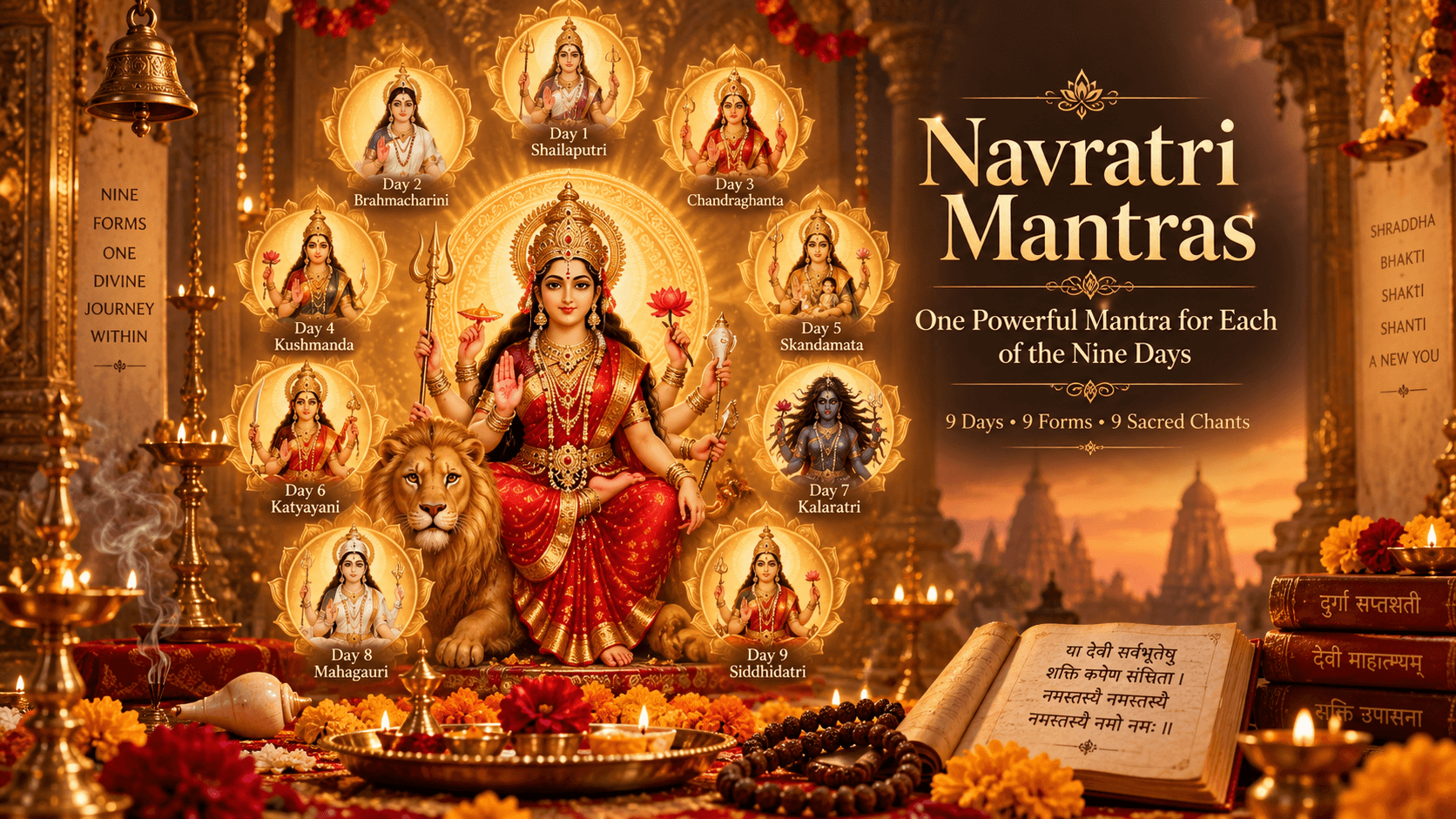
For several homes, the soul of Navratri happens to be not so much the decorations or even the fasting as the few minutes each morning or evening that one spends in front of the Goddess reciting Her name. Each day of the Navratri is dedicated to a unique manifestation of Durga, commonly called Navadurga, with each manifestation having a respective simple, well-recited Naam Mantra — a short invocation in Sanskrit that neither takes rigorous practice nor involves a priest in retelling.
Shardiya Navratri for this year is between 11th October and 19th October, and below is an entire list of the mantras for each of the day, including their significance and the reciting process itself, regardless of whether one is at a home temple in Lucknow or a corner of the apartment in London.
Why Each Day Has Its Own Mantra
The nine incarnations of the goddess Durga don't represent nine individual goddesses but rather nine different ways in which this divine power manifests itself. Each of the nine forms symbolises a different trait such as self-discipline, bravery, motherhood, and resolution. The idea is that a devotee can channel his or her connection to a particular goddess by repeating a mantra associated with her.
The Nine Navratri Mantras, Day by Day
Day 1 — Maa Shailaputri Om Devi Shailaputryai Namah. Associated with stability and new beginnings, this mantra is chanted to invoke groundedness as the nine days begin.
Day 2 — Maa Brahmacharini Om Devi Brahmacharinyai Namah. Linked to discipline, penance, and devotion, this invocation is often chanted by those seeking patience or clarity of purpose.
Day 3 — Maa Chandraghanta Om Devi Chandraghantayai Namah. Chandraghanta represents courage paired with grace, and her mantra is traditionally chanted for protection and inner calm during uncertain times.
Day 4 — Maa Kushmanda Om Devi Kushmandayai Namah. Believed to be the creative force behind the universe, Kushmanda's mantra is often chanted for vitality, clarity of mind, and renewed energy.
Day 5 — Maa Skandamata Om Devi Skandamatayai Namah. Worshipped as the protective mother of Kartikeya, this mantra is commonly chanted by parents seeking wellbeing and safety for their children.
Day 6 — Maa Katyayani Om Devi Katyayanyai Namah. Associated with strength and resolve, Katyayani's mantra is also widely chanted by those seeking clarity in relationships or marriage-related decisions.
Day 7 — Maa Kalaratri Om Devi Kalaratryai Namah. Despite her fierce form, Kalaratri is considered deeply protective, and her mantra is chanted to dispel fear, negativity, and obstacles.
Day 8 — Maa Mahagauri Om Devi Mahagauryai Namah. Representing purity and peace after penance, this mantra is often chanted alongside Kanya Pujan rituals on Ashtami.
Day 9 — Maa Siddhidatri Om Devi Siddhidatryai Namah. Chanted on the final day, this invocation is associated with the fulfilment of spiritual goals and a sense of completeness as the nine nights draw to a close.
(A quick note: due to this year's specific tithi calculations, Ashtami and Navami fall very close together in 2026 — worth checking a dedicated day-wise date guide if you're planning Kanya Pujan or Sandhi Puja around these two mantras specifically.)
How to Chant These Mantras Correctly
None of these mantras require elaborate ritual to be meaningful, but a few simple practices are widely followed:
Best time: Early morning after a bath, or in the evening during Sandhya (twilight), facing east or north
Chanting count: 108 times using a rudraksha or tulsi mala is traditional, though even a handful of repetitions with genuine attention carries meaning
Setting: A clean, quiet space, ideally near a small diya or the day's corresponding colour, though this isn't mandatory for the mantra to be effective
Posture: Sitting comfortably, spine upright, hands in a relaxed gesture — formality matters far less than consistency and sincerity
For those unable to maintain a daily practice across all nine days, even chanting a shortened version — focusing on the mantra for the day that feels most relevant, or simply Om Devi Durgayai Namah throughout — is considered perfectly acceptable.
Do You Need to Understand Sanskrit to Chant These?
A lot of beginners do not know how to pronounce these names correctly, especially those who are new to the practice and who might not have had the opportunity to hear these names very frequently in their life. The answer to that question would be No! These are naam mantras, which are derivatives of names of the goddess. The efficacy of its application lies not in its pronunciation, but rather in the intent behind its repetition. A practicum approach can also be adopted, in which one listens to the audio of the mantras to understand the correct response.
A Balanced Note on Chanting and Daily Life
Let’s state this categorically: chanting these mantras does not mean confronting your practical issues in life, nor does skipping a day constitute a spiritual failure. Many people view this time as simply a calming interlude in their otherwise hectic and demanding lives rather than an onerous task. What counts is the quality of your intention rather than your performance itself.
Taking the Practice Further
Those who see real importance in this nine-day cycle, and wish to get to the bottom of energies - whether planetary, emotional or anything else in between - influence their natal chart during this period the most, can benefit far more from consulting an astrologer than from a mere list of mantras. Get in touch with an astrologer on HiAstro to discover what is of utmost importance in the current Navratri for you.
Frequently Asked Questions
1. Which is the Mantra for Navratri Day 1?
The Day 1 Mantra is Om Devi Shailaputryai Namah which is dedicated to Maa Shailaputri and chanted for peace as the nine days begin.
2. Is it necessary to have a pandit for chanting these mantras at home?
No, the mantras mentioned are simple Naam mantras which can be chanted alone at home without seeking the help of a pandit.
3. How many times should one chant each mantra?
Though 108 times is considered traditional, even chanting fewer times with true devotion is equally effective.
4. Is it OK to chant all the nine mantras in one day if I missed the previous days?
Yes, because instead of stopping the practice altogether, many people chant combined prayers or concentrate on the mantra which they find most relevant if they miss the previous days.
5. Do we need to have a knowledge of Sanskrit to pronounce these mantras correctly?
It's not essential, as these are simple invocations, which require more sincerity and practice rather than perfect pronunciation.
6. When is the right time to chant the Navratri mantras?
The early morning is generally recommended after bathing or evening twilight period (Sandhya), although any pause during the day that you dedicate to this act would work.
7. Is there one mantra suitable for the whole period of Navratri?
Perhaps one could use Om Devi Durgayai Namah in this case when practicing all nine mantras according to a specific day of Navratri period is too difficult.