


HiAstro Insights
Durga Ashtami and Maha Navami 2026: Correct Dates, Muhurat, and What's Different Between the Two
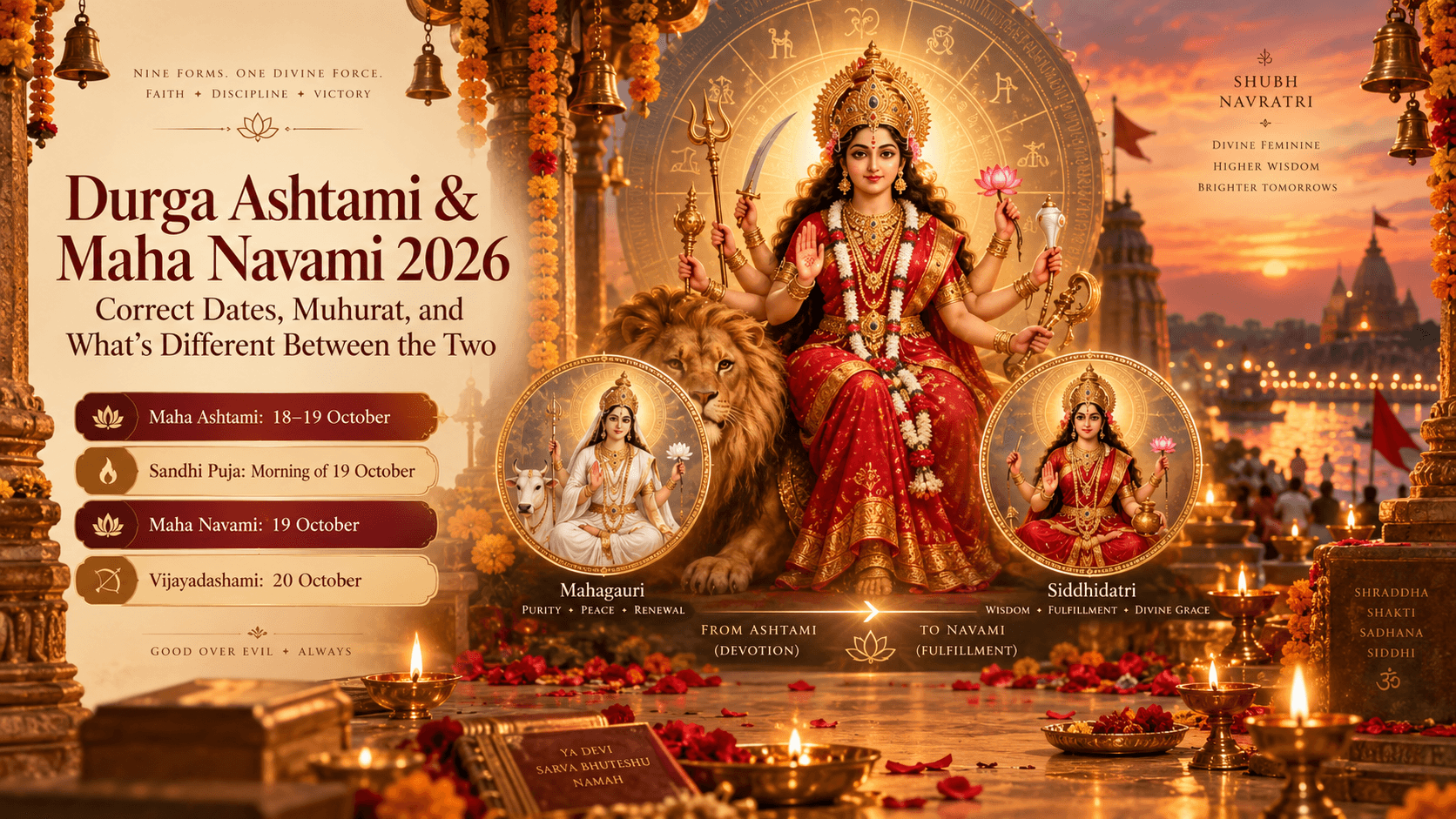
Every Navratri, a little confusion crops up in family WhatsApp groups around the eighth and ninth day: Which day is Ashtami, and which is Navami? Also, if there's a clear answer to this query, what difference does it make? In any given year, the two days are usually one after the other, but this year the tithi calculations seem to have placed Ashtami and Navami very close together, so it's worth pondering this slightly before planning the Kanya Pujan.
To keep it short: there are Maha Ashtami celebrations taking place on Sunday and Monday, the 18th and the 19th of October, with the Ashtami tithi concluding on the 19th morning and Maha Navami celebrations taking place the same day on Monday, 19th October, starting at the onset of the Navami tithi. Vijayadashami (Dussehra) follows on Tuesday, 20th October.
What Is Durga Ashtami?
Durga Ashtami, also called Maha Ashtami, falls on the eighth day of Navratri and is dedicated to Maa Mahagauri, the serene, purifying form of the Goddess. It's widely considered one of the most spiritually significant days of the entire festival, marked by elaborate puja, fasting, and, in many households, Kanya Pujan — the ritual worship of young girls as living representations of the Goddess.
What Is Maha Navami?
Maha Navami, the ninth and final day of Navratri, honours Maa Siddhidatri, the form associated with spiritual accomplishment and fulfilment. It traditionally closes the nine nights of worship with a Navami Havan (fire ritual), final offerings, and — in many homes — the Kanya Pujan ceremony, if it wasn't already performed on Ashtami.
Why Ashtami and Navami Fall So Close Together in 2026
This is the most confusing portion, so it needs to be explained directly. The dates for Hindu festivals follow tithi (lunar day) rather than following the solar calendar. Hence, tithis do not always correspond with a 24-hour cycle, so they can extend to two different calendar dates or condense such that two different tithis occur at the same time or date.
The Ashtami tithi for the year 2026 falls on the evening of Sunday 18 October and extends into the morning of Monday 19 October. So, at this point, the tithi changes to Navami tithi and lasts for the day. Hence, this year the festivals of Maha Ashtami and Maha Navami are celebrated on 19 October, with the time of the transition from one to the other, called Sandhi Puja, taking place in the morning. As the timings for change of tithi can vary a little depending on the city and the particular Panchang, it is advisable to consult a local Panchang as it approaches the date to check your local time precisely.
What Is Sandhi Puja, and Why Does It Matter?
Sandhi Puja denotes the exact intersection of Ashtami and Navami as it is the last 24 minutes of Ashtami and the first 24 minutes of Navami which makes this almost 48-minute timing the most spiritually charged period of the festival because this is believed to be the point where Goddess Durga manifested her most formidable avatar to fight the demons Chanda and Munda, so many families light 108 lamps and pray at this time.
Due to this year's tithi set up, the Ashtami-Navami meeting happens in the morning of October 19 which makes the timing of Sandhi Puja very significant in cases when missing this period when the significance would be diminished, in contrast to other ceremonies that can be performed during various periods of the day.
Kanya Pujan: Should It Be Done on Ashtami or Navami?
This is one of the most pragmatic queries that families have to deal with; the truth is that both dates hold significance and the choice usually depends on which family or ethnic custom prevails over the other and not on any hard-and-fast rule. Some households in Northern India observe Kanya Pujan on Ashtami morning, while others prefer to do so on Navami in case Ashtami coincides with a day with various other engagements. Moreover, since much of the year 2026 will have both Ashtami and Navami falling on the same date, it will be feasible for families opting for both ceremonies to manage them in one single day instead of two days, which is the usual case.
What's the Real Difference Between the Two Days?
The overall distinction, taking into account which goddess is being worshipped annually, is primarily dependent on the nature of each day within the overall festival. Ashtami is the peak of the fight — the goddess is at her most intense, leading up to Sandhi Puja. Navami is the end of the battle — when victory is achieved and blessings granted through Navami Havan. Many traditions interpret the nine nights as achieving strength (Durga) going through affluence (Lakshmi), and finishing with wisdom (Saraswati), thus Ashtami and Navami form the final transition in that chain of events.
A Quick Date Summary for 2026
Maha Ashtami: Observed Sunday evening into Monday morning, 18–19 October; Mahagauri is worshipped
Sandhi Puja: Falls during the Ashtami–Navami junction on the morning of Monday, 19 October (check your local Panchang for the exact window)
Maha Navami: Observed Monday, 19 October, once the Navami tithi begins; Siddhidatri is worshipped
Vijayadashami (Dussehra): Tuesday, 20 October
A Note on Regional Variation
Being honest is important in this respect. Not all regions and communities celebrate these two days in the same way. In some areas of Eastern India, Durga Puja takes on a more elaborate five-day ritual based on community pandals. Ashtami and Sandhi Puja are highly important in these parts of the country. In many places in North India, the celebration is more focused on Kanya Pujan and simpler puja rituals at homes. Neither celebration is more “correct” than the other; they are both equally valuable since they represent the same etiquette of worship through different regional practices.
Making the Most of These Two Days
As both Ashtami and Navami are happening in close proximity to one another this year, it would make sense to prepare for the dates and timings of Sandhi Puja, Kanya Pujan, and Navami Havan ahead of time, and not wait until the day itself, especially for families with jobs or coordinating with others. Those who would like to see how the exact time of the festival can impact their personal chart, whether it is for some prayer, starting anew, or getting to know more about how the astrological influences work in their lives, should contact an astrologer, who would be able to help them more than any general calendar. Speak with an astrologer on HiAstro to plan these two significant days around what matters most for you this Navratri.
Frequently Asked Questions
1. Are Durga Ashtami and Maha Navami the same in the year 2026?
Indeed, yes. The Ashtami tithi ends on 19 October at daybreak, and the Navami tithi occupies the remaining time of the same day, so both are celebrated on Monday, 19 October 2026.
2. What is Sandhi Puja?
It is about 48 minutes interval between Ashtami and Navami tithi, regarded as the most auspicious time of Navratri festivals.
3. Is Kanya Pujan performed on Ashtami or Navami?
Both days are regarded as valid days for the purpose, and the decision depends upon the custom of a particular region or community. Since now both days fall together, many families may perform it as a unified occasion.
4. Which goddess is worshiped on Ashtami and which goddess is worshiped on Navami?
Goddess Mahagauri is worshipped on Ashtami and Goddess Siddhidatri is worshipped on Navami.
5. In the Navami Havan, what does it entails?
This is a fire ceremony that is conducted on Maha Navami, which usually encompasses making offerings to the Goddess and praying for prosperity. It ends with the last worship of the festival.
6. Why do Ashtami and Navami sometimes occur on separate dates in the years following Maha Navami?
Different tithi lengths in different years and due to the lunar and solar positions result in Ashtami and Navami taking place on two separate calendar dates instead of happening on the same date as it happens in 2026.
7. Does the exact timing of Sandhi Puja remain constant throughout India?
No, there are slight differences in the time between cities due to Sunrise timings and local Panchang readings, so it is better to check the local Panchang close to the date to determine the exact time.