


HiAstro Insights
What Data Does AI Use to Generate Your Horoscope?
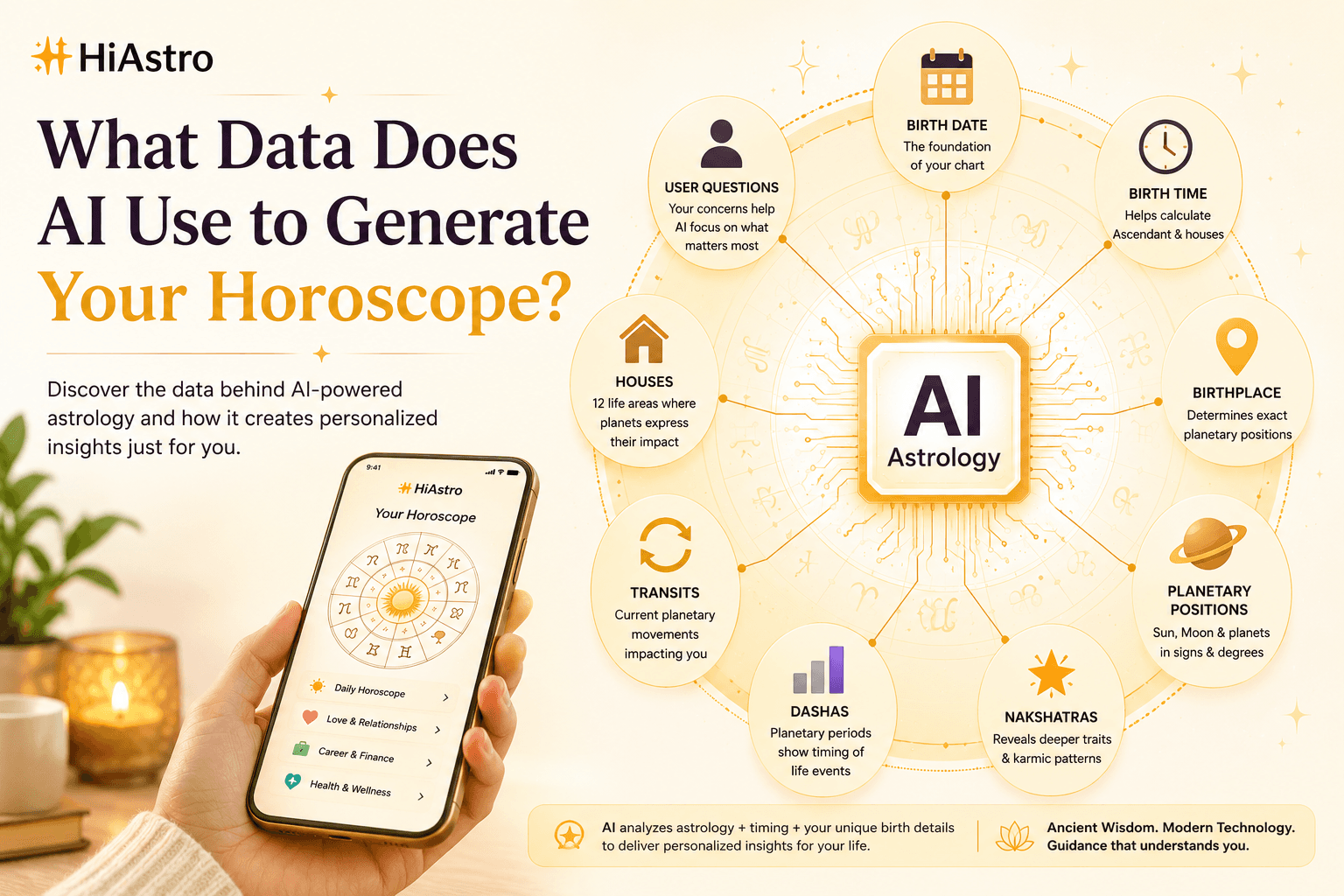
Artificial Intelligence is significantly altering how we've traditionally approached Astrology. Until recently, most people used books; had their charts manually computed; or sought assistance directly from an astrologer when they wanted to read their horoscopes. Today however, an astrological chart can be generated in seconds instead of hours or days, based on birth date and location, current planetary positions, zodiac signs, houses, nakshatras, dashas and transits.
But there is one big question that is frequently asked; what data does AI use to create your horoscope?
AI systems do not generate horoscopes randomly; rather they generate a horoscope based on structured astrological data (Planetary data) astrological chart calculations (calculating where planets were on your day of birth) and on the set of rules for interpreting a birth chart (generally the four types of information we receive from an astrologer's reading: your personality, timing, relationships, career, finances, health and your emotions).
1. Date Of Birth: The Core Data Point for Your Horoscope Calculation
Your date of birth is the first and most fundamental data point that AI uses in this process. The date of your birth will allow AI to determine where the planets were on your date of birth.
In astrology, for example, all of the planets are constantly moving through space in relation to one another. The Moon, for example, moves from one zodiac sign to another relatively quickly, while Saturn and Jupiter take longer to cross through the zodiac. Therefore, by using your date of birth, AI can calculate the location of all of the planets (in this case, Sun, Moon, Mars, Mercury, Jupiter, Venus, Saturn, Rahu and Ketu) at the time of your birth.
2. Importance of Birth Time
Your birth time is one of the most significant things that will define your astrological chart, as it is how the Lagna (Ascendant) is calculated. Lagna changes approximately every 2 hours, meaning that even if two people are born on the same day, if they are born at different times, they can have vastly different Kundlis.
Some of the aspects AI can use your birth time for are:
Ascendant or Lagna
House placements
Moon degree
Planetary degrees
Divisional charts
Dasha balance at birth
Marriage, career, and health indicators
For example, if you were born at 8:30 AM, your Lagna would be different from someone who was born at 11:30 AM on that same day. This creates an entirely different house structure for your horoscope.
That’s why many AI horoscope applications will ask for your accurate birth time before generating your personalised horoscope.
3. Birthplace: Location Matters More Than You Think
Your birthplace is the third major piece of information that will be fed into the AI system to calculate your horoscope. AI will use your birthplace to calculate the latitude and longitude coordinates and tie this into your birth time zone. All of these are important to accurately determine the position of the sky at your moment of birth.
For example, if you were born in Delhi and a person was born in London on the same day and time, while you might share the same zodiac sign, you will not have the same astrological chart because you are in different geographical locations.
Your birthplace will also be used by AI to calculate:
Local time correction
Ascendant degree
House positions
Planetary visibility
Accurate birth chart alignment
A birth chart will be too vague without the place of birth; therefore, with a place of birth, artificial intelligence can generate a more precise birth chart.
4. Planetary Positions: The Core Horoscope Data
Once you enter your date of birth, time, and place, the AI identifies the planetary positions for you. The planetary positions indicate the zodiac sign as well as the degree of each planet at your time of birth.
Each planet represents a different part of your life:
Sun: confidence, authority, soul purpose
Moon: emotions, mind, inner comfort
Mars: courage, action, aggression
Mercury: communication, logic, intelligence
Jupiter: wisdom, growth, blessings
Venus: love, beauty, luxury, relationships
Saturn: discipline, karma, delay
Rahu: ambition, obsession, unconventional path
Ketu: detachment, spirituality, past karma
The AI then studies these planets to determine how each of these planets affects your personality, decisions, relationships, career and direction in life.
Read AI Astrologer vs Traditional Astrologer: https://www.hiastro.in/blog/ai-astrologer-vs-human-astrologer-which-is-more-accurate
5. Zodiac Sign is Important Information to Understand how a Planet Acts
The AI checks the sign of each planet to determine how the zodiac sign influences a planet. Each planet behaves differently depending on which sign it is in.
For example, Mars in Aries may be bold, straightforward and active, while Mars in Cancer may become emotional and reactive. The Moon in Cancer is emotional with strength and sensitivity, while the Moon in Capricorn is responsible and emotional in his or her strength.
By analysing the influences of a planet's zodiac sign, the AI learns how the planet will produce results.
6. Houses: The Life Areas AI Studies
An astrological chart consists of twelve houses, representing the different areas of life. In an astrological chart, the placement of different planets within these houses demonstrates where the planet can show the greatest impact.
For example:
First House: Personality and Physical Body
Second House: Financial Strength and Family Resources
Third House: Communication and Courage
Fourth House: Home and Mother
Fifth House: Education, Love, Children
Sixth House: Competition, Health, Enemies
Seventh House: Marriage and Partnerships
Eighth House: Transformation and Secrets
Ninth House: Luck and Higher Learning
Tenth House: Career and Reputation
Eleventh House: Income and Affluence
Twelfth House: Expenditures, Foreign Travel, Spirituality
If a person's Venus is in the seventh house, they would likely interpret their relationship to be harmonious. If a person's Saturn is situated in the tenth house, they would experience a slow but steady rate of growth concerning their career.
7. Nakshatras and Padas
In Vedic Astrology, nakshatras add more depth to the horoscope. There are 27 nakshatras and each nakshatra is broken down into four padas. Artificial Intelligence (AI) uses nakshatra data to determine certain personality traits, emotional patterns, karmic tendencies, and overall life themes.
The Moon nakshatra is used for dasha calculations, compatibilities, and emotional analysis.
For example, a person with their Moon in the Rohini nakshatra may have creative and attractive qualities; while an individual with their Moon in the Ashlesha nakshatra could be very intuitive, observant, etc.
8. Dashas: Timing of Life Events
Not only does the AI evaluate the birth chart for information on what’s currently in the individual’s life, but it also looks to see when certain results may be activated.
Dasha information will aid in this process. The Vimshottari Dasha has been used in Vedic Astrology to understand the timing of different periods in life, indicating when different planets will be active. For example, a person with a Venus Mahadasha (or a period ruled by Venus) would generally expect to have increased themes around relationships, luxury, creativity, or comfort. Conversely, during a Saturn Mahadasha, the individual would generally be experiencing increased themes of discipline, persistence, responsibility, and delays.
The AI will utilize Dasha information to provide timing-based life insights related to career, marriage, finances, health, and personal development.
9. Transits: Current Planetary Movement
Another source, or data point, for the AI is planetary transits. Transits are indicative of where the planets are currently in the sky; how their current locations are interacting with the planets in the individual’s natal chart.
As a result, when you receive your daily, weekly, monthly, or yearly horoscope, the AI will compare the current positions of the planets with your natal chart to provide predictions such as:
Career growth
Relationship improvement
Financial caution
Health awareness
Emotional ups and downs
Favourable timing for decisions
Because of this, the information presented in the individual’s daily horoscope may be different than what was presented in the natal chart, despite the individual’s natal chart remaining unchanged.
10. User Questions/Topics & Their Corresponding House
Today’s AI Horoscope tools will also consider your question when creating a personalised response to your inquiry. For example: If you ask “Will I get a job soon?," AI will look to the 10th (career) house, 6th (service) house, Saturn, Sun, Mercury, and which dasha you are in.
For love questions, it will consider the 5th, 7th houses, Venus, Moon, and relationship combinations. For marriage, it will look at the 7th House, Venus, Jupiter, Navamsa chart and compatibility indicators.
By using your question to filter out the results, the results you receive from AI astrology will be more relevant than generic results..
11. Rules of Astrology/Pattern Recognition from Historical Data
AI Horoscope Systems are built - trained/programmed -by using astrological rules, combinations & logic used for interpretation. These rules can also be referred to as classical rules and include several criteria such as: house meanings, friendly and enemy provable relationships between planets, the aspects formed between planets, and many other criteria such as: Yoga, Doshas, the strength and/or weakness of the planets, and gaining a feel for the timing of the event by looking at when the events occurred.
For instance, the AI may check to see if:
A planet is exalted or detrimental; a planet is in a friendly or effeminate house; a planet lord of a house is strong or weak. Benefic planets supporting the house of the 7th house; malefic planets creating pressure on the 7th house.
The further the AI goes through those steps to all the potential combinations of factors, the when the details of the interpretation for the horoscope will be as detailed as possible.
Read about: https://www.hiastro.in/blog/how-ai-interprets-planetary-positions-in-your-horoscope
12. Is your personal data used by AI for anything other than astrology?
The only information used by a proper AI horoscope application will be your personal data, and the appropriate information for astrology (e.g., birth date, charting data and question) does not include unrelated personal information to produce your horoscope.
When using an AI astrology application it's important to confirm that their privacy policy is defined prior to using it, including what data is collected and how it will be used.
Benefits of AI Horoscope Generation
AI makes horoscope generation faster, easier to structure and easier to interpret. In addition, AI can use the user's date of birth and calculate the exact house of each planet as well as the current date. Thereby, providing a detailed analysis for both the user and their horoscope.
The greatest advantage of this application is the personalized aspect of using an AI-generated horoscope. General zodiac horoscopes can be generated for millions of individuals; however, an AI-generated astrological Kundli can be created using your personal date of birth.
Additionally, AI can provide an explanation of complex astrology concepts in a more reader-friendly discussion, thus providing assistance to novice readers.
Limitations of AI Horoscope Data
While AI can guide you, it is not intended to be perceived as determinism or a definitive outcome; rather, astrology reflects the possibilities and trends associated with each moon and planetary position. The person has a fair number of options in his/her life and choices will influence the outcome of his/her life, including his/her emotions, work effort and influence of the environment on him/her.
AI astrology provides the best clarity tools available to help you understand the patterns of your life, what questions to ask, and how to make decisions in a thoughtful way.
Conclusion
AI generates your horoscope using all kinds of data about you, including your date of birth, time of birth, place of birth, planetary alignment, zodiac sign, house placement, nakshatra, dasha periods, transiting planets and your questions as a user. After gathering this information, AI will use specific astrological rules to produce predictions and offer directions customised specifically for each user.
The true power of AI-generated horoscopes is how they break down complicated Kundli analysis into easy-to-understand information that can be accessed by anyone who is interested in learning more about Astrology. Whatever support you are seeking, whether it be regarding your career, relationships, family and marriage, financial situations, health or personal growth, you will be able to use AI astrology to view your horoscope and gain clarity and meaning.
Astrology is the map of your life, where AI assists in determining the pattern of your individual life based on your decision-making process which will determine your route.