


HiAstro Insights
Ekadashi Dates in 2026: Complete Vrat Calendar & Parana Guide
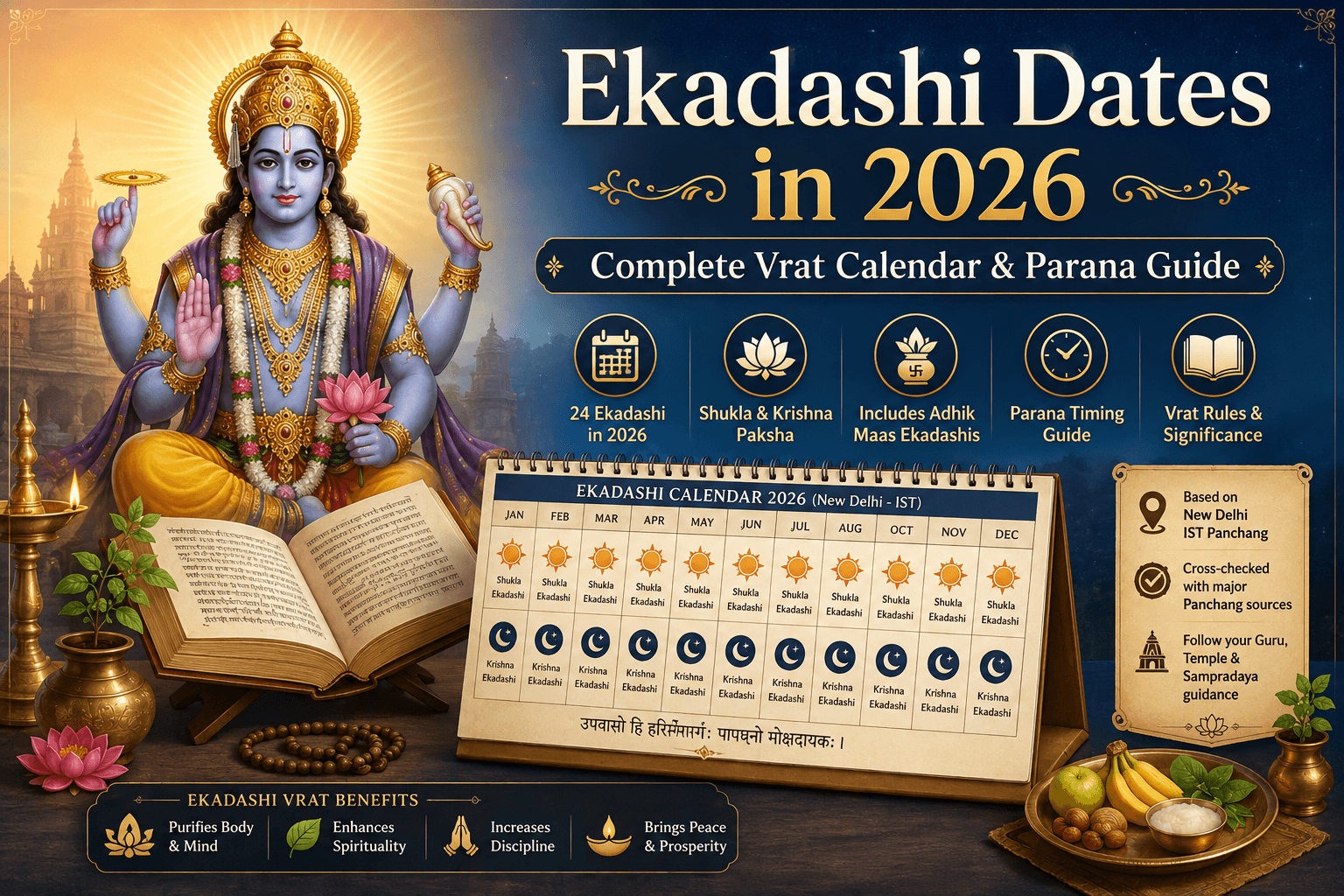
When someone states in Delhi that it is Ekadashi today, the temple calendar of a location abroad may mention that Ekadashi falls tomorrow. Both may be right according to their own Panchang. Ekadashi is a lunar Tithi and not a set date on the Gregorian calendar, and the Tithi depending on sunrise may vary based on your location. The same astronomical principles are applicable when deciding the date for breaking the fast on Dwadashi.
In this instance, the calendar in consideration operates on a base of New Delhi-IST Smarta calendar. The validity of the dates obtained here is verified as per the New Delhi Panchang and the major Ekadashi calendars available in the vicinity. The days in this respect are just used as a planning reference and not performed in replacement of the calendar of the guru, temple or sampradaya, especially when a Vaishnava fast coincides with the adjacent civil date.
Start by using the baseline to determine the year, and then verify that each fast conforms to the authoritative Panchang according to the location where the fast is being observed. This additional verification is useful when travelling, even when outside India or when Ekadashi starts or ends close to sunrise, as this moment is when the rules set by Smarta and Vaishnavas clash.
Ekadashi basics: Tithi, Paksha, Adhik Maas and Types of Fasting
A Tithi refers to one out of 30 lunar segments within a synodic month. There are two subdivisions of lunar months: the waxing segment, known as Shukla Paksha and the waning segment referred as Krishna Paksha. Ekadashi is the 11th Tithi in either subdivision and occurs twice throughout every lunar month. Hence, the day is held sacred to Lord Vishnu throughout the year due to practices such as fasting, chanting prayers, reading scriptures and controlling one’s senses.
A lunar month is shorter than a solar month and in order to synchronize lunar months with seasons, an additional lunar month called Adhik Maas has been added from time to time in the Hindu calendar. In the year 2026, this month will be marked as Adhik Jyeshtha, with Padmini Ekadashi observed in Shukla Paksha and Parama Ekadashi celebrated in Krishna Paksha.
Adhik Maas adds Padmini and Parama to the Ekadashi sequence of the lunar year's impact. If we look at the Gregorian year in New Delhi, we would find that there are 24 Smarta fasting dates for the year between 1 January and 31 December 2026. It is very important to ensure that when comparing totals and observance dates, factors like the location, date range, and the Smarta or Vaishnava tradition are the same.
Different observance levels differ in rigor. One needs to choose the appropriate type depending on their health, need for medication, and one's tradition and experience.Nirjala Ekadashi means no food and no water has been consumed in fasting. While this is a traditional form of fasting that is optional, some people may need to consult with their physician before engaging in this fasting style.
The simplest Ekadashi form, in which worshipers refrain from consuming any grains and legumes but can eat simple dishes prepared in accordance with vows. Different types of roots, spices, salt, and dairy vary depending on the region and tradition of worship.
How Location and Sampradaya affect your Ekadashi date
You should bear in mind that deciding when Ekadashi falls is not just a matter of checking if the Tithi overlaps with some civil date. A Panchang also considers local sunrise and Tithis surrounding it. Since the time of sunrise is different in such cities as Kolkata, Delhi or London, the Ekadashi which occurs at sunrise in one place can occur on different civil days at the same time.
Smartas always pick a day based on the rules regarding the local sunrise and its relations to the Dashami, Ekadashi, and Dwadashi. Vaishnavas would introduce extra rules to check that the Dashami is either before or around the sunrise. When this is not the case, the Vaishnava community might have to fast on the following day, sometimes naming it Gauna or Mahadvadashi and disclosing the time for the Parana according to that practice.
This is why putting New Delhi dates into a calendar in Japan and Nigeria can be cumbersome. You must check the calendar based on location rather than the city where your parents are from in India, and select a Panchang that aligns with your customs. If a temple in your area has its own fasting schedule, then that will probably be the best point of reference for your fasting days.
Ekadashi dates in 2026: New Delhi–IST baseline calendar
14 January 2026 — Wednesday: Shattila Ekadashi falls during Krishna Paksha in the month of Magha. Observe the standard Ekadashi fast and break it on Dwadashi morning after checking the local Panchang for the appropriate Parana window.
29 January 2026 — Thursday: Jaya Ekadashi falls during Shukla Paksha in Magha. Parana should be performed on Dwadashi after sunrise, following your city's Panchang and family tradition.
13 February 2026 — Friday: Vijaya Ekadashi falls during Krishna Paksha in Phalguna. Devotees traditionally observe a grain-free fast and complete Parana during the Dwadashi window prescribed for their location.
27 February 2026 — Friday: Amalaki Ekadashi falls during Shukla Paksha in Phalguna. The observance is associated with worship of the amla tree in many regions, with the fast broken on Dwadashi according to the local Panchang.
15 March 2026 — Sunday: Papamochani Ekadashi falls during Krishna Paksha in Chaitra. The day is traditionally associated with repentance and prayer, with Parana completed on Dwadashi within the recommended local timing.
29 March 2026 — Sunday: Kamada Ekadashi falls during Shukla Paksha in Chaitra. Devotees may observe a standard grain-free fast and break it on Dwadashi after sunrise, following their local Panchang.
13 April 2026 — Monday: Varuthini Ekadashi falls during Krishna Paksha in Vaishakha. Fasting may be observed according to one's capacity, with Parana performed on Dwadashi within the recommended local window.
27 April 2026 — Monday: Mohini Ekadashi falls during Shukla Paksha in Vaishakha. It is associated with the Mohini incarnation of Lord Vishnu. Follow the Dwadashi Parana timing given by your local Panchang.
13 May 2026 — Wednesday: Apara Ekadashi falls during Krishna Paksha in Jyeshtha. Observe the standard Ekadashi fast and complete Parana on Dwadashi according to your local Panchang and tradition.
27 May 2026 — Wednesday: Padmini Ekadashi falls during Shukla Paksha of Adhik Jyeshtha. This is an Ekadashi associated with Adhik Maas. Observe the fast and break it during the Dwadashi window specified by your local Panchang.
11 June 2026 — Thursday: Parama Ekadashi falls during Krishna Paksha of Adhik Jyeshtha. This is the second Ekadashi of Adhik Maas, and Dwadashi Parana should be performed according to city-specific Panchang timings.
25 June 2026 — Thursday: Nirjala Ekadashi falls during Shukla Paksha in Jyeshtha. Traditionally associated with a waterless fast, many devotees may instead choose a gentler grain-free or fruit-based observance. The fast should be broken on Dwadashi according to local guidance.
10 July 2026 — Friday: Yogini Ekadashi falls during Krishna Paksha in Ashadha. Follow the standard Ekadashi observance and complete Parana on Dwadashi within the local Panchang's prescribed window.
25 July 2026 — Saturday: Devshayani Ekadashi falls during Shukla Paksha in Ashadha. It traditionally marks the beginning of Chaturmas for many communities. Parana is performed on Dwadashi morning according to one's local Panchang and sampradaya.
9 August 2026 — Sunday: Kamika Ekadashi falls during Krishna Paksha in Shravana. Devotees can observe a simple fast and complete Parana on Dwadashi during the time indicated by their local Panchang.
23 August 2026 — Sunday: Shravana Putrada Ekadashi falls during Shukla Paksha in Shravana. In some regions, the day is associated with prayers for children. Parana should be performed on Dwadashi according to local Panchang guidelines.
7 September 2026 — Monday: Aja Ekadashi falls during Krishna Paksha in Bhadrapada. Observe the standard Ekadashi fast and check your local Panchang for the appropriate Dwadashi Parana time before breaking the fast.
22 September 2026 — Tuesday: Parivartini (Parsva) Ekadashi falls during Shukla Paksha in Bhadrapada. Observed during Chaturmas, it is symbolically associated with the turning of Lord Vishnu. Break the fast on Dwadashi according to your tradition's prescribed window.
6 October 2026 — Tuesday: Indira Ekadashi falls during Krishna Paksha in Ashwin. It is connected with Pitru-related observances in some traditions. Complete Parana on Dwadashi according to your local Panchang.
22 October 2026 — Thursday: Papankusha Ekadashi falls during Shukla Paksha in Ashwin. The day focuses on prayers for forgiveness, with Dwadashi Parana performed according to the timings provided by your city Panchang or temple calendar.
5 November 2026 — Thursday: Rama Ekadashi falls during Krishna Paksha in Kartika. Observe the standard Ekadashi fast and complete Parana during the Dwadashi window specified for your location and sampradaya.
20 November 2026 — Friday: Devutthana Ekadashi falls during Shukla Paksha in Kartika. It marks the awakening of Lord Vishnu and the close of Chaturmas in many communities. Parana is performed on Dwadashi, often alongside Tulsi-related rituals, using local timings.
4 December 2026 — Friday: Utpanna Ekadashi falls during Krishna Paksha in Margashirsha. Observe the standard grain-free Ekadashi fast and perform Parana on Dwadashi according to your location's Panchang.
20 December 2026 — Sunday: Mokshada Ekadashi falls during Shukla Paksha in Margashirsha. The observance focuses on prayers for spiritual liberation and often coincides with Gita Jayanti. Break the fast on Dwadashi according to the time window given by your city's Panchang.
Read more https://www.hiastro.in/blog/navratri-2026-dates-colors-puja-vidhi-and-fashion-guide
Meaning and spiritual focus of key Ekadashis in 2026
Nirjala Ekadashi is a day connected with Bhima and the special type of fasting that involves observing the fast completely without a drop of water. The word may indicate what the true ideal is but it does not mean that everyone has to follow it. People who cannot remain without water may choose to fast on grains or fruits according to the instructions they have received from their families or spiritual leaders.
Devshayani Ekadashi symbolizes the beginning of the period of inactivity for Lord Vishnu and Chaturmas in some communities. Devutthana Ekadashi indicates the end of Chaturmas and the awakening of Lord Vishnu. Parivartini Ekadashi occurs during Chaturmas and is indicated by the change of side of the God.
Padmini and Parama Ekadashi belong to the month of Adhik Maas, which is time meant for increased prayer, reading scriptures, and deeds of charity. Mokshada Ekadashi signifies the will for liberation and occurs on Gita Jayanti.
How to observe Ekadashi fasting safely and practically
Before checking out the timings of Ekadashi, it is important to determine your fasting method so that it gives you spiritual benefit while being practical enough for your health, work and family circumstances.
Finalise your fasting type
Decide whether you are going to observe a Nirjala fast, a phalahar fast or a milder Ekadashi fast without grains. A first-time faster might choose to go with plain fast whereas an experienced faster may opt for fruits, milk and nuts. The Nirjala fast requires a great effort and may not be attempted just for the sake of its strictness; it is better to focus attention to spiritual goals accompanied by good practice.
Be ready for Dashami and Ekadashi days
On Dashami, many devotees would eat just a simple meal, stay away from heavy food and prepare for the fast even before the dawn of Ekadashi. Make sure to decide in advance what foods you will have as you can eat fruits, dairy products, nuts, potatoes, sweet potatoes, sabudana and special rock salt in some homes while avoiding grains, rice, wheat, flour and legumes. If you have to work or travel, take food and drinks according to your fasting choice.
Keep Ekadashi day focused and balanced
Ensure that Ekadashi is calm and focused. If possible, maximize your devotion on this special day of worship. Set aside ample time for prayers to Lord Vishnu, chant mantras, read the Bhagavad Gita or Vishnu Sahasranama, make temple visits, engage in charity work and spend less time on entertainment and transportation. Relax as needed, and drink fluids such as water, if permitted under your choice of fasting.
Plan a simple Parana on Dwadashi
Arrange for a simple Parana on Dwadashi. Check a reliable Panchang for your city either before sleeping on Ekadashi, or early on Dwadashi morning to find out about the Parana time period. Prepare a simple meal before the fasting period because you do not want to turn Parana into a heavy meal; many devotees begin with things like water, fruits or some other light item and gradually return to normal diet.
Children, pregnant or breastfeeding women, elderly persons and persons suffering from diseases such as diabetes, kidney disease and eating disorders should avoid strict fasting without professional advice because light food without grain, a simple symbolic diet or devotional practice without dietary restrictions is enough.
Parana: Breaking the fast at the right time
The act of completing the Ekadashi fast is called Parana. This paraphernalia is performed sometime on Dwadashi, otherwise known as the twelfth lunar day, and it must be performed after sunrise. Devotees do their best to perform Parana the moment Dwadashi sets in, as performing Parana either at daybreak or at any time after Dwadashi is considerably acceptable as part of the ritual, and many calendars caution devotees against performing the act at any time after Dwadashi.
At the beginning of Dwadashi, the first quarter of the day is called Hari Vasara, after which the traditional rules of performing Parana are stipulated. The timeframes mentioned above are dictated by three local conditions of the geographical place — the moment of sunrise, the end of Hari Vasara, and the expiry of Dwadashi. If Dwadashi is short or one of these conditions happens close to the moment of sunrise, then local practices apply, and the timeframe for performing Parana may be extremely short.
The time given for Vrindavan, Jaipur or Dallas is true exclusively for that particular place and the calendar tradition that it follows. It must not be applied to another city. Geolocation-based panchang tools show different Ekadashi and Parana timings for cities, as they recalculate Tithi and sunrise for every particular place, frequently using Drik calculations.
Parana typically starts with water or fruit or simple allowed food items and moves back to normal meals. If you miss the window, do not panic and do not attempt to extend your fast in an unsafe manner.
Read more https://www.hiastro.in/blog/pitru-paksha-2026-shraddha-dates-for-each-tithi
Check your local Tithi with HiAstro Panchang
HiAstro provides access to a Panchang hub where you can select your relevant city, thus enabling you to view the exact dates and times pertaining to the next day or tomorrow. You can rely on these pages for determining the current Tithi information and local sunrise/sunset hours. If you are looking to check any other date from 2026, do so using an annual Panchang based on your location or the calendar defined by your temple or sect.
HiAstro's Panchang can be referred to at the time of fasting or during the time of Parana for finding out information related to that particular day. If there are any specific pointers related to Hari Vasara or Vaishnava procedures that are only used in your sector, please compare them with the calendar provided by the relevant authorities.
Planning your 2026 observance across work, travel and family
Mark the basic dates in your own calendar, then set an alert a few days before each of them. Use the alert for double-checking fasting dates, organizing meals, and determining the conditions of Dwadashi the following day. Pay special attention to Nirjala , Padmini, Parama, Devshayani, Devutthana and Mokshada if those rituals are very important for your family.
When travelling, take into account the location of your sunrise, not the origin of the journey. The crossing of many time zones may change both civil and Parana dates. Local temple calendars are probably the best source in case your travel leads you to a different Vaishnava community.
In case relatives and calendars have different data, first make sure you are comparing the right cities. A New Delhi smart date and a London Vaishnava date are not interchangeable. When you finish your alignment you can easily rely on your guru and the temple data and stop switching between calendars every month.
Health, tradition and calendar limitations
There is no single universal Parana timing in India, nor will simply labeling something with IST mean anything regarding local sunrise time in the country. The dates above are to be regarded as approximate planning dates. Before any fast, check one’s Tithi. Some traditions provide for some leeway in terms of fasting so that when there are problems such as health issues, age, being pregnant, taking medication, or unavoidable duty, fasting is altered accordingly.
Frequently asked questions about Ekadashi dates and fasting in 2026
What is the Ekadashi date in my location today?
You can set your Panchang according to your new location in order to know which Tithi is ongoing. The day on which Ekadashi is present during the local sunrise is usually the Ekadashi fasting day. In the case of Ekadashi, do not rely only on the Gregorian date in an Indian list, and make sure that you are following the Smarta or Vaishnava calendar, because the fasting day may be different depending on whether Dashami or Ekadashi receives an important sunrise.
How many dates of Ekadashi fasting should be expected in the year 2026?
The Gregorian calendar has a Smarta format of dates that states that there were 24 dates for fasting from January 1 to December 31, 2026 (as per Drik Panchang and AstroSage). However, be careful since Padmini and Parama are both types of Adhik Jyeshtha within this period of days. Depending on your Vaishnava or another calendar, the dates can differ, so you should learn about the calendars used by your region in advance.
What date do I observe for Ekadashi if I stay outside of India?
You need to calculate the date from your local observance rather than using an Indian civil date. You must first select your city and relevant time zone in the trusted Panchang, then follow the tradition you belong to. If you attend a local temple or satsang, you can usually find that its observed fasting and Parana schedule would align with your community’s observance.
What can I do if I have eaten grains on Ekadashi by mistake?
Even if you make a mistake on this auspicious day, it does not overturn its spiritual significance. You can go back to your own fasting level, continue your prayers and japa and complete the Parana. However, in case your school of thought has a specific corrective approach, you should ask your guru or temple representatives about it. In any case, there is no sense in using fear-based responses or trying to “divert” the situation by fasting very long.
What if I miss the ideal Parana window?
If you find that the time for breaking the fast as mentioned in the Parana has elapsed then it is advisable to break your fast in a safe manner rather than availing the bad effects associated with prolonging it. In case Dwadashi is still running, you may consult the local Panchang or temple for appropriate time for breaking your fast. In case the prescribed time is very much over, then complete your fast properly and take advice on future observances.