


HiAstro Insights
Navratri 2026: Dates, Colors, Puja Vidhi & Fashion Guide
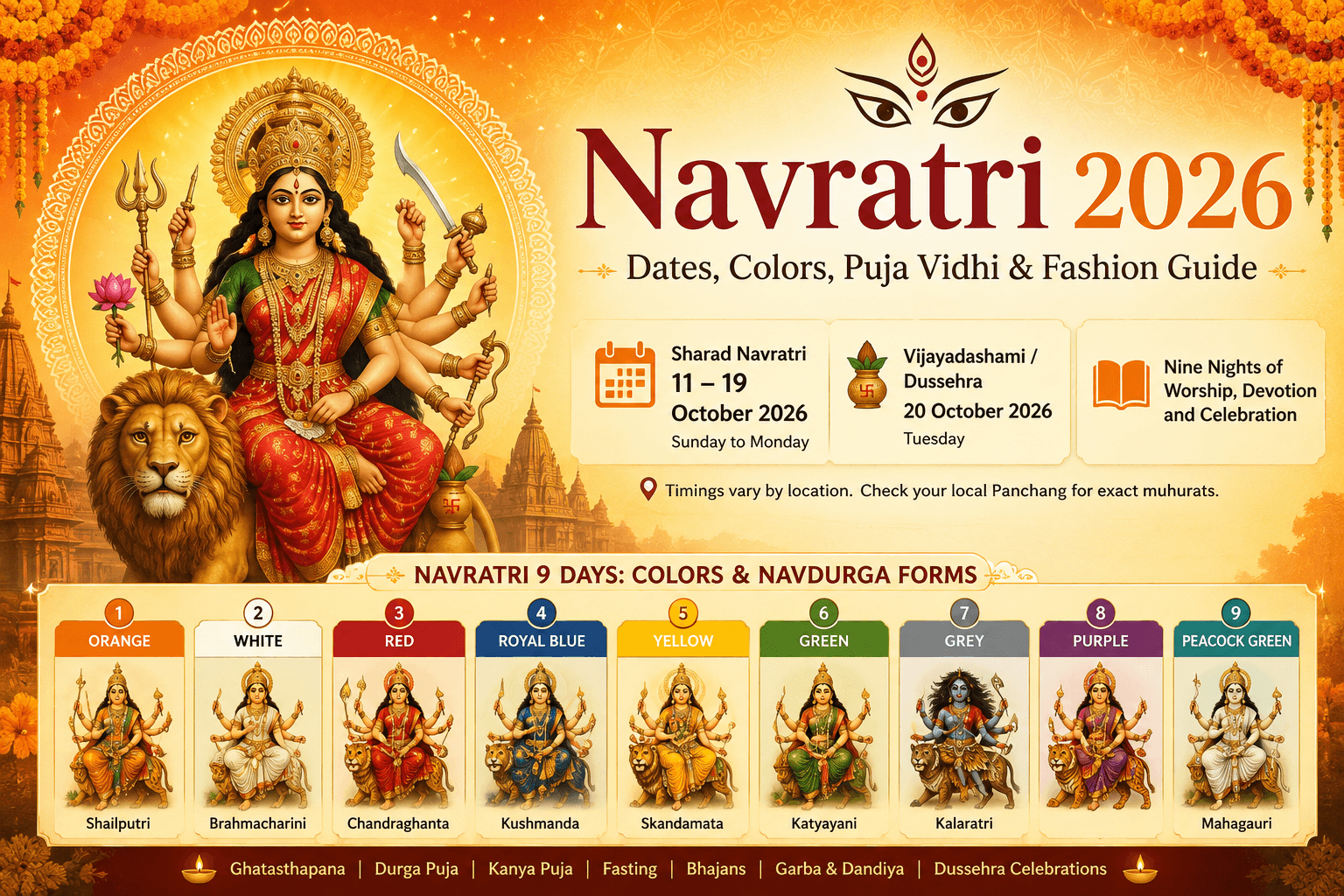
Searching for Navratri dates in 2026 can produce two different answers because the year contains both Chaitra Navratri in March and Sharad Navratri in October. The focus here is Sharad Navratri, the autumn festival observed from Sunday, 11 October through Monday, 19 October 2026. Vijayadashami, also known as Dussehra, follows on Tuesday, 20 October.
The nine festival days run consecutively from Sunday to Monday. The widely followed sequence is Orange, White, Red, Royal Blue, Yellow, Green, Grey, Purple and Peacock Green. These colours are a popular social and clothing tradition rather than a compulsory part of worship, so a family or temple may follow a different sequence without changing the devotional meaning of the festival.
Panchang dates are based on lunar tithis, not midnight-to-midnight civil days. A tithi can begin or end during a Gregorian date, and muhurats also depend on local sunrise. Use the dates here for advance planning, but confirm precise puja timings with a Panchang set to your city or with your temple.
Sharad vs Chaitra and the other Navratris in 2026
Navratri means nine nights, but the name applies to more than one annual observance. Four seasonal Navratris are recognised in tradition: Chaitra in spring, Ashadha Gupta Navratri, Sharad Navratri in autumn and Magha Gupta Navratri. The two Gupta Navratris are generally quieter and are associated more closely with specialised or private forms of worship.
Chaitra Navratri 2026 begins on Thursday, 19 March. Rama Navami falls on Thursday, 26 March in Smarta calendars and on Friday, 27 March in many Vaishnava or ISKCON calendars. The observance begins the Hindu lunar year in several calendars, and household fasting and scripture recitation are prominent while public festivities vary by region.
Sharad Navratri runs from 11 to 19 October and leads into Dussehra on 20 October. It has a larger public presence through Gujarat’s garba and dandiya, Bengal’s Durga Puja, northern Indian jagratas and Kanya Puja, and southern golu displays and Ayudha Puja. Colour calendars are especially visible during this autumn cycle, which is why March and October outfit lists should not be assumed to match.
Read more https://www.hiastro.in/blog/pitru-paksha-2026-shraddha-dates-for-each-tithi
Sharad Navratri 2026 calendar: dates, tithis, Navdurga forms and colours
The tithi names below are the festival-day labels commonly used in Panchang calendars for India. Because a lunar tithi can change during the day, consult local timings before scheduling a sankalpa, homa or other time-sensitive ritual.
Day 1 — Sunday, 11 October: Pratipada is dedicated to Maa Shailputri. The traditional colour is Orange, representing grounding and resolve. Devotees begin Ghatasthapana and their Navratri vrata.
Day 2 — Monday, 12 October: Dwitiya is dedicated to Maa Brahmacharini. White is the traditional colour, symbolising simplicity, discipline, tapas and strengthening the sankalpa.
Day 3 — Tuesday, 13 October: Tritiya is dedicated to Maa Chandraghanta. The traditional colour is Red, associated with courage, alertness and prayers for protection.
Day 4 — Wednesday, 14 October: Chaturthi honours Maa Kushmanda. Royal Blue is the traditional colour, representing vitality, clarity, creative energy and balanced activity.
Day 5 — Thursday, 15 October: Panchami is dedicated to Maa Skandamata. The traditional colour is Yellow, associated with nurturing devotion, learning and family well-being.
Day 6 — Friday, 16 October: Shashthi honours Maa Katyayani. Green represents growth and determination and also marks the beginning of many Durga Puja observances.
Day 7 — Saturday, 17 October: Saptami is dedicated to Maa Kalaratri. The traditional colour is Grey, symbolising fearlessness and confronting and removing negativity.
Day 8 — Sunday, 18 October: Saptami continues through the day, with Ashtami beginning later. Purple is the traditional colour. Devotees can continue household worship and prepare for Durga Ashtami.
Day 9 — Monday, 19 October: Ashtami prevails, with Navami beginning after Sandhi. The day honours Maa Mahagauri, with Peacock Green as the traditional colour. Major observances include Durga Ashtami, Sandhi Puja and Maha Navami. Exact timings should be confirmed with a local Panchang.
Day 10 — Tuesday, 20 October: Navami continues while Dashami begins later in the day, with Maa Siddhidatri as the Navdurga form. The day includes Navami Homa, Navratri Parana and Vijayadashami (Dussehra) in New Delhi. Since tithi timings vary by location, check a city-specific Panchang for exact ritual timings.
Across the festival, the devotional arc moves from grounding and resolve, through discipline, courage and creativity, into intense worship and thanksgiving. Because Saptami spans an extra sunrise in 2026, New Delhi's ritual calendar closes on 20 October with Navami and Siddhidatri worship, even though the nine weekday-linked colour days end on 19 October.
The widely followed 2026 sequence—Orange, White, Red, Royal Blue, Yellow, Green, Grey, Purple and Peacock Green—uses a weekday-linked convention. Other publications or regional communities may follow a different list; clothing colour does not determine the validity of the puja.
Ghatasthapana, Ashtami, Navami, Kanya Puja and Dussehra 2026
Ghatasthapana, or Kalash Sthapana, falls on Sunday, 11 October. The traditional rule is to establish the kalash during Pratipada in the first third of the day, after local sunrise, while avoiding Amavasya and unsuitable night hours. Major city-based Panchang pages place the principal 2026 period from local sunrise into the mid-morning, but there is no single clock time for all of India. Set your city before using the published start and end times; an Abhijit period should be treated as an alternative only when your local Panchang considers it valid.
For a simple home Ghatasthapana, you can follow this sequence within the appropriate local muhurat.
1. Prepare the space and yourself
Clean the puja area, bathe, and wear fresh clothes. Place a clean cloth on the altar and arrange basic items such as a diya, incense (if used), flowers, water and prasad.
2. Set up the kalash base
Place a clay or metal pot on a bed of sown barley or another grain used in your family, or on a clean plate with rice. This base symbolises growth and auspiciousness through the nine days.
3. Fill and decorate the kalash
Fill the vessel with clean water as prescribed by your tradition, optionally adding a coin, mango leaves or betel leaves. Place a coconut wrapped in red cloth on top if that matches your custom, and tie a kalawa or moli around the neck of the pot.
4. Invoke the Goddess and begin the vrata
Sit facing the altar, state your sankalpa for the nine days, and invoke the Goddess, especially Maa Shailputri for the first day. Light the diya safely, offer flowers and akshata, and recite a short prayer or mantra according to your family practice.
5. Maintain the altar through Navratri
Keep the space clean, refresh flowers and water, and ensure any continuously burning lamp is placed safely away from fabrics and movement. Offer daily aarti and prasad, treating the kalash as the seat of the Devi until immersion on the final day according to your custom.
Read more https://www.hiastro.in/blog/janmashtami-2026-nishita-puja-time-and-fasting-rules
Simple Puja Vidhi and Fasting Rules for Navratri 2026
A manageable daily routine keeps Navratri worship steady even on work or school days.
Begin with personal and altar cleanliness
Bathe, wear fresh clothes and wipe the altar area. Remove wilted flowers, change the cloth if needed and arrange the kalash, diya, incense (if suitable) and basic offerings.
Make a short sankalpa and light the diya
Sit facing the altar, mentally state the intention of your vrat, and light the diya in a safe holder away from fabric and children’s reach. Offer water, akshata and flowers to the Goddess.
Invoke the day’s Navdurga form and recite prayers
Mentally remember or name the Navdurga form for that tithi and chant a familiar stotra, Durga Chalisa or selected verses from Durga Saptashati. If you are short on time, even a few sincere minutes of japa and quiet reflection are meaningful.
Offer aarti and prasad
Perform aarti with a small lamp, bell or claps, and offer simple satvik food such as fruit or homemade sweets. Share the prasad among family members and, where possible, with guests or neighbours.
Close the day with an evening diya
If work or study keeps you busy, light a diya again in the evening, sing a short aarti together and spend a few quiet moments in gratitude. A simple, consistent routine is more practical than aiming for an elaborate schedule you cannot maintain.
Navratri fasting ranges from one satvik meal a day to fruit-and-milk diets, partial fasts or observing only key days such as Pratipada, Ashtami or Navami. Choose a pattern that you can follow steadily without strain, especially if you are working, travelling or managing family routines.
Common Navratri-friendly choices and avoidances include:
Often included: fruit, milk, yoghurt, nuts, potatoes, sweet potatoes, pumpkin, kuttu (buckwheat), singhara (water chestnut), rajgira (amaranth), sama rice and sendha namak in place of regular salt.
Often avoided: wheat and ordinary rice, most pulses, meat and eggs, alcohol, onion, garlic and regular table salt, though exact rules differ by household and sampradaya.
A fast may be concluded after Kanya Puja on Ashtami or Navami, after Navami worship, or on Dashami, depending on the sankalpa taken at the beginning. Break it gently with prasad and a familiar, light meal rather than treating one rigid pattern as universal. If your family observes a specific rule about when grains return to the kitchen, follow that custom or ask the officiating priest.
Regional ways Navratri 2026 will be celebrated across India
In Gujarat, the nights from 11 to 19 October will centre on garba circles and dandiya raas, often with participants adapting the day’s colour to mirror-work chaniya cholis, kediyus, kurtas or dupattas. Maharashtra combines community dance events with household Devi worship and local forms such as Bhondla in some communities.
In West Bengal, preliminary rites may begin on 16 October, while the main Durga Puja sequence runs from Shashthi on 17 October through Saptami on 18 October, Ashtami on 19 October, Navami on 20 October and Dashami or Bengal Vijayadashami on 21 October. Pandal visits, dhunuchi dance and bhog shape the public experience, while Sandhi Puja marks the precise Ashtami–Navami junction.
North Indian homes and temples commonly hold jagratas, Ramayana-linked events and Kanya Puja on 18 or 19 October. In southern India, families may arrange golu dolls, invite neighbours for sundal and devotional singing, and honour books, tools, instruments or vehicles during Saraswati and Ayudha Puja. Vijayadashami on 20 October is also considered an appropriate day in many communities for beginning lessons or returning respectfully to tools and study materials.
Navratri 2026 Fashion Guide for Puja, Work and Garba Nights
Start with the setting rather than the colour. A cotton, linen or lightweight silk saree works well for home puja and daytime temple visits, while a breathable kurta set is easier for commuting or managing children. For crowded pandals, choose secure pleats, closed or strapped footwear and a crossbody potli. The day’s colour can appear in the full outfit, a blouse, dupatta, stole or even a small accessory.
Garba clothing must allow repeated turns and arm movement. A flared lehenga or ghagra should clear the ankles, and a well-fitted choli or kurta reduces constant adjustment. Secure dupattas at the shoulder and waist, choose lightweight mirror work instead of heavily embellished panels, and avoid long necklaces or loose earrings that can catch during dandiya. Men can pair a reusable neutral kurta or kediyu with coloured jackets, turbans or pocket squares; children need soft seams, secure embellishment and footwear they can move in.
For office or college, translate the palette into one controlled element: a coloured handloom saree, straight kurta, shirt, jacket, scarf or earrings. Orange and Yellow pair easily with ivory or beige, Red and Purple with navy or charcoal, and Green or Peacock Green with cream, black or muted gold. Royal Blue can carry an evening outfit on its own, while Grey becomes festive with oxidised silver, a bright bindi or a contrasting dupatta.
Keep accessories functional. Jhumkas, bangles, bindis, fabric potlis and removable waist belts can shift a familiar outfit from daytime puja to an evening event. Oxidised silver works across most garba looks, while restrained gold-toned jewellery suits silk sarees and family gatherings. Cushioned juttis, mojaris or secure flats usually serve long evenings better than unfamiliar heels.
Re-wearing and Sustainable Styling for Navratri wardrobe
You do not need nine new outfits to follow the colour calendar. A compact wardrobe might contain two neutral kurtas or blouses, one solid saree, one printed skirt or lehenga, two trousers and several coloured dupattas. Change the blouse, stole, jewellery or bindi to bring in the day’s shade while repeating the main garment.
A cream kurta can work with Orange, Red, Green and Royal Blue dupattas on separate days. The same black or navy skirt can move from an office-friendly look to garba with a mirror-work blouse, embroidered jacket or waist belt. A saree can be restyled with a contrasting blouse, and a festive dupatta can later serve with wedding or Diwali clothing.
Before shopping, inspect existing garments for alterations, missing hooks and uncomfortable linings. Borrow statement pieces from family, swap dupattas with friends, rent a heavily embroidered lehenga for one major night, or buy from a local artisan when you need something new. Prioritise pieces that can be washed, repaired and worn beyond October rather than one-use colour matches.
Frequently Asked Questions about Navratri 2026 dates, colours and rituals
Is Navratri 2026 in March or October?
Both answers refer to valid but different observances. Chaitra Navratri begins on 19 March 2026; Rama Navami falls on 26 March in Smarta calendars and 27 March in many Vaishnava or ISKCON calendars. Sharad Navratri runs from 11 to 19 October, followed by Vijayadashami on 20 October in New Delhi; Bengal Vijayadashami falls on 21 October.
Are the Navratri 2026 colours compulsory?
No. The colours are a widely followed festive convention, not a requirement for valid worship. You can wear a small accent, choose another respectful outfit or follow the sequence used by your family or local community.
What should I do if my local Panchang gives a different date or muhurat?
Use the Panchang calculated for your city and follow your temple’s announcement for time-sensitive rituals. Differences can arise from local sunrise, tithi boundaries and regional rules, so a generic national time should not override a location-specific calculation.
Must I fast on all nine days?
No single fasting pattern applies to everyone. Some devotees fast for nine days, while others observe only Pratipada, Ashtami or Navami, eat one satvik meal, or avoid selected foods. Choose a sustainable observance that fits your health, responsibilities and family tradition.
How can I follow the colour calendar without buying more clothes?
Use the day’s colour in a dupatta, blouse, scarf, bindi, jewellery, jacket or bag instead of the whole outfit. Repeating a comfortable neutral base is practical, especially when you are balancing office hours, puja and evening events.