


HiAstro Insights
Ganesh Chaturthi 2026: Sthapana Muhurat and Visarjan Dates
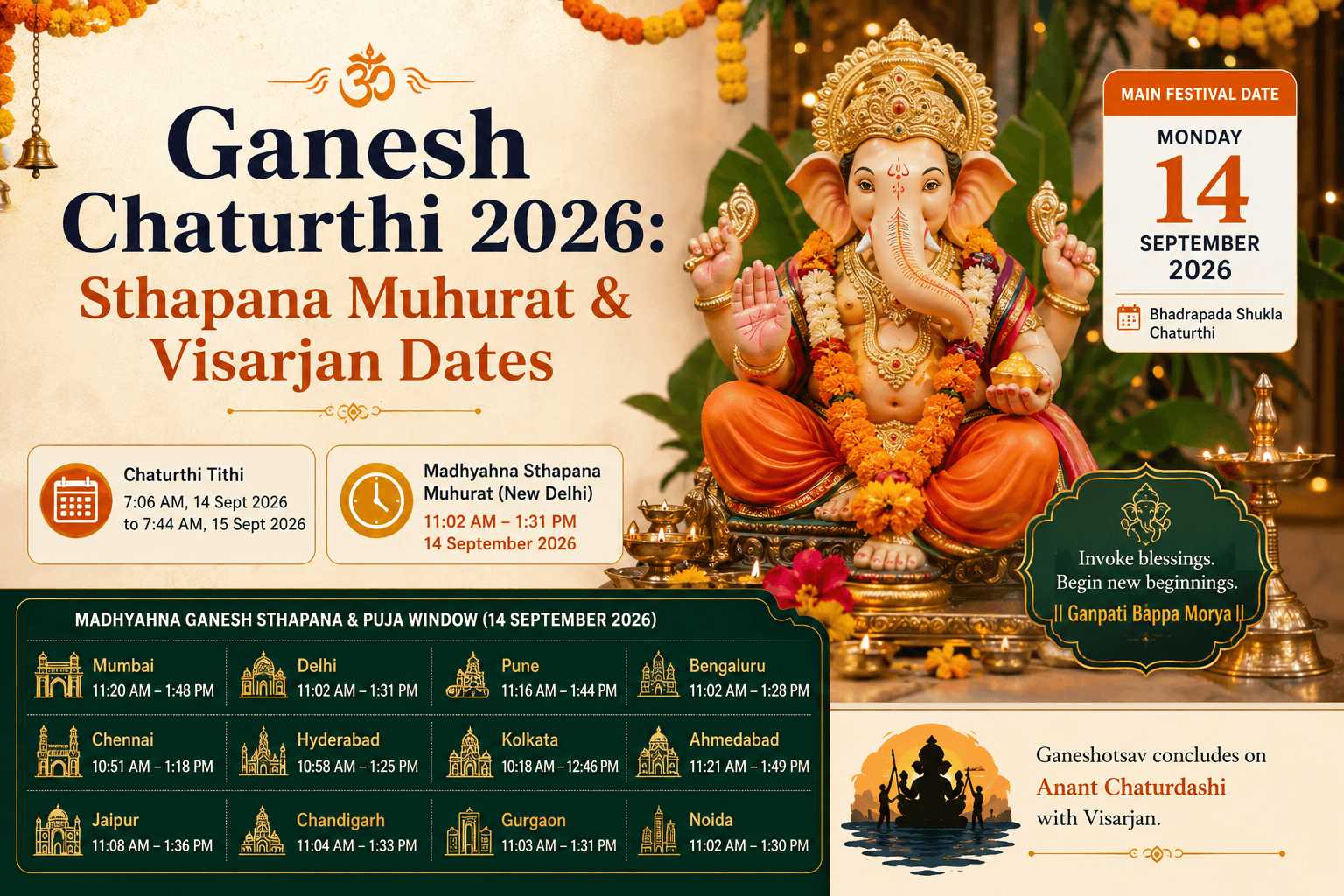
Families and housing societies that are ready to book pandals, priests, music or transportation for immersion can note Monday, 14 September 2026 as the main Ganesh Chaturthi date in India. This is Bhadrapada Shukla Chaturthi, which is the lunar date traditionally chosen for Ganesh Sthapana as well as the start of Ganeshotsav.
According to the panchang reference for New Delhi, the Chaturthi tithi will last from 7:06 AM till 7:44 AM on 15 September and the preferred time for Madhyahna Ganesh Sthapana and puja will take place between 11:02 AM and 1:31 PM on 14 September. Since the tithi exists during Madhyahna on Monday, 14 September will be the main observance day.
Ganesh Chaturthi is marked as a holiday on 14 September in the 2026 calendar of the Supreme Court of India. That does not mean it automatically becomes a public holiday across the country, so it is wise to find out whether your state, employer or educational institution declares this day a holiday or not.
Chaturthi Tithi and Madhyahna Sthapana Muhurat for major Indian cities
Tithi stands for the lunar day and can start or finish at any clock time during the day. Madhyahna is considered the midday of Hindus in terms of invocation of Lord Ganesha. Sthapana must be commenced during the time of Chaturthi and local Madhyahna overlapping for best results. The altar has to be prepared in advance, so that the main rituals can be performed within the time of necessity.
Approximate Madhyahna Ganesh Sthapana and puja windows for major Indian cities on Monday, 14 September 2026 (IST).
Mumbai: 11:20 AM – 1:48 PM
Delhi: 11:02 AM – 1:31 PM
Pune: 11:16 AM – 1:44 PM
Bengaluru: 11:02 AM – 1:28 PM
Chennai: 10:51 AM – 1:18 PM
Hyderabad: 10:58 AM – 1:25 PM
Kolkata: 10:18 AM – 12:46 PM
Ahmedabad: 11:21 AM – 1:49 PM
Jaipur: 11:08 AM – 1:36 PM
Chandigarh: 11:04 AM – 1:33 PM
Gurgaon: 11:03 AM – 1:31 PM
Noida: 11:02 AM – 1:30 PM
The given timings and references are just an approximate guideline. Sunrise with its longitude and timings of the local Panchang can alter the timing by a few minutes. Hence, it is wise to check the local Panchang closer to the celebration date zone.
Read more https://www.hiastro.in/blog/raksha-bandhan-2026-date-shubh-muhurat-and-bhadra-timing
Ganeshotsav 2026: Festival Calendar and Visarjan options
Ganeshotsav starts on Monday, 14 September 2026, with Ganesh Sthapana. The festival ends on Friday, 25 September, Anant Chaturdashi. According to tradition, the festival lasts ten days, but tracks for Ganeshotsav indicate the festival will run for 12 days in 2026 due to differences in tithi and Gregorian dates.
The festival tithi sequence starts from Chaturthi going through Panchami, Shashthi, Saptami, Ashtami, Navami, Dashami, Ekadashi, Dwadashi, Trayodashi and Chaturdashi. Even though the time of change varies, the festival is known to last ten days. It is advisable to use civil dates for making bookings and Panchang for keeping track of tithis.
The option of same-day Visarjan on September 14 is ideal for quick ceremonies where the installation process takes less time. A 1.5-day installation will conclude either in the late afternoon or the evening of September 15. The traditional options of the 3rd, 5th, and 7th day will take place on September 16, 18, and 20, respectively. Most large mandals will continue celebrating until Anant Chaturdashi on September 25, but the duration may vary by family or region.
Working families may choose either a 1.5-day or a weekend-friendly 7th-day Visarjan, while communities may select a date based on the availability of volunteers, crowd capacity, and local immersion dates. Determine the length of the event before bringing the idol home and inform everyone about the aarti and leaving times.
Home Ganesh Sthapana and daily puja routine
Ensure that you prepare all necessary materials for a basic home Sthapana ceremony ahead of time so there is no need for unnecessary rushing during the Madhyahna muhurat.
• An image of Ganesh and a stable chowki or platform
• A clean red or yellow cloth
• A kalash, water, coconut and leaves specific to your ritual
• Turmeric powder, kumkum, sandalwood paste and akshata
• Janeu, durva grass and flowers
• Agarbatti, diya with oil or ghee and camphor for pooja
• Fruits, sweets and offerings
• Items of puja dhyaan and bell, and a clean plate for offerings.
• Panchamrit and additional items.
The Sthapana steps can be modified according to what one knows about their family traditions, but these can be followed in general:
Preparing and purifying the puja area
It is important to clean the space where the idol will be kept. Set up your covered chowki or platform so that all that remains to be done during the Madhyahna will be the puja when it is being performed.
Place the idol in a safe place and light the lamp
Put the Ganesh idol on the cloth-covered platform in such a way that it is well-stable and overlooks the direction that your family follows. Light the lamp and the incense sticks carefully.
Take a simple Sankalp
With hands in prayer you should say the simple sankalp giving information on the occasion, place, time and duration of the events and asking for the family and guests blessing.
Invoke God Ganesha and offer him some water or symbolic bathing
You should invoke Ganesha according to your family practice. You may offer some water for the idol and carry out abhishek or symbolic bathing with clean water or Panchamrit in case it is needed and necessary.
Put tilak and open other upacharas
First of all, you need to apply sandal paste, turmeric and kumkum to the idol and present akshata. Then you have to take janeu and offer durva grass and flowers.
Offer naivedya and drinks
Offer fruits, modak and/or other sweets as naivedya before the deity, along with water or milk depending on your customs. Keep the naivedya covered and clean until you finish the aarti ceremony.
Chant mantras or stotras and do the aarti
Recite a known Ganesha mantra or stotra like Ganapati Atharvashirsha or the simple repetition “Om Gan Ganapataye Namah”, then do aarti using your lamp and all the people present chant along with you.
Wrap up with pranam and prasad distribution
Bow down before the idol, say your individual prayers internally, and give prasad to all those present there. If the diya is not to be kept lit, extinguish it properly.
In a daily puja, make it simple: refresh the water and flowers, offer durva or other renewable leaf, safely light the lamp, offer naivedya and do the morning/evening aarti/conclude with pran pratishtha.
Read more https://www.hiastro.in/blog/janmashtami-2026-nishita-puja-time-and-fasting-rules
Planning Ganeshotsav in housing societies and community mandals
A schedule for a society should distinguish between auspicious timings for events and any public events. The Sthapana should be completed during Madhyahna and daily poojas can be performed at any time that is suitable to school students, working people, and aged persons. Different timings can be chosen for events, distribution of meals and putting on louder music so that the puja is not disrupted or other households are affected by noise.
Get the timing for Visarjan confirmed before sending for quotations of the vendors or booking sound system, decorators, or the vehicle.
Different named teams should be assigned for checking electrical connectivity and wiring, fire extinguishers and emergency exits, crowd control, food hygiene and first aid.
For large mandals it would be better to act in coordination with municipal and police authorities for seeking permissions and for managing traffic and noise levels at the time of immersion instead of relying on casual arrangements of previous years.
The schedule of aartis, queues and official ceremony arrangements should be shared beforehand.
Moon-sighting tradition and 2026 Chandra darshan caution
According to tradition, worshippers should avoid looking at the moon during Ganesh Chaturthi. This belief comes from a story about the moon making fun of Lord Ganesha and is connected with Mithya Dosha, or the fear of being falsely accused. Another story associated with this belief relates to the incident involving Krishna and the Syamantaka jewel. The experience is regarded as a tradition, but not a warning of imminent danger.
It is important to keep in mind that the times of moonrise and moonset depend on location and are meant as an approximate guidance only. You should consult the Panchang or your family priest concerning the local time for Chandra darshan on the day of the festival, but usually closing the curtains during Chandra darshan hours is sufficient.
If you see the moon by mistake, you should act in accordance with the tradition and either pray to Lord Ganesha or listen to or recite the Syamantaka story or Ganesha hymn.
Eco-friendly Ganesh idols and Visarjan for 2026
Use an uncolored terracotta or Shadu Mati statue if you can find one. Avoid plaster of Paris and plastic; and avoid paints too. Use reusable fabric or paper or flowers or leaves or existing décor instead of using thermocol or plastic items. Buy the minimum amount of prasad that can be distributed without leaving behind any leftovers as dry and wet waste.
Medium-sized idols can easily be immersed in household containers, if allowed by local laws. The idol can be left to dissolve, the water collected may be used for watering non-eating plants, if the components used are qualified as natural; flowers and leaves can be sent to compost rather than be thrown away.
Create a controlled environment for immersions; make use of controlled queues, designated immersion spots, and usage of approved transport. Keep the decorative articles away from water bodies, and avoid unnecessary noise and using generators during the immersion. Make sure to keep the bins labeled clearly for easy disposal.
Panchang timings can vary slightly by city, calculation method and religious tradition. Confirm local muhurats and moon timings close to the festival, follow your family priest where customs differ, and comply with 2026 municipal rules for processions, noise, waste and immersion.
Frequently Asked Questions about Ganesh Chaturthi 2026
What would you do if you could not perform Sthapana on Madhyahna?
Madhyahna is the best time to perform the task, but if you could not do it, it does not put an end to your celebration. Consult your priest about other times that can be chosen as long as Chaturthi tithi is ongoing, and make sure they are appropriate for your family’s custom. Get the setup ready in advance so only the actual installation and puja are left to do.
Will Ganesh Chaturthi 2026 take place in January or September?
The Main Ganesh Chaturthi of Bhadrapada falls on September 14, 2026. What we refer to in January are the dates of Ganesh Jayanti or a time when Vinayaka Chaturthi is celebrated. So, they have nothing to do with the main festival.
When should the Visarjan be held to make it easier for working family members?
Holding a 1.5-day Visarjan on September 15 is a good option as it helps keep the process short. If, however, it’s easier for relatives and school children to participate, one can opt for a one-week Visarjan on Sunday or September 20.
Is the day of Ganesh Chaturthi a public holiday in India?
The 14th of September does appear on the Supreme Court of India’s holiday list for 2026 however the information on whether it is a public holiday differs by state, school or employer. So do not take a national holiday for granted and confirm about the holiday from your local calendar and apply for leave accordingly if the puja happens in the daytime.
How can someone outside the cities mentioned in the list check for the muhurat?
Use a Panchang according to your own town instead of finding the one nearest to a metro city. You must first check the local Chaturthi tithi and the Madhyahna timing for your area and then follow your local practices as well as that of your priest, if they seem to vary from what is mentioned above.