


HiAstro Insights
Hartalika Teej: The Festival That Remembers Parvati’s Choice
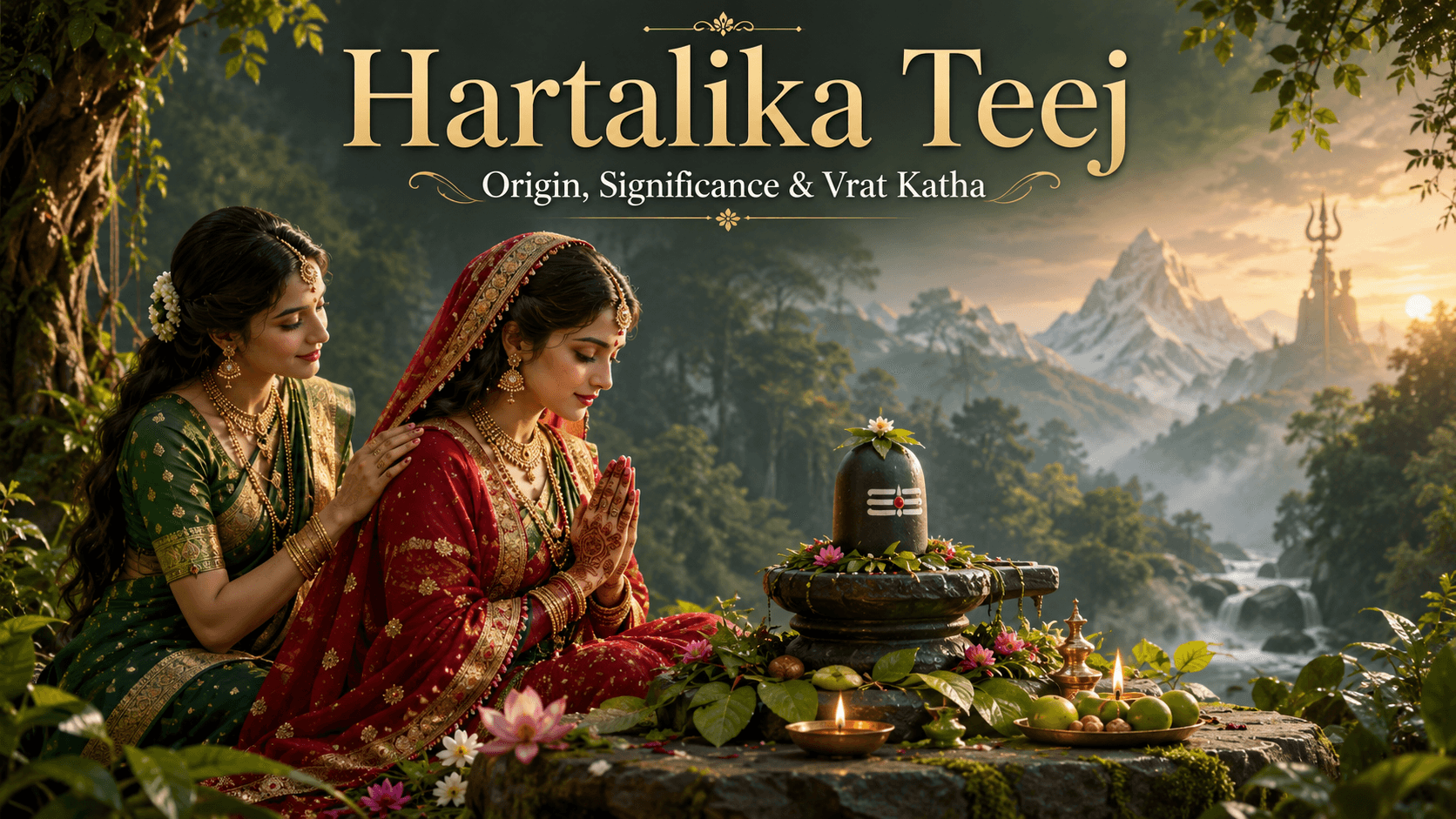
Hartalika Teej is often considered to be a fast done by women for a happy marriage and healthy husbands. This may be one of the major aspects of the celebration, but it does not show the most interesting part of the whole story. The festival does not start with a wedding; it starts with the refusal of Goddess Parvati to give up on her long-cherished decision and her female friend who helps her defend it.
Thus, Hartalika Teej is not just a festival of marriage but also a story of perseverance, friendship, patience, spiritual discipline, and refusal to betray one’s principles.
What Is Hartalika Teej?
Hartalika Teej is observed on Shukla Paksha Tritiya, the third lunar day of the bright fortnight of the Hindu month of Bhadrapada. Dedicated to Goddess Parvati and Lord Shiva, it is celebrated prominently across parts of North and Central India and in Nepal. It generally comes about a month after Hariyali Teej and often falls close to Ganesh Chaturthi.
Hartalika Teej, Hariyali Teej and Kajari Teej are part of the same Teej family in terms of festivities but distinguishable celebrations. The day has a special religious significance as this vrat is associated with the story of Parvati’s tapasya and commitment.
Why Is It Called Hartalika?
The name refers to the part of the festival that people often forget to notice.
The name “Hartalika” is said to come from the words “harat,” meaning to take away, and “aalika—friend of a woman.” As the traditional vraa katha informs, Parvati’s friend took her to a forest when it became known that her father was going to marry her off to Lord Vishnu against her will. Her father thought that she had been taken away, and this fact made this event associated with the name “Hartalika”.
Thus, the name gives more meaning to the holiday. Besides Shiva and Parvati, the name also reminds about Parvati’s friend. The unnamed friend listens to Parvati when she tells her about her problems, and does not disregard her wishes or advise her to accept the decision of others. What she does is provide Parvati with a place where she could satisfy her beliefs. Thus, the holiday can also be regarded as a celebration of women supporting women.
The Origin Story of Hartalika Teej
It has been believed traditionally that Parvati made up her mind about marrying Shiva, but her father Himalaya was ready to take proposals from others. This news upset Parvati and she told her worries to her friend. The friend took her to a forest where Parvati could remain uninterrupted and continue her spiritual activities.
Parvati distanced herself from her home and went through an arduous period of penance, during which she worshiped Shiva intensely. Every legend has it that she made a Shiva linga out of sand or soil to worship her God. The latter was so much impressed by her dedication that he appeared before Parvati and accepted her as his future wife.
After some time Parvati came back home because her father agreed to her will. There is a saying “Parvati was on a fast to marry Shiva,” which makes this story sound like a tale of simple wish realization; however, there is much more to it than mere wish fulfillment. It is essential to note that Parvati not only realized what she wanted but also took necessary steps.
Read more https://www.hiastro.in/blog/navratri-2026-dates-colors-puja-vidhi-and-fashion-guide
The Deeper Meaning of the Hartalika Teej Vrat
In several families, females go through a strict fast while some follow a nirjala vrat that requires them not only to abstain from food but from water as well. Married women typically pray for the health of their husbands and the state of their marriage, while single women can ask for a worthy husband.
Nevertheless, the significance of vrat is not limited to what foods are avoided. Upavasa is often interpreted as “remaining close” and means becoming closer to God. Fasting serves the purpose of cutting off the routine distractions and moving one’s attention toward prayers and self-control.
For that reason, Hartalika Teej vrat can be employed to ask deeper questions:
What truly do I stand for? Do I make decisions based on enlightenment or exterior pressures? Am I ready to make an effort to pursue something worthwhile without becoming unbalanced emotionally?
With this understanding of the vrat practice, the notion of fasting changes from merely suffering hunger for the desired outcome, but instead becomes a tool for self-awareness and self-discipline in, and through, devotion. The rules of fasting practices differ among families and geographical areas. Children, pregnant women, the elderly, and people who suffer from different illnesses should not see nirjala fasting as proof of their faith. Instead, a modified version of fasting done under the relevant supervision/care would yield the same spiritual effects without jeopardizing health.
Why Are Shiva and Parvati Made from Sand or Clay?
One of the most remarkable aspects of the Hartalika Teej celebration is the people’s tradition of creating sand, clay or earth sculptures of the deities Shiva and Parvati. This celebration may include various rituals like offerings, prayers, the reading of the vrat katha, and an overnight vigil.
These sculptures bear great meaning. Parvati demonstrated her worship by using what nature gave her, being free from any expensive items and palatial temples.
The practice is very good at showing people that holiness can be attained in ordinary life. It is enough to have handmade idols and simple altars at home, along with genuine prayers.
The Meaning of Mehendi, Bangles and Shringar
Hartalika Teej is both serious and joyful in nature, with fasting being representative of discipline, and other parts of the celebration such as mehndi, bright dress, flowers, bangles and traditional shringar being symbols of luck and joy.
For example, green is described as being associated with the rainy season, revival and fertility, while red is a symbol of strength and good fortune in marriage. Songs, family gathering and regional traditions make a calm day of fasting and prayer filled with joy.
In Nepal, Teej is a culturally and religiously important holiday. Many women visit temples of Shiva (including Pashupatinath) wearing red dresses. Different customs also mean different styles of dress, and whatever is done by one devotee is not necessarily how other people will celebrate Teej.
Read more https://www.hiastro.in/blog/ekadashi-dates-in-2026-complete-vrat-calendar-and-purana-guide
A Festival of Marriage—or a Festival of Choice?
Marriage is a large part of Hartalika Teej; however, to regard this festival as just a "fast for the husband" is to reduce it to something that is almost unrecognisable.
As for the tale, Parvati recognises the path she wants to take and the man she chooses to be her partner. Shiva, rather than her looks, wealth or status, falls for her true self and determination.
To married worshippers, it may signal the connection as well as stability between a couple, and to the unmarried – wisdom in choosing the right partner instead of yielding to social peer pressure. Finally, the moral of the story for everyone involved is that any vital decision should be made with an open mind.
Why Hartalika Teej Still Matters
Might it be possible that the character people will remember from the story of Hartalika is not the king, or the marriage proposal, but the person who believed Parvati’s story? She reminds us that being supportive does not mean being loud. It is sometimes being there for someone to help them see what their own thoughts are.
Hartalika Teej symbolizes three forms of strength: the resolve of Parvati, the companionship of her friend, and Shiva’s recognition of her devotion.
The rituals of fasting, mehendi, pooja and joy bring to our attention the eternal truth that in order for faith to become effective, courage, perseverance and the presence of a friend are needed.
Frequently Asked Questions About Hartalika Teej
1. What does Hartalika Teej stand for?
Hartalika Teej is a festival of Hindu religion devoted to Goddess Parvati and Lord Shiva. The festival celebrates the devotion, spirituality and determination of Parvati in her objective of marrying Shiva. The festive occasion is celebrated on Shukla Paksha Tritiya, i.e. the third day of the bright fortnight in the lunar month of Bhadrapada.
2. What is the purpose of celebrating Hartalika Teej?
The festival is dedicated to the celebration of the principle of devotion and tapasya through which Goddess Parvati had been able to stay true to Lord Shiva despite pressure for marrying someone else. It is a special day for married women as they pray for peace, security, and well-being of their husbands while unmarried women hope to find a suitable life partner.
3. What does Hartalika mean?
The term "Hartalika" is derived from two words: harat meaning to take something away, and aalika meaning female friend. The legend behind the festival explains that the friend of Parvati had led her away to the woods so that she could avoid an unwanted marriage proposal and practice her worship of Lord Shiva instead.
4. What is the story of Goddess Parvati’s friend?
Upon learning about her father's proposal for marriage, Parvati confided to a close friend about her dismay. The friend was sensitive to Parvati’s plight and helped to guide her deep into the forest so that she could continue her meditation without being disturbed. This lesser-known aspect of the tale gives Hartalika Teej its significance as a celebration of solidarity among women.
5. Who can observe the Hartalika Teej vrat?
Traditionally, the vrat is performed by both married and unmarried women. Married women pray for a happy married life while unmarried women pray for a spouse. There are no restrictions on gender or marital status for prayer and dedication to the worship of Shiva and Parvati.