


HiAstro Insights
How Lord Ganesha Was Born: The Story Behind Ganesh Chaturthi
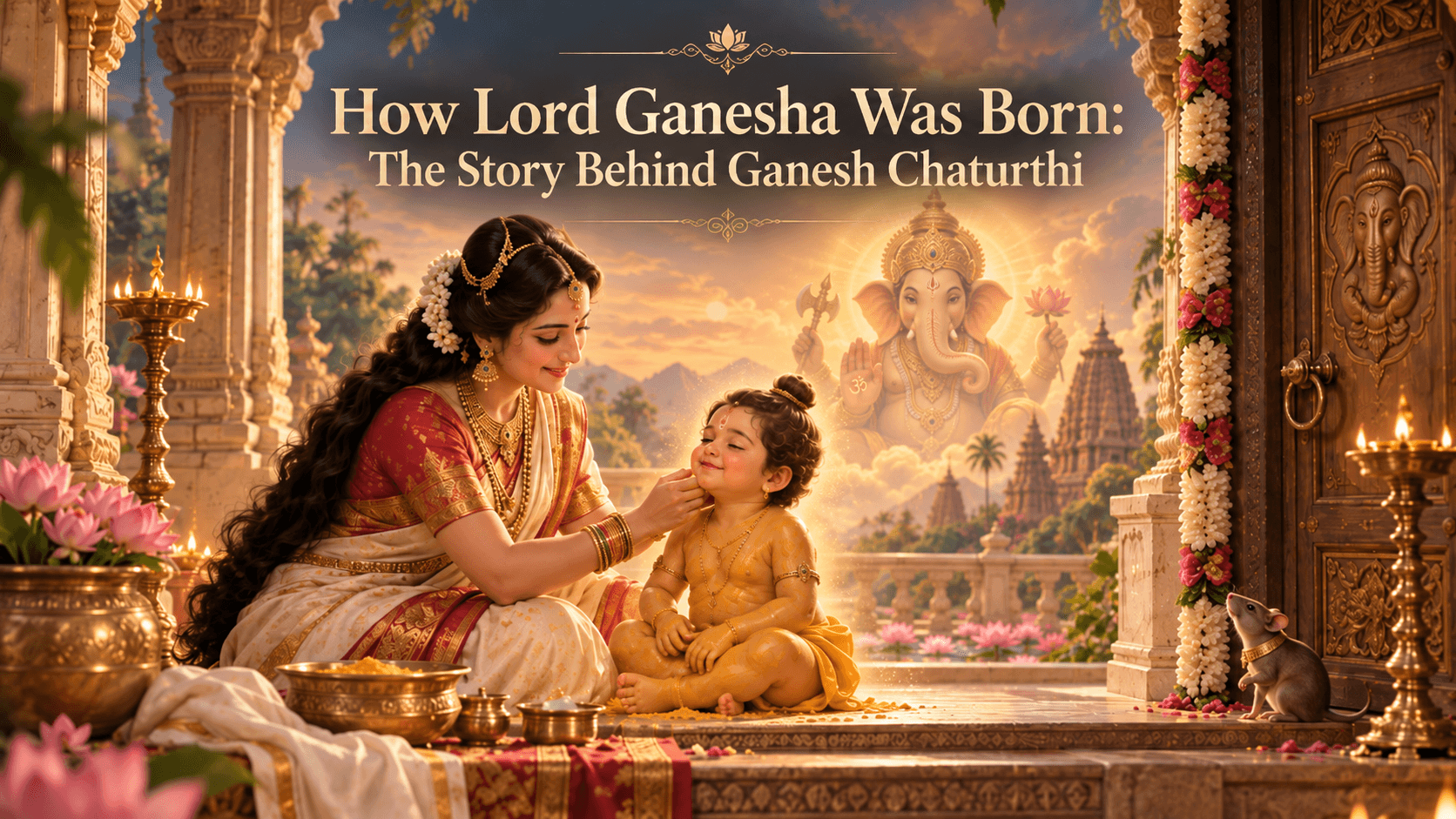
The expression of love and care for Lord Ganesha is seen every successive year. The family prepares a place for the idol of Lord Ganesha to reside, the craftsmen dedicate their effort to prepare the idol for Lord Ganesha, and the residents work to put up pandals for the festival celebrations. After a few days of celebration comes the day of visarjan where the idol is immersed into water.
But the question is, why do we welcome the Lord Ganesha and immerse him again?
This question answers the deeper meaning of Ganesh Chaturthi which is not only the celebration of the birth of Lord Ganesha but the significance of the birth, limit, knowledge, change of one’s life and significance of letting go.
Ganesh Chaturthi 2026 Date
Ganesh Chaturthi will be celebrated on 14 September 2026, which is a Monday. The date falls on the Bhadrapada Shukla Chaturthi day. The Ganesh Puja Muhurat in Madhyahna for New Delhi is from 11:02 AM to 1:31 PM. As the timings differ for Hindu festivals based on their sunrise time, people in other cities must check the Panchang of the timing according to their locality.
Read more https://www.hiastro.in/blog/ganesh-chaturthi-rituals-and-puja-prasad-and-visarjan
The Story Behind Ganesh Chaturthi
There are several myths regarding the birth of Lord Ganesha, which do not offer the same story. According to the most famous version of this story, Goddess Parvati gave birth to a son and instructed him to guard her door. Hence, when Lord Shiva came back, Ganesha refused to let him pass, as he was commanded by his mother to guard the entrance.
Ganesha lost his original head in a fight that ensued. In response to the pleas of his mother, Shiva provided Ganesha with the head of an elephant. This way, Ganesha was given life again and awarded with the title of Ganapati, meaning the “Lord of the Ganas,” and is recognised as the deity to be worshipped before important undertakings.
This tale is often recalled mainly as an explanation of Ganesha’s elephant head but the importance of the setting chosen for the story is great as Ganesha appears at a doorway which indicates that the doorway is the boundary between two spaces at the same time being a transition point.
The doorway separates two areas making it a point of transition between such notions as the outer world and the inner world, knowledge and lack of knowledge, intention and action, or the past and some new events.
Since Ganesha is the figure that appears at the threshold, he is therefore worshipped before people go on a journey, get married, make business deals, pass exams and take part in certain ceremonies or creative projects because before entering the new stage of life, one has to stop, comprehend and act wisely.
Why Is Ganesha Worshipped First?
Lord Ganesha can be referred to as Vighnaharta, who removes any obstacles and is the god of all good initiatives. His idols can often be found in the entrances or at the beginning of important activities and ceremonies.
However, praying to Lord Ganesha does not imply asking for a life without difficulties.
Sometimes overcoming obstacles is necessary, sometimes it is enough to go through them patiently. Sometimes it may be a challenge that prevents a person from making the most reckless choice. Ganesha represents the intellect that helps to see the distinction.
The blessing granted by Lord Ganesha can therefore be understood as having a clear plan of action, having a lot of patience, and being able to spot problems before they escalate.
The Meaning Hidden in Ganesha’s Form
Ganesha embodies diverse contrasting components: a giant elephant head, a human body, and a little mouse serving as a means of transportation. Ganesha’s form shows that wisdom should be seen as a combination of qualities rather than an ideal perfection.
The well-known interpretations of the symbolic meanings of the elephant head view it as a symbol of strength, remembrance, and great intelligence. Ganesha’s big ears show that one should be attentive while his sharp eyes are meant to symbolize concentration. The moveable nose can carry heavy items and perform nail-polished actions when needed.
The mouse (mushaka), Ganesha’s vehicle, is commonly viewed as a symbol of endless desire. The mouse can fit in the narrowest gap and so can the desire. His broken tusk is often viewed as a representation of sacrifice, patience, and readiness to accomplish a responsibility undertaking despite the imperfection of results.
Read more https://www.hiastro.in/blog/ganesh-chaturthi-2026-sthapana-muhurat-and-visarjan-dates
From Household Worship to a Public Festival
The worship of Ganesha has deep historical roots, but the communal aspect of Ganeshotsav acquired considerable significance in Maharashtra during the independence struggle.
In 1893, Lokmanya Bal Gangadhar Tilak contributed to the idea of converting Ganesh Chaturthi from a festival into a grand community celebration. Political meetings were under strict colonial regulations, and public Ganesh festivals provided a chance for ordinary people to gather, take part in performances, listen to speeches, and cultivate a sense of belonging among them.
This historical background shows that Ganesh pandal is not just a place of worship. Its purpose has extended to serve multiple functions, including a venue for different arts, education, and civic service.
As of today, many Ganesh mandals carry out charity activities, various awareness campaigns, and cultural contests. The festival shows how private beliefs become public responsibility.
Why Ganpati Arrives—and Why He Leaves
During Ganesh Chaturthi, the idols are placed at home as a guest of honour and worshipped in the family space, where worship, eating, and family life take place. Visarjan conveys the opposite message: while we may love a certain physical representation so dearly, we cannot hold on to it permanently.
The clay idol goes back into the water, while the devotion will last forever. Farewell is simply not understood as Ganesha going away; devotees request him to come back next year because the relationship continued beyond the temporary idol’s existence. Thus, in a sense, the festival symbolizes birth and death. It teaches everybody to be open to receiving happiness without expecting to keep it forever.
Traditionally, idols were created using clay and natural colours. In modern times, using natural materials is both environmentally responsible and signifies the original concept of something coming out of the Earth and going back into it later.
A Lesser-Known Detail About Ganesha’s Birth Festival
In India, Bhadrapada Ganesh Chaturthi is celebrated as the day of the birth or divine arrival of Lord Ganesha. In Maharashtra and the Konkan, however, Ganesha Jayanti is celebrated on Magha Shukla Chaturthi, which is observed as his birthday.
This brings about the conclusion that both traditions are not wrong; it only emphasizes the fact that religious calendars and traditions have made it possible to celebrate the same god in different ways.
The Significance of Ganesh Chaturthi Today
Ganesh Chaturthi continues to have its relevance because we keep starting something new every time – a new school, job, romantic relationship, business venture, home or any other goal that we are pursuing.
This festival helps us understand the importance of making wise beginnings.
For students, this means the importance of attitude in studying; for professionals – the importance of ethical behavior in achieving success; for families – the need for listening in order to have harmony and for communities – to learn that a celebration should promote unity instead of wastage.
Read more https://www.hiastro.in/blog/navratri-2026-dates-colors-puja-vidhi-and-fashion-guide
Frequently Asked Questions About Ganesh Chaturthi
1. What date is Ganesh Chaturthi in 2026?
Ganesh Chaturthi falls on Monday, September 14, 2026. The time of puja may differ from place to place, so it is advisable to refer to the panchang specific to the city for accurate timings.
2. What is the reason for celebrating Ganesh Chaturthi?
The festival is dedicated to the celebration of the birth of Lord Ganesha, who is regarded as the God of wisdom and new beginnings, prosperity, and the remover of all obstacles.
3. What is the significance of worshipping Lord Ganesha first?
Lord Ganesha is known to be the God of beginnings, and hence his worship before commencing anything signifies the importance of having clarity and wisdom before taking an action.
4. In what way does the elephant head of Ganesha work?
The elephant head is associated with wisdom, intelligence, memory, and deliberation. Besides, the elephant’s enormous ears also indicate the importance of listening.
5. What does Ganesha riding a rat mean?
The rat symbolizes impetuous desire and ego. Ganesha riding the rat represents wisdom and self-control in relation to these instincts.
6. What is Ganesh Visarjan’s spiritual meaning?
Visarjan demonstrates the idea of transience and returning physical matter to nature, meaning that the devotion is continued after the temporary idol is let go.