


HiAstro Insights
Janmashtami Origin and Significance: The Night Hope Was Born Behind Prison Walls
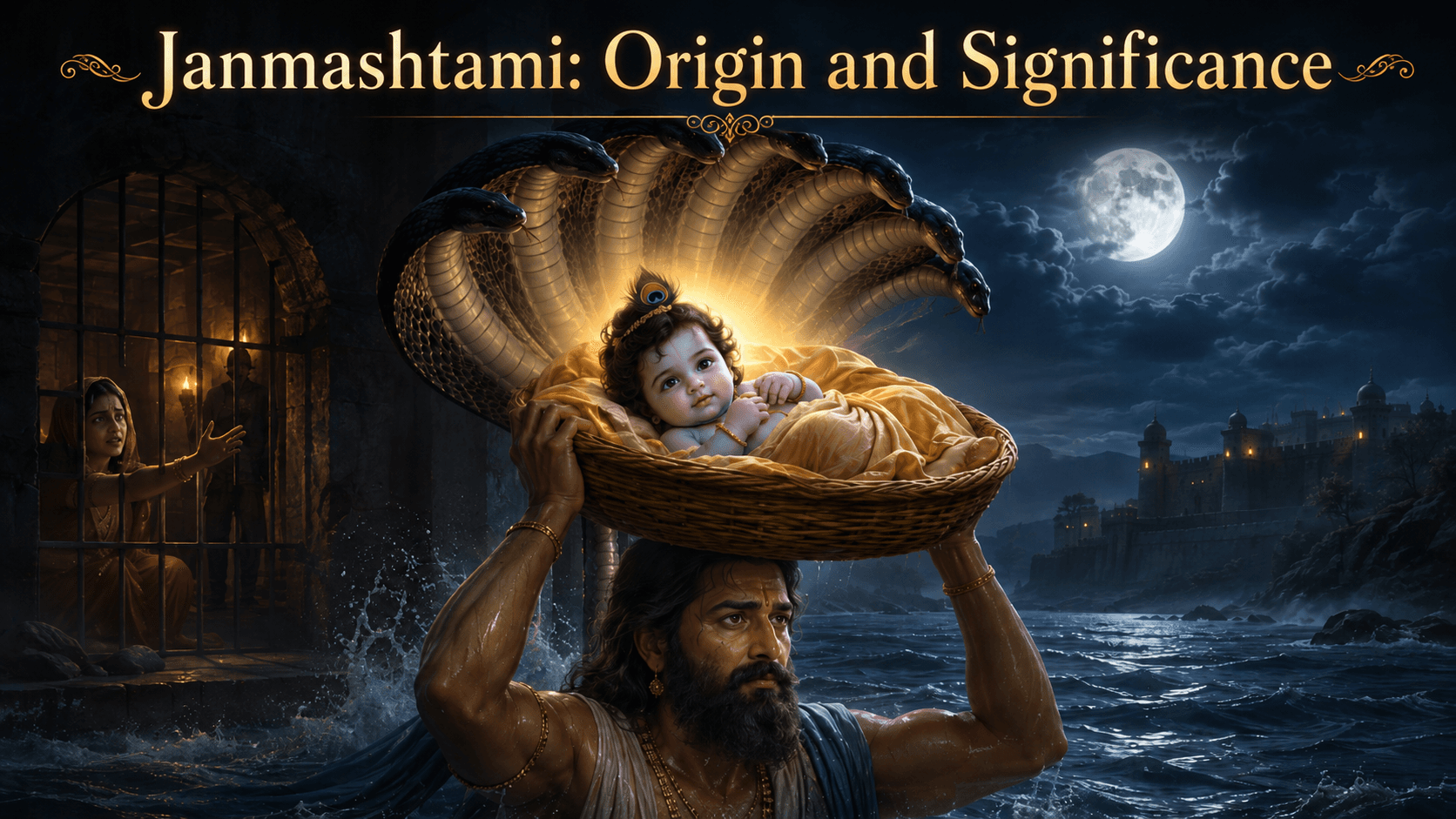
While some celebrations start with lights and music, Janmashtami commences in a prison. According to legend, when Mathura was asleep under the rule of Kansa, Devaki gave birth to Krishna in a locked cell at midnight. There was no grand celebration and very little hope that the baby would survive the night. That is what makes Janmashtami such a remarkable festival. While it involves the celebration of the divine birth, it also represents the birth of hope in a time of despair. The Bhagavata Purana describes how Krishna appeared out of the darkness of midnight while his parents remained in a dungeon due to Kansa’s imprisonment.
The Origin of Janmashtami
The term Janmashtami comprises two terms, janma, meaning birth, and Ashtami, which refers to the eighth lunar day. This festival marks the birth of Shri Krishna, whose famous biography is narrated in the tenth book of the Bhagavata Purana. The story of Krishna’s birth and childhood is still recited by devotees on Janmashtami.
The story of Krishna starts with a prophecy. Kansa learns that his cousin Devaki will give birth to a child that will defeat him. Such fear makes him a tyrant. He imprisons Devaki and her husband Vasudeva and kills all children born to them.
Krishna’s name is often associated with his being the eighth avatar of Vishnu. However, it is not widely known that some traditions of Vaishnavism regarded him not only as an avatar of Vishnu but also as Svayam Bhagavan—the deity in his original form.
Read more https://www.hiastro.in/blog/janmashtami-2026-nishita-puja-time-and-fasting-rules
Krishna Did Not First Appear as an Ordinary Baby
In most retellings of Janmashtami, a very interesting element is left out.
When Krishna appears in front of Devaki and Vasudeva for the first time, he does not look like an ordinary baby. In fact, in the Bhagavata Purana, we find out Krishna makes his first appearance in the luminous four-armed form.
Since Devaki is afraid that Kansa will find out that this divine being is actually their son, she urges Krishna to cover this extraordinary form and turn into an ordinary baby. Thus, Krishna agrees to her request and transforms himself into a child.
This moment is filled with a great sense of significance. God is not far from people. Krishna determines to be small. The omnipotent deity chooses to become an infant. The baby can be hugged, cared, and loved.
In this way, Janmashtami is the occasion that celebrates the closeness to God. People are reminded that divinity does not come to earth with a loud noise or imposing appearance. At times, divinity arrives silently in an innocent way and needs to be accepted with openness.
A Prisoner’s Offering That Required No Wealth
Another piece of interesting information about Vasudeva, who wanted to celebrate Krishna's arrival with donations of one thousand cows, but he was in jail and could not donate in public. So, he made this donation mentally. According to Bhagavata Purana, he mentally made a donation of ten thousand cows in Kurukshetra because Krishna appeared.
The above-mentioned episode shows us the important principle of faith.
Dedicating something means that you are grateful and are able to show your gratitude, no matter the conditions you live in. You might be poor, not free, not have enough time, etc. but this does not mean that you can’t dedicate something. Janmashtami shows us that your devotion is not in the procedure of dedicating but in the intention to dedicate.
Read more https://www.hiastro.in/blog/krishna-janmashtami-2026-date-puja-vidhi-and-how-to-celebrate
The Doors Opened—but Vasudeva Still Had to Walk
When Krishna becomes an infant, the jailers sleep soundly, and the doors open by themselves. Vasudeva takes Krishna in his arms and heads to Gokul. It is raining heavily. Shesha opens his hoods to provide shelter for the baby. The Yamuna river permits Vasudeva to cross to the other side. At the house of Nanda and Yashoda, the child is exchanged with the one born with the help of Yogamaya. Vasudeva comes back to the jail, the situation returns to what it had been.
The miracle is amazing, but so is the role of Vasudeva.
The doors are open, but it is still necessary to take the child. The way is possible, but it is necessary to cross the river. Everything is safe, but courage is required to act.
One of the spiritual lessons of Janmashtami can be that in some situations divine grace does not go all the way, but it simply opens a door, and we should be able to identify it and act further.
Why Was Krishna Born at Midnight?
The midnight hour in this story represents more than just a stage setting; it is the climax of dark hours, when discerning directions is hard and when most of the world is resting.
When Krishna is born at this hour it serves as a spiritual metaphor: the transformation could begin even before it is visibly revealed.
At the time of Krishna’s birth, Kansa was still the king. The prison walls have not fallen, Mathura was still under the rule of Kansa. The situation seemed unchanged in every way.
However, it was obvious that the future had already changed.
This is why it has some meaning that the bells, the conches and the bhajans start at midnight. People are not just announcing that the child is born. They are telling that the darkness has its limitations and adharma does not have the last word.
Later Krishna gives a similar reassurance in the Bhagavad Gita: as soon as dharma starts to decline and adharma becomes to thrive, the Divinity comes to restore the harmony.
The Deeper Significance of the Janmashtami Vrat
The Janmashtami vrat involves discussions that only revolve around what is to be eaten or not to be eaten. However, the real aim of the vrat is not to measure devotion in terms of hunger.
The term “upavasa” is interpreted as being close to the divine by giving up food. Giving up food serves to eliminate ordinary distractions and refocus the attention on Krishna through prayers, remembrance, scriptures, bhajans, and seva.
The intention behind the fast is more important than the elimination of food. An intense fast should not serve as an indicator of a higher level of devotion especially when the situation dictates a milder observation of the vrat.
The whole day spent waiting not only allows the devotee to get in tune with the overall emotional flow of the story of the birth. Janmashtami does not start with the celebration; it begins with waiting.
Thus, the devotee must wait just as the people in the narrative waited for the end of Kansa's reign. At midnight, waiting will turn into jubilation, silences into sounds and desires into darshan.
Thus, the vrat raises an important question that goes beyond fasting.
What can we put on hold in order to allow something holy to take place? It could be food, or it could be anger, gossip, distractions, ego, or even resentment. A person who avoids grain but remains in an irritated state all day long may have followed the diet but missed the significance.
Thus, the true Janmashtami vrat is not simply a fast for one's stomach but for one's whole bearing.
Read more https://www.hiastro.in/blog/ganesh-chaturthi-rituals-and-puja-prasad-and-visarjan
Why Janmashtami Still Matters
There was much to come in Krishna’s life: the mischief of Gokul, the friendship with cowherds, the courage of a hero, the political skills of a statesman and the wisdom of the Gita. However, Janmashtami takes us to the very beginning.
It shows us an infant in chains.
That image embodies the festival. The festival speaks to anyone who has experienced the feeling of being imprisoned by anything—fear, circumstances or doubt. The festival teaches us that freedom happens before physical release takes place.
It teaches us that courage is carrying one’s child through the pouring rain while devotion exists without possessions and that great power can be unleashed silently.
Thus, when families put Laddu Gopal in a cradle, sing the song when the clock strikes midnight or follow the fast on the day of Janmashtami, they are not only performing a ritual. They are welcoming an eternal truth:
Even in the darkest hour, a new beginning can be born!