


HiAstro Insights
Krishna Janmashtami 2026: Date, Puja Vidhi & How to Celebrate
Working life, school life, bedtime duties, and members of the family's customs make it difficult to prepare for the festival of Janmashtami. One should start by fixing the festival date and local observance before planning a celebration.
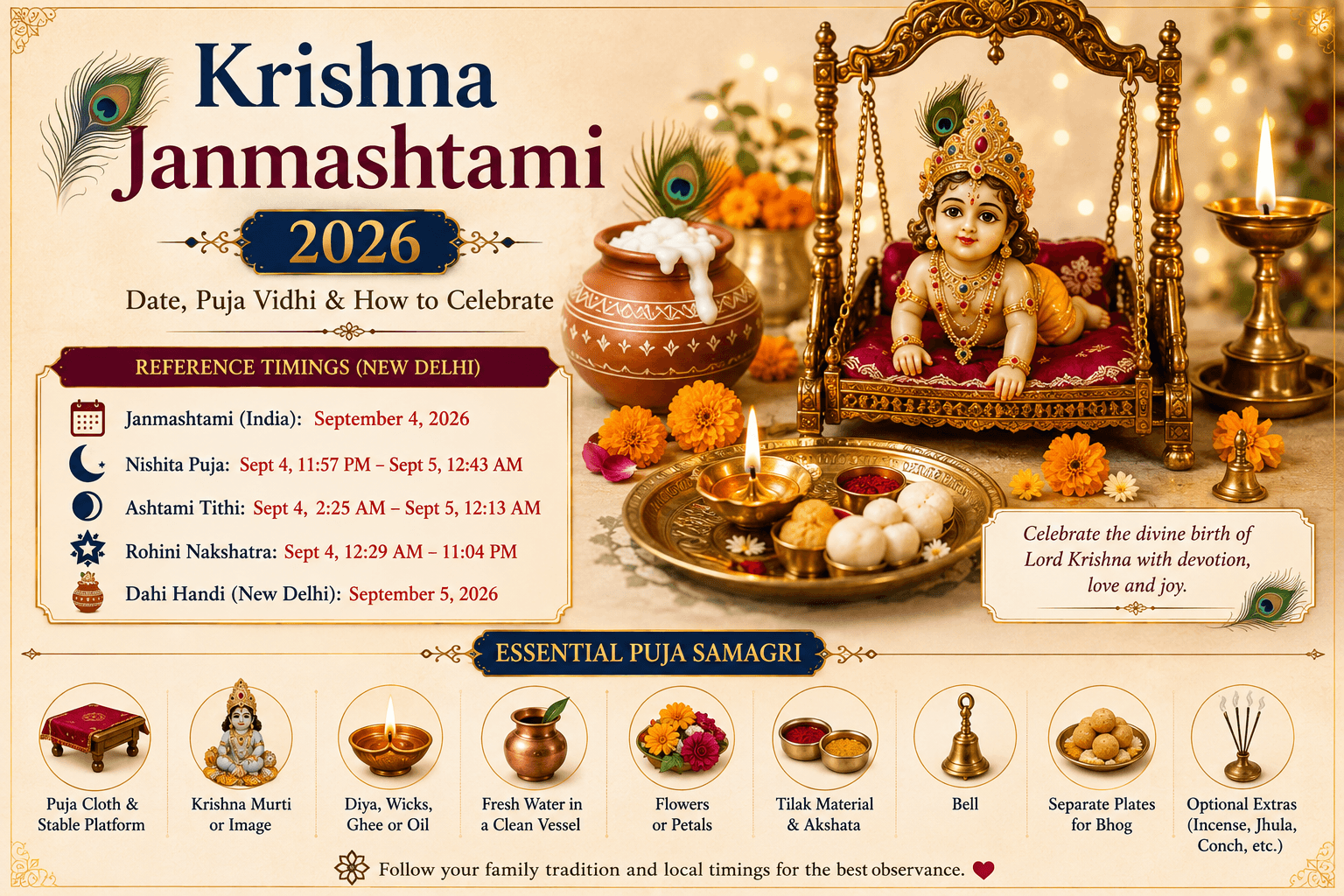
The timings below are provided in New Delhi time for the celebration of Krishna Janmashtami 2026.
Krishna Janmashtami (India): September 4, 2026
Timings for Nishita Puja: September 4, from 11:57pm to September 5, 12:43 am
Ashtami tithi: September 4, from 2:25 am to September 5, 12:13 am
Timing of Rohini nakshatra: September 4, from 12:29 am to 11:04 pm.
Dahi Handi (New Delhi): September 5, 2026.
The timings provided above are only for New Delhi and they differ for every place. Most temples and sampradayas have their own method of observance. For further details of Nishita timings, vrat, and parana, please follow the HiAstro blog titled “Janmashtami 2026: Nishita Puja Time and Fasting Rules.”
Krishna’s Birth Story and the Meaning of Janmashtami
According to Hindu scriptures and traditions like the Bhagavata Purana and Vaishnava stories, Krishna was born to Devaki and Vasudeva when they were imprisoned by his evil uncle, King Kamsa, in Mathura. Vasudeva saved his son by carrying Krishna across the river Yamuna to Gokul, where he was raised by Nanda and Yashoda. Janmashtami, an important festival, commemorates this divine and significant birth of the lord Krishna.
The variances in celebratory practices stem from the fact that the festivities comprise devotional rituals and the offering of love to Krishna and his child form, Bal Gopal. The devotees sing the Krishna katha, rock their decorated and bejeweled cradle on Janmashtami and, therefore, celebrate the birth of the God at night. Some temples are known for performing elaborate abhishek, few temples give importance to the singing of bhajan, while some people offer only flowers, fruits and an aarti, indicating that worshiping devotion is all about the heart of the devotee.
Preparing your home, samagri, altar and jhula
Clean the puja area and choose a stable surface away from busy walkways, curtains and pets. Cover it with a fresh cloth and place a Krishna murti or framed image at a comfortable height. Keep lamps and incense where an adult can supervise them, and leave enough room to set down offering plates without reaching across a flame.
- Puja cloth and stable table or platform: Use it to cover and protect the altar area and keep the worship space clean.
- Krishna murti or framed image: Place it at a comfortable height as the central focus of the Janmashtami puja.
- Diya, cotton wicks, ghee or oil: Use these to light the main puja lamp under adult supervision.
- Matches or a lighter: Keep these available for lighting the diya and incense sticks, if incense is part of your family’s practice.
- Fresh water in a clean vessel: Keep water for offering to Lord Krishna and for simple purification rituals.
- Fresh flowers or petals: Offer them at the feet of the Krishna murti or use them to decorate the altar.
- Tilak material: Sandalwood paste, kumkum or another tilak material can be used according to your family tradition for the murti or forehead.
- Akshata (unbroken rice), if customary: Offer it with prayers or mantras as a symbol of wholeness and blessings, where your tradition permits.
- Bell: Ring it at appropriate points during the puja, such as during aarti or the main offerings.
- Clean cloths or towels: Keep these nearby for wiping hands, cleaning small spills and keeping the puja area tidy and dry.
- Separate plates or bowls for bhog: Use dedicated utensils for Krishna’s food offerings and keep them separate from everyday use until the bhog is distributed as prasad.
- Optional puja items: Incense, a conch, flower garlands, a Krishna jhula or abhishek ingredients can be included according to your family tradition, provided they are safe and manageable at home.
For a safe jhula or cradle setup:
- Set the cradle on a flat and solid floor and make sure that the chains and other attachments are tight before putting any deity in the cradle.
- Use only light flower garlands and decorations for this purpose which would not weigh down on the murti or cover up its face.
- Remove any beads, sharp objects, small coins and other loose items if the cradle is in close proximity to young kids to minimize choking risks.
- Let an adult handle the cradle while the children gently rock it to avoid any accidents and keep the cradle in its position.
A Simple step-by-step Janmashtami Puja at Home
Use this straightforward home sequence in the evening, adjusting the start time to your local observance.
Prepare yourself and settle the altar
Bathe or wash your hands and face, change into clean clothes and gather near the prepared altar. Make sure the lamp, matches, offerings and seating for family members are all within easy reach.
Light the lamp and make a simple sankalpa
Have an adult light the diya safely. Remember Ganesha, your guru or family deities according to custom, and state in your own words that you are worshipping Shri Krishna with devotion on Janmashtami. Invite everyone to sit quietly for a moment.
Offer water, tilak and flowers to Krishna
Offer a little fresh water in a spoon or small vessel, then apply sandalwood paste or your family’s tilak material and place flowers or petals near the murti or picture with respect.
Offer incense (if used) and the lamp
If your household is comfortable with incense, wave it gently before Krishna and place it in a safe holder. Then move the lit lamp in small circles as an offering, keeping cloth and hair away from the flame.
Include optional abhishek if appropriate for your murti
If your tradition allows and the murti’s material is suitable, you may perform a brief abhishek here. Use only small amounts of clean water or other permitted liquids and keep the area dry and safe. If there is any doubt about material or hygiene, skip the bathing and continue with dry offerings instead.
Dress and seat Bal Gopal, then offer bhog
Gently dress Bal Gopal, place the murti or picture securely, and set the prepared bhog in front. Make sure nobody tastes the food before it is offered, and keep dairy dishes out of the heat while Krishna’s plate is on the altar.
Spend time in katha, japa or bhajans
Use the remaining time for reading or telling Krishna katha, repeating a mantra or singing a few chosen bhajans together. Let children clap, ring a bell with supervision or join simple refrains so everyone participates.
Welcome Krishna’s birth and perform aarti
Welcome Krishna’s birth at the selected place/set up for worship. If you have a jhula then gently swing the cradle to celebrate Krishna’s birth and also perform aarti with a diya. The celebration should end with pranam, a short prayer and offering of prasad according to the fasting practices being followed.
A family that cannot withstand the night must not orchestrate the rest of the evening around the weakness of the body. Parents can celebrate puja, sing one bhajan, and offer bhog before bedtime; even if the adults who wish to keep up may continue for the night. Elderly relatives and anybody who feels tired can do the puja earlier.
Also read about https://www.hiastro.in/blog/ganesh-chaturthi-2026-sthapana-muhurat-and-visarjan-dates
Optional Abhishek and Caring for the Krishna Murti
Abhishek is the act of bathing the idol, and it is up to the family to perform it at home. Bathe the idol only if you are sure it can withstand getting wet. A deity made of solid metal or stone is fine to wash, providing you are allowed in accordance with your tradition. However, if the figure is painted, made of clay or plaster, wood, fragile, glued together, or electrically illuminated, then it must not be washed. Never pour water upon a framed picture – instead, offer flowers or wipe the frame.
Make sure to wash your hands and have a clean bowl and spoon to prepare the required things for the ritual. Your tradition may dictate the use of one of water, milk or panchamrit, but you will need only a little quantity. It is very important to avoid extremes in temperature while you are performing the ritual. The idol must be securely held so that it would not slip. Avoid wet floors and bowls or trailing cloths in the access of children and electrical devices.
The cleaning process should begin only after the advice on caring for the murti says so and then every part of the Bal Gopal should be dried using a clean, soft cloth prior to dressing it again. Do not consume the abhishek water if it has come in contact with unhygienic surfaces for have a doubt concerning hygiene.
Dressing Bal Gopal and Decorating the Space
When you handle Bal Gopal, make sure to keep your hands clean and dry. It is advisable to hold Bal Gopal by supporting the image instead of lifting it by some part of the body like a crown or an ornament. One may dress Bal Gopal in different types of clothing like dhoti, angavastra, crown, peacock-feather ornaments, etc., as per the customs of the family.
Be careful while adding ornaments and taking other safety measures:
- Make sure to check for sharp wires, unstable stones, and tight elastics in the jewellery and crowns before they are worn.
- Keep pins, sequins, coins, etc. out of reach of young children.
- Avoid using synthetic fabrics and decorating with paper flowers and hanging ornaments when using a diya or fire.
- Though battery-operated lights may be safe, their wires and battery compartments should be kept dry.
Bhog, Prasad and the Midnight Aarti
Some common food offerings during Janmashtami are makhan-mishri, fresh fruits, milk, curd, kheer, panjiri and easy milk sweets that can be prepared by a family according to its traditions and type of diet that can be prepared in a clean way. Prepare the food and separate the part of Krishna so he could get food before anyone tries food, always making sure that none of the components of the dish are something that might be harmful for the family. You can always add tulsi in the offerings.
Make sure the offered food is put in front of Krishna and offered in a proper manner by either following a special ritual or just staying silent, as one’s earnest request to Krishna is enough for him to accept food.
After offering the food for a certain amount of time, the food should be treated as prasad. Food should be kept in a cool place and you shouldn’t forget about the fact that allergens should be marked by you for safety in sharing sweets.One of the adults can perform aarti while the family sings.
Bhajans and mantras for a family celebration
Choose a few chants that everyone can repeat rather than assembling a long programme. This keeps the atmosphere focused and relaxed, especially when you are managing children or elders at home.
Accessible options many families use on Janmashtami include:
The Hare Krishna maha-mantra: “Hare Krishna Hare Krishna Krishna Krishna Hare Hare, Hare Rama Hare Rama Rama Rama Hare Hare”.
“Om Namo Bhagavate Vasudevaya”, a short mantra honouring Krishna as Vasudeva.
Bhajans such as “Achyutam Keshavam” that describe Krishna’s names and qualities.
Simple call-and-response songs like “Govind Bolo Hari Gopal Bolo”, which children can echo easily.
Families less familiar with Sanskrit can listen to one line and repeat it slowly, read a transliteration or sing Krishna’s names in the language used at home. Children can clap a simple rhythm, ring a bell with supervision or lead a response after each line. Clear pronunciation is helpful, but worship does not stop because an accent or tune is imperfect.
Celebrating with Children and in the Diaspora
It is important to engage children with tasks that match their age; this includes activities such as arranging unbreakable flowers, painting pictures, making paper crafts, leading washable footprints to the temple, or listening to the birth of Krishna. A short puja with children can create stronger memories than forcing children to stay awake when they are tired. Children should not be forced to fast or handle hot objects, heavy murtis or tiny ornaments.
Households in countries outside India may follow the routine that incorporates the work week, school, and temple programs. Follow the tithi and worship hours suitable for your region and not adopt another city’s timing. A temple may have a celebration time based on the local Panchang calendar and availability of participants, so you should check its calendar before making travel arrangements.
The language can be flexible. Tell the story in the language that children understand, provide transliterated mantras, and invite people from other time zones to participate in a video call at an earlier time.
Checking local Panchang timings for your city
Tithi, nakshatra and Nishita Kaal are location-sensitive, so clock times can differ from the New Delhi reference even within India. HiAstro’s city-specific Panchang can serve as one planning aid alongside your temple calendar and the guidance you already follow in your sampradaya. Select the correct city and civil date before finalising your puja schedule.
Check the Panchang when arranging your local evening plan. If you need a fuller discussion of Janmashtami timing, vrat or parana rather than home-puja preparation, read HiAstro’s dedicated “Janmashtami 2026: Nishita Puja Time and Fasting Rules” article alongside your local temple announcements.
Temple visits, Dahi Handi and event safety
While visiting temples, it is important to wear clean clothes and comply with guidelines for footwear, photography, and prasad. Also, avoid blocking the line for long periods. Select less crowded periods when bringing children or elderly persons, and agree with them where to meet in case of separation.
Dahi Handi reminds us of Krishna’s fun-loving nature about butter and is traditionally celebrated by forming human pyramids. Due to the popularity and potential risks of such celebrations, only go to occasions with clear indications of crowd-control measures, and stay behind the crowd control measures and follow the orders given by the host and local authorities.
Never join an ad hoc human pyramid nor participate in improvisation, especially if someone is trying to get a child into a pyramid. Wet ground, hanging wires, fragile piers, and crowded places can be dangerous. Risky human pyramids are not a practice related to worship, and if the conditions are not safe, it is better to watch the festival from far away or from a temple celebrating the event.
Choosing a fasting approach that respects your health
Fasting may be done, and fasting methods may include anything from not fasting at all and eating two vegetarian meals a day to follow family traditions of phalahar, or a partial fast. Fasting means one must drink water, so the body functions properly. This article does not advise anyone to do dry fasting, nor should young children fast.
If one has diabetes, it is essential to plan the fasting during religious rituals with doctors, especially for diabetes patients who use insulin or medication that can be affected by not eating. According to NIDDK, there are multiple risks such as hypoglycemia, hyperglycemia and dehydration, while it is important to remember that any changes in medication medication have to be guided by a professional doctor. It is important not to change crucial medication without permission from a physician.
People who are pregnant, have children of some age, are older than 60 years of age or have any disease can opt for no fasting or modify the fasting practice in any way as long as they are guided by medical professionals.
Frequently asked questions about Krishna Janmashtami 2026
Why is Janmashtami celebrated differently in some temples?
While temples might follow a certain sampradaya or local Panchang calculation, etc. The fact that there is a difference does not imply that one way of observing Janmashtami is any less appropriate than the other. Follow the calendar followed by your temple or family as per your location.
Is it possible to celebrate Janmashtami without an idol?
Yes, one can simply place a clean framed picture of Krishna on the altar and perform the puja with the help of the necessary items like lamps, flowers, bhog, mantras, and aarti. Avoid putting liquid offerings on the picture; keep the ritual simple so that it is mostly symbolic.
Can women perform or lead the home puja?
Women also can participate in the ritual, prepare the bhog, sing during the ceremony, or lead the whole procedure depending on their home traditions. Even though individual roles might change, local regulations should not be considered a general rule for Janmashtami.
What can I do with leftover prasad?
You may share some prasad with family or friends that abided by food safety protocol. Dairy items should be kept cold. Use proper serving utensils and discard spoiled food immediately.
Is it acceptable to perform puja at home and visit the temple after that?
Families usually perform home puja and also go to the temple for darshan or bhajan separately. You should check out the temple for entry procedures and ensure the day is not crowded with young kids and older relatives.
Do I need to fast and stay awake until midnight for Janmashtami?
No, there are no general rules governing every family. ISKCON has midnight puja while families are free to do whatever they want. A family with small children is welcomed to worship earlier. If you are diabetic or on any medication, you should consult your doctor before fasting.
Plan Your Janmashtami Puja Around the Local Panchang
The celebration of Janmashtami at home can become hassle-free as long as bhog and worshiping at midnight is well-timed according to the calendar timings of Ashtami and Nishita. HiAstro makes this possible by providing all the local information you need through its panchang before setting the jhula, fighting with family about the timings and beginning any puja.
For larger inquiries, get the AI-based consultations provided through the HiAstro service from Arcenia Tech Private Limited that can be accessed through the web as well as Android and iOS/iPadOS in Hindi, Hinglish and English.
Recheck your city's Ashtami and Nishita window before finalising the puja plan. Open the HiAstro Panchang