


HiAstro Insights
Raksha Bandhan: History, Significance, Rituals & Date
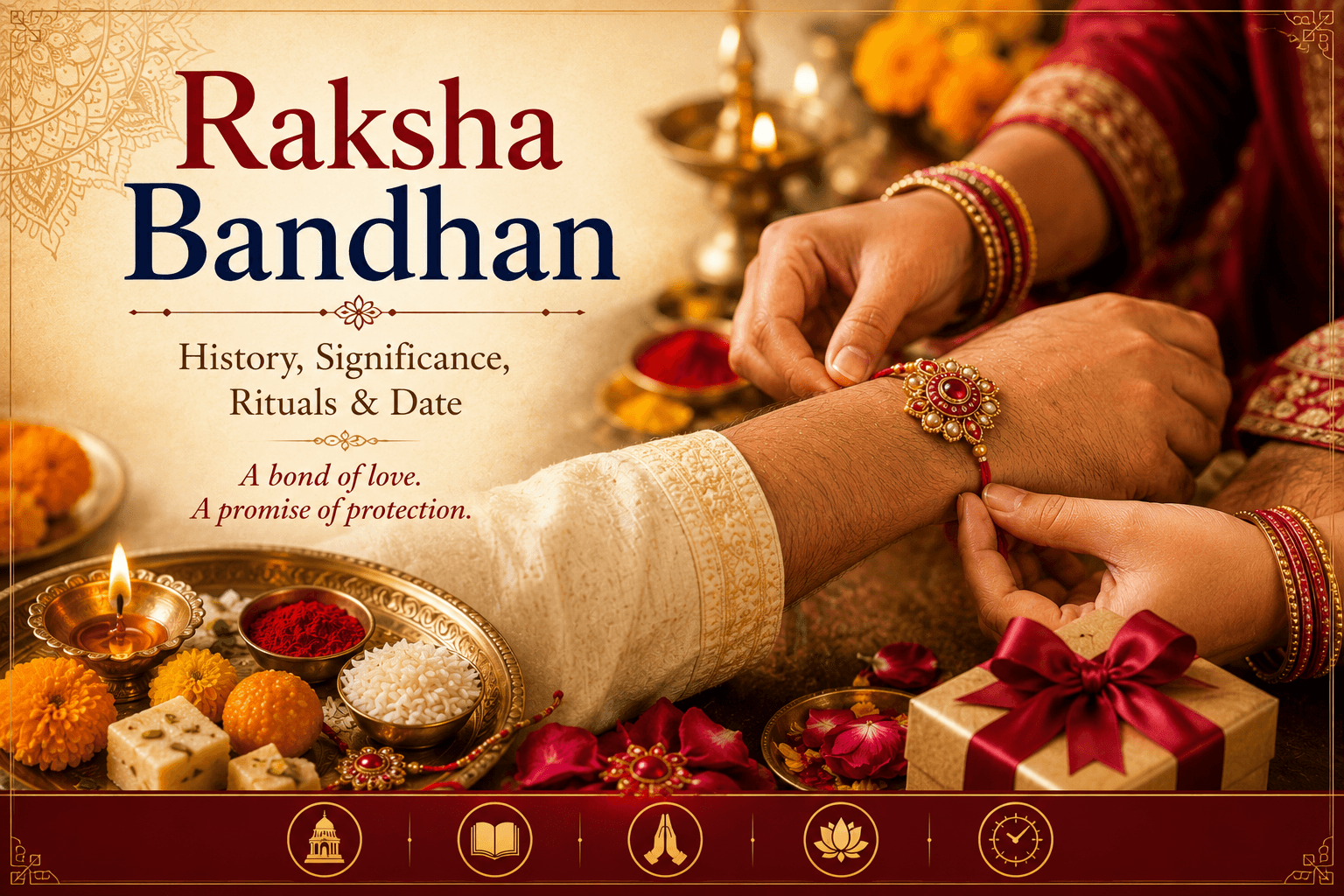
If you are coordinating leave, travel or a family video call, the date to mark is Friday, 28 August 2026. For New Delhi, the local Rakhi-tying window is 5:57 AM to 9:48 AM IST. Bhadra ends before sunrise, so it does not extend into that morning window. Readers who need a minute-by-minute Muhurat or Bhadra breakdown should consult a dedicated 2026 timing guide, such as HiAstro’s detailed Raksha Bandhan 2026 date, Shubh Muhurat and Bhadra timing article, rather than treating this short New Delhi answer as a universal schedule.
Raksha Bandhan is observed most visibly through the tying of a rakhi, or protective thread. The name combines ideas of protection and bond, but the ceremony is not only about the object. It expresses affection, responsibility, gratitude and a commitment to remain present for one another. Traditionally associated with a sister and brother, it now takes many forms across families and communities.
How Shravan Purnima sets the changing Raksha Bandhan Date
Raksha Bandhan takes place on Shravan Purnima, the full-moon day of the Hindu month of Shravan. The festival does not fall on the same day every year due to the discrepancy between the lunar and Gregorian calendars.
Tithi is a term used in the Hindu lunar calendar to represent the lunar day interval that is calculated using the longitudes of the Sun and Moon. Thus, a tithi may take more or less than 24 hours, which leads to a situation where it may start on one civil date and end on another. While celebrating Rakshabandhan, different countries' Panchang rules must also be kept in mind, as certain periods are not suitable for the celebration.
This is how there can be an apparent discrepancy in dates when two sources provide different dates for the beginning of Purnima and the date of Rakhi. The calculation of timing should take into account the time zone and timing of the sunrise in order to avoid misunderstanding between the timelines of New Delhi and Mumbai and that of London and Toronto.
Mythological Narratives Linked to Rakhi
Raksha Bandhan lacks a firm historical basis. The traditions it refers to are more numerous than just one. The account of Shachi and Indra is one of them. When Shachi binds Indra's wrist with a thread before the fight, the link between the binding and prayer, bravery and protective rituals can be made. However, that is not a story that may be compared to modern sibling or rakhi tales.
Another tradition involves the goddess Lakshmi binding King Bali as her brother before asking for his help in getting Vishnu back. The idea of brotherhood here becomes coupled with the idea of hospitality and kinship. The narrative of Krishna and Draupadi states how Draupadi ties Krishna's wounded finger and is later treated well by Krishna. However, this connection to present-day Raksha Bandhan is better treated as later religious explanations rather than the evidence of historical accuracy of the episode of its origin.
It can be concluded that the resulting body of stories enables a better understanding of why the holiday could mean safe, loyal, grateful, and preferring a partner to everybody else in life. However, these stories should be understood as the underlying beliefs and opinions shaping religious imagination.
From Protective Thread to Public Solidarity: Raksha Bandhan’s Social Evolution
An examination of the historical records suggests that the significance of using rakhis is visible in both the practices of siblings as well as the sacred relationships between priest and patron. The modern instance regarding the race has more to do with the tradition of rakhis rather than with one specific starting event. Rituals regarding protection and social responsibilities have evolved over the ages.
The opposition to the Partition of Bengal in 1905 saw a remarkable modern reinterpretation of the festival. Rabindranath Tagore suggested that both Hindus and Muslims tie rakhis to symbolise solidarity against colonial interventions. According to documents stored in the archives of the University of Oxford, Tagore’s use of Raksha Bandhan was intentional, while the descriptions of the partition refer to its inter-community aspects.
At present, the festival can have the same meaning of affection among siblings without the idea that protection can be claimed only by men. Brothers and sisters may undertake to support each other, sisters can tie rakhis to one another, and cousins, friends and acquaintances may participate, with the importance of the act lying in the relationships between those involved.
Rituals and Meaning for Families Today
A flexible Rakhi thali usually contains rakhis, roli or kumkum for tilak, unbroken rice grains, a small diya and sweets. Depending on household practice, it may also include flowers, incense, sandalwood paste or a small gift. A reusable plate and the items already used in your home are sufficient; there is no need to make the arrangement elaborate.
You can adapt the flow below to match your family’s customs, mobility needs and language.
1. Prepare the space and thali
Arrange the rakhis, tilak materials, rice, diya and sweets on a clean plate, and choose a comfortable place to sit together.
2. Begin with a short prayer or reflection
Light the diya if you use one, offer a simple prayer or silence, and set an intention of mutual care.
3. Apply tilak and rice
Place a small tilak on the recipient’s forehead and add a few rice grains as a blessing.
4. Tie the rakhi and exchange blessings
Tie the rakhi on the wrist, say personal promises or blessings, and offer sweets to one another.
5. Share gifts or tokens
If your family exchanges gifts, the recipient may offer a present or other token of affection; some families also perform an aarti or recite a short mantra, while others keep the moment informal.
The emotional exchange matters as much as the sequence. A promise might mean checking in during a difficult month, respecting a sibling’s decisions, helping an older relative or remaining connected across distance. Gifts can mark the occasion, but they do not replace the reciprocal care represented by the thread. Family custom, mobility needs and personal comfort can all shape the ceremony.
Also read about https://www.hiastro.in/blog/ganesh-chaturthi-2026-sthapana-muhurat-and-visarjan-dates
Regional variations, diaspora practice and long-distance Rakhi
Many rituals of Shravan Purnima vary from region to region and community to community. Narali Purnima, for instance, concerns coastal communities in the western part of India and is characterized by offerings related to the ocean. Upakarma is celebrated in multiple Brahmin communities, known as Avani Avittam in some southern traditions, as a revival of holy learning and the sacred thread. Meanwhile, in Nepal, Janai Purnima includes the changing of sacred thread and tying of protective threads around the wrist. These observances share a lunar date, though they are not equivalent to Raksha Bandhan, which focuses on sibling relationships.
Often, long-distance family members will send a rakhi through the mail and set up a video call to open the package together. If delivery takes too long, a brother or sister may opt to use a thread from home for the occasion and keep the rakhi in the mail as a memento. Digital greetings, audio blessings, and local gifts can help families with this ritual without overselling their distance.
When relatives are located in different time zones, the first thing to do is decide whether to conduct a shared call or follow the local customs. An overlap in the schedules may force one family to celebrate the ritual at a much earlier or later time than another family. Families can either celebrate it according to their time zone or the one used by the person tying the rakhi.
Sustainable and inclusive ways to celebrate
Simple options exist for creating low-waste decorations. Opt for biodegradable materials like jute, cotton, wooden objects, seeds etc. instead of plastic. Use a thali made of metal, reusable wrapping paper and decorations from home. Gifts such as books, experiences, or cash, can also be more useful than elaborate wrapping.
Inclusion must be done with the consent of the people involved. No one should be forced to take part in the tying of the rakhi since it has social implications. It is important to ask permission before tying the rakhi and to be sensitive to the needs of individuals who are joining in the ceremony.
Checking Raksha Bandhan 2026 timings for your city
A Panchang brings together traditional calendar elements used to identify tithi, Bhadra and festival windows. Because these calculations depend on location, a city-specific page is more useful than a screenshot or schedule forwarded from somewhere else. For local details you can use an online Panchang service such as HiAstro’s online Panchang, or any trusted resource your family already follows.
For a fuller explanation of the 2026 Muhurat and Bhadra sequence, consult HiAstro’s Raksha Bandhan 2026: Date, Shubh Muhurat and Bhadra Timing article. Treat such tools as practical presentations of traditional calculations, and when needed compare them with the Panchang or family custom you normally follow.
Frequently asked questions about Raksha Bandhan
Why do some calendars mention 27 August when Raksha Bandhan is on 28 August 2026?
A lunar tithi can begin on one civil date and continue into the next, so 27 August may appear as part of the Purnima calculation. The selected observance date for Raksha Bandhan in 2026 is Friday, 28 August. Check whether a calendar is showing the tithi’s starting point or the recommended local day for the ceremony.
What if we cannot tie rakhi during the New Delhi morning window?
First check a trusted Panchang for your actual city, since the New Delhi window may not apply. If work, travel, health or time zones make the preferred period impractical, follow your family’s custom or ask a family priest about an alternative. Many households place greater emphasis on observing the relationship sincerely than on achieving perfect scheduling.
Who can tie a rakhi to whom?
The best-known custom is a sister tying rakhi to a brother, but practice is broader. Sisters, brothers, cousins, relatives and close friends may exchange rakhis as an agreed expression of care. The relationship should be comfortable and voluntary rather than imposed by gender or social pressure.
How can we celebrate Raksha Bandhan when we live in different countries?
Mail the rakhi in advance and arrange a video call at a workable time. If local Muhurat matters to your family, check the Panchang for the place where the ceremony is being performed rather than converting New Delhi timings mechanically. A handmade or symbolic thread can stand in if the package does not arrive on time.
Does a rakhi literally protect someone from harm?
Within religious practice, the thread may carry prayers and sacred meaning. It should not be presented as a provable guarantee against illness, accidents or misfortune. In everyday family life, its protection is also relational: staying in touch, offering practical help and treating one another with respect.
What should be included in a simple Raksha Bandhan thali?
A practical thali can include the rakhi, roli or kumkum, unbroken rice, a diya and sweets. Flowers or incense are optional and household practice varies. Use a reusable plate, supervise the flame and omit anything unsafe or unavailable.